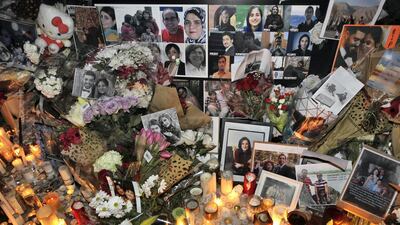
Iran is accused of orchestrating a cover-up during its year-long investigation into the shooting down of a Ukrainian Airlines flight that killed all 176 people on board.
Flight PS752, bound for Kiev, was hit by two Iranian missiles within minutes of take-off from Tehran’s Iman Khomeini International Airport on January 8, 2020, a disaster the regime described as a tragic accident.
As the anniversary looms, Iranian air accident investigators are yet to publish a final report despite concerted pressure from foreign governments to come clean about the circumstances that led to the downing of the civilian airliner carrying passengers from six countries.
Iran says the missile was mistakenly fired by a mobile defence unit positioned on the edge of the airport. Its account includes a series of calamitous blunders by the missile unit, including misaligning the unit by 107 degrees – nearly one third of the compass – and failing to recognise the problem.
It said the unit then suffered a communications failure that cut it off from its commanders. The regime finally claims that the two surface-to-air missiles were launched at PS752 in direct contravention of orders not to fire until authorised by central command.
The litany of failures was dismissed by the families of the victims who said they knew from day one that it was not human error.
They believe the final definitive report of the disaster has not been published by Iran because it will expose its failure to properly investigate what happened and attribute blame to those responsible.
"We believe that Iran will do anything it can to hide the truth," said Amirali Alavi, a campaigner for the families and whose mother died on the aircraft. "And everybody's looking for answers."
Key questions unanswered include:
- Who gave the final order to launch the missile attack?
- How could PS752 have been considered an incoming missile if it was flying from Tehran?
- Why was airspace open despite Iran launching missile attacks on Iraq just hours before?
- Why was the PS752 flight delayed for an hour before take-off and on whose orders?
- Was anybody taken from the plane while it stood on the runway, as claimed by families?
- Why was there a six-month delay in handing over black box flight recorders?
- Did Iran warn airlines of the potential risks given the military build-up around Tehran?
- What systems were in place to stop civilian jets being attacked and why did they not work?
Up to six Iranians face charges over the shooting down of the aircraft but their identities and their positions in the military hierarchy are unknown.
The Canadian report said: “Iran bears a heavy burden of responsibility to be completely comprehensive and transparent in substantiating its explanations with credible, compelling evidence, which has not yet been forthcoming.”
The missile attack on the plane came amid heightened tensions after the assassination in a US drone strike five days earlier of Qassem Suleimani, the head of the Quds Force of the Islamic Revolutionary Guard Corps.
The killing prompted promises of retribution with several volleys of Iranian missiles fired at two air bases in Iraq where US forces were housed just hours before the aircraft was attacked.
But Iran did not close its airspace to civilian aircraft despite airlines from countries including the US, Canada and Australia avoiding the area.
Lawyers for some of the families said Iran was on the highest state of defensive alert and the IRGC was “totally prepared for a fully-fledged war”.
Some relatives of those killed believe the attack was an act of reprisal rather than a blunder calibrated not to spark war with the US. Iran admitted it was responsible only three days after the attack.
International aviation rules give responsibility for investigating the crash to Iran – where the plane came down – which investigators said raised concerns about the independence of the investigation and lessons to be learnt for the sector.
“The party responsible for the situation is investigating itself, largely in secret,” Ralph Goodale, the adviser, wrote in the report. “That does not inspire confidence or trust.”
The families of those killed expressed frustration that Iran has been able to delay publishing the outcome of the inquiry.
Hamed Esmaeilion, a spokesman for The Association of Families of Flight PS752 Victims, said justice had been delayed while they tried to find out exactly what happened.
Mr Esmaeilion, whose wife and daughter died in the crash, said: “Iran is smart enough to know that it's in the driving seat.
“This is so frustrating, because I think the international community has accepted Iran as a normal regime.
“But this is not true. This is not a normal regime. They are criminals, they have done crimes for the last 42 years.
“And the world has decided to tolerate them for some reason. When they commit another crime, you see that nobody condemns it.”

In numbers: China in Dubai
The number of Chinese people living in Dubai: An estimated 200,000
Number of Chinese people in International City: Almost 50,000
Daily visitors to Dragon Mart in 2018/19: 120,000
Daily visitors to Dragon Mart in 2010: 20,000
Percentage increase in visitors in eight years: 500 per cent
RACE CARD
6.30pm Al Maktoum Challenge Round-1 Group 1 (PA) Dh119,373 (Dirt) 1,600m
7.05pm Handicap (TB) Dh102,500 (D) 1,200m
7.40pm Handicap (TB) Dh105,000 (Turf) 1,800m
8.15pm UAE 1000 Guineas Trial (TB) Dh183,650 (D) 1,400m
9.50pm Handicap (TB) Dh105,000 (D) 1,600m
9.25pm Handicap (TB) Dh95,000 (T) 1,000m
Dr Amal Khalid Alias revealed a recent case of a woman with daughters, who specifically wanted a boy.
A semen analysis of the father showed abnormal sperm so the couple required IVF.
Out of 21 eggs collected, six were unused leaving 15 suitable for IVF.
A specific procedure was used, called intracytoplasmic sperm injection where a single sperm cell is inserted into the egg.
On day three of the process, 14 embryos were biopsied for gender selection.
The next day, a pre-implantation genetic report revealed four normal male embryos, three female and seven abnormal samples.
Day five of the treatment saw two male embryos transferred to the patient.
The woman recorded a positive pregnancy test two weeks later.
Pox that threatens the Middle East's native species
Camelpox
Caused by a virus related to the one that causes human smallpox, camelpox typically causes fever, swelling of lymph nodes and skin lesions in camels aged over three, but the animal usually recovers after a month or so. Younger animals may develop a more acute form that causes internal lesions and diarrhoea, and is often fatal, especially when secondary infections result. It is found across the Middle East as well as in parts of Asia, Africa, Russia and India.
Falconpox
Falconpox can cause a variety of types of lesions, which can affect, for example, the eyelids, feet and the areas above and below the beak. It is a problem among captive falcons and is one of many types of avian pox or avipox diseases that together affect dozens of bird species across the world. Among the other forms are pigeonpox, turkeypox, starlingpox and canarypox. Avipox viruses are spread by mosquitoes and direct bird-to-bird contact.
Houbarapox
Houbarapox is, like falconpox, one of the many forms of avipox diseases. It exists in various forms, with a type that causes skin lesions being least likely to result in death. Other forms cause more severe lesions, including internal lesions, and are more likely to kill the bird, often because secondary infections develop. This summer the CVRL reported an outbreak of pox in houbaras after rains in spring led to an increase in mosquito numbers.
U19 WORLD CUP, WEST INDIES
UAE group fixtures (all in St Kitts)
- Saturday 15 January: UAE beat Canada by 49 runs
- Thursday 20 January: v England
- Saturday 22 January: v Bangladesh
UAE squad:
Alishan Sharafu (captain), Shival Bawa, Jash Giyanani, Sailles
Jaishankar, Nilansh Keswani, Aayan Khan, Punya Mehra, Ali Naseer, Ronak Panoly,
Dhruv Parashar, Vinayak Raghavan, Soorya Sathish, Aryansh Sharma, Adithya
Shetty, Kai Smith
Conflict, drought, famine
Estimates of the number of deaths caused by the famine range from 400,000 to 1 million, according to a document prepared for the UK House of Lords in 2024.
It has been claimed that the policies of the Ethiopian government, which took control after deposing Emperor Haile Selassie in a military-led revolution in 1974, contributed to the scale of the famine.
Dr Miriam Bradley, senior lecturer in humanitarian studies at the University of Manchester, has argued that, by the early 1980s, “several government policies combined to cause, rather than prevent, a famine which lasted from 1983 to 1985. Mengistu’s government imposed Stalinist-model agricultural policies involving forced collectivisation and villagisation [relocation of communities into planned villages].
The West became aware of the catastrophe through a series of BBC News reports by journalist Michael Buerk in October 1984 describing a “biblical famine” and containing graphic images of thousands of people, including children, facing starvation.
Band Aid
Bob Geldof, singer with the Irish rock group The Boomtown Rats, formed Band Aid in response to the horrific images shown in the news broadcasts.
With Midge Ure of the band Ultravox, he wrote the hit charity single Do They Know it’s Christmas in December 1984, featuring a string of high-profile musicians.
Following the single’s success, the idea to stage a rock concert evolved.
Live Aid was a series of simultaneous concerts that took place at Wembley Stadium in London, John F Kennedy Stadium in Philadelphia, the US, and at various other venues across the world.
The combined event was broadcast to an estimated worldwide audience of 1.5 billion.
Mercer, the investment consulting arm of US services company Marsh & McLennan, expects its wealth division to at least double its assets under management (AUM) in the Middle East as wealth in the region continues to grow despite economic headwinds, a company official said.
Mercer Wealth, which globally has $160 billion in AUM, plans to boost its AUM in the region to $2-$3bn in the next 2-3 years from the present $1bn, said Yasir AbuShaban, a Dubai-based principal with Mercer Wealth.
“Within the next two to three years, we are looking at reaching $2 to $3 billion as a conservative estimate and we do see an opportunity to do so,” said Mr AbuShaban.
Mercer does not directly make investments, but allocates clients’ money they have discretion to, to professional asset managers. They also provide advice to clients.
“We have buying power. We can negotiate on their (client’s) behalf with asset managers to provide them lower fees than they otherwise would have to get on their own,” he added.
Mercer Wealth’s clients include sovereign wealth funds, family offices, and insurance companies among others.
From its office in Dubai, Mercer also looks after Africa, India and Turkey, where they also see opportunity for growth.
Wealth creation in Middle East and Africa (MEA) grew 8.5 per cent to $8.1 trillion last year from $7.5tn in 2015, higher than last year’s global average of 6 per cent and the second-highest growth in a region after Asia-Pacific which grew 9.9 per cent, according to consultancy Boston Consulting Group (BCG). In the region, where wealth grew just 1.9 per cent in 2015 compared with 2014, a pickup in oil prices has helped in wealth generation.
BCG is forecasting MEA wealth will rise to $12tn by 2021, growing at an annual average of 8 per cent.
Drivers of wealth generation in the region will be split evenly between new wealth creation and growth of performance of existing assets, according to BCG.
Another general trend in the region is clients’ looking for a comprehensive approach to investing, according to Mr AbuShaban.
“Institutional investors or some of the families are seeing a slowdown in the available capital they have to invest and in that sense they are looking at optimizing the way they manage their portfolios and making sure they are not investing haphazardly and different parts of their investment are working together,” said Mr AbuShaban.
Some clients also have a higher appetite for risk, given the low interest-rate environment that does not provide enough yield for some institutional investors. These clients are keen to invest in illiquid assets, such as private equity and infrastructure.
“What we have seen is a desire for higher returns in what has been a low-return environment specifically in various fixed income or bonds,” he said.
“In this environment, we have seen a de facto increase in the risk that clients are taking in things like illiquid investments, private equity investments, infrastructure and private debt, those kind of investments were higher illiquidity results in incrementally higher returns.”
The Abu Dhabi Investment Authority, one of the largest sovereign wealth funds, said in its 2016 report that has gradually increased its exposure in direct private equity and private credit transactions, mainly in Asian markets and especially in China and India. The authority’s private equity department focused on structured equities owing to “their defensive characteristics.”
MORE ON TURKEY'S SYRIA OFFENCE
Profile Box
Company/date started: 2015
Founder/CEO: Mohammed Toraif
Based: Manama, Bahrain
Sector: Sales, Technology, Conservation
Size: (employees/revenue) 4/ 5,000 downloads
Stage: 1 ($100,000)
Investors: Two first-round investors including, 500 Startups, Fawaz Al Gosaibi Holding (Saudi Arabia)
THE SPECS
2020 Toyota Corolla Hybrid LE
Engine: 1.8 litre combined with 16-volt electric motors
Transmission: Automatic with manual shifting mode
Power: 121hp
Torque: 142Nm
Price: Dh95,900
More coverage from the Future Forum
Read more from Aya Iskandarani
The five pillars of Islam
The burning issue
The internal combustion engine is facing a watershed moment – major manufacturer Volvo is to stop producing petroleum-powered vehicles by 2021 and countries in Europe, including the UK, have vowed to ban their sale before 2040. The National takes a look at the story of one of the most successful technologies of the last 100 years and how it has impacted life in the UAE.
Read part four: an affection for classic cars lives on
Read part three: the age of the electric vehicle begins
Read part one: how cars came to the UAE
WWE TLC results
Asuka won the SmackDown Women's title in a TLC triple threat with Becky Lynch and Charlotte Flair
Dean Ambrose won the Intercontinental title against Seth Rollins
Daniel Bryan retained the WWE World Heavyweight Championship against AJ Styles
Ronda Rousey retained the Raw Women's Championship against Nia Jax
Rey Mysterio beat Randy Orton in a chairs match
Finn Balor defeated Drew McIntyre
Natalya beat Ruby Riott in a tables match
Braun Strowman beat Baron Corbin in a TLC match
Sheamus and Cesaro retained the SmackDown Tag Titles against The Usos and New Day
R-Truth and Carmella won the Mixed Match Challenge by beating Jinder Mahal and Alicia Fox
OPINIONS ON PALESTINE & ISRAEL
The specs
- Engine: 3.9-litre twin-turbo V8
- Power: 640hp
- Torque: 760nm
- On sale: 2026
- Price: Not announced yet
Profile
Company: Libra Project
Based: Masdar City, ADGM, London and Delaware
Launch year: 2017
Size: A team of 12 with six employed full-time
Sector: Renewable energy
Funding: $500,000 in Series A funding from family and friends in 2018. A Series B round looking to raise $1.5m is now live.
