

Pupils over the age of six must wear masks throughout the school day when they return after the summer, Abu Dhabi's education regulator said.
In a document prepared for parents, Abu Dhabi Department of Education and Knowledge (Adek) set out rules designed to keep children safe when they return to classes.
Mandatory masks for children, temperature checks before entering the building, social distancing of 1.5 metres for all and an intensive cleaning programme are some of the key guidelines.
Headteachers can decide on whether pupils should be allowed into school daily or the study time should be reduced to half days, alternate days or weeks.
Schools will require approval from Adek for the model they select and must inform parents by July 30 at the latest.
Children who are homeschooled in the new academic year run the risk of having to repeat it once they rejoin the mainstream, the department said.
The shape of the school day
Schools will be given the choice to allow children into school full time, in other words, daily; or on alternating days, for half days; alternating weeks; or a combination.
Full distance-learning will not be an option and all children must be enrolled in school, as opposed to homeschooled by their parents.
Schools must decide and let parents know which model they will follow by Thursday, July 30.
Adek advised that schools do not need to offer fee reductions if they pursue a part-time study model.
“We have just completed one of the most challenging academic years in our history as a nation, and your unparalleled commitment and co-operation was instrumental in ensuring that our schools delivered quality learning to our children,” Adek said in the document.
“Over the summer, Adek has worked extensively with schools, parent representatives, teachers and federal policymakers to develop guidelines to ensure a safe return to school for our children.”
What happens if parents homeschool their children this academic year?
Children must be enrolled in school for the 2020/2021 academic year.
Any child taken out of school runs the risk of having to repeat the grade once they rejoin the system, said Adek.
Full-time distance learning is only available to children who have a health condition that puts them at risk.
"Schools will provide distance learning for pupils who have a medical reason for not being physically present on campus," said the document.
"If your child has a high-risk health condition, he/she may continue distance learning by submitting a medical certificate to the school. Contact your school for details."
Schools may request parents to provide a "medical clearance" certificate if their child is absent for a prolonged period, it added.
Precautions to be taken in school
Officials have confirmed that both children and teachers will have to undergo a Covid-19 test before they return.
Pupils' temperatures will be checked daily with a non-contact thermometer before they enter school.
“Your child will have to wear a mask if they are older than six years,” which applies to grade 1 or year 2 in the British system.
“If your child is unable to wear a mask, they may be allowed to wear a face shield if supported by a medical certificate.
“Children of Determination with hearing impairments may use transparent masks.”
Pupils must bring at least two masks to school to wear during the day, and carry a 70 to 80 per cent alcohol-based sanitiser with them, if they can.
Gloves are not recommended, but they may be worn, according to the guidelines.
Pupils must remain 1.5m apart “at all times”.
Younger children who may find it difficult to maintain social distancing in KG and the early primary grades may be grouped into bubbles of up to 10 pupils.
“A bubble is a group of pupils and staff member who spend the entire day together and do not interact with others,” said the document.
How schools will ensure physical distancing
It is likely that classes will be split into two or more groups to accommodate for social distancing. Children will remain in their group until the end of the pandemic.
“Some schools may convert non-teaching areas such as gymnasiums and libraries into classrooms,” according to the document.
Pupils will receive regular breaks, “but they will likely be very different from what they experienced in pre-Covid times”.
They must maintain a distance of 1.5m from their fellow pupils at all times.
Swings, slides and other playground equipment may not be available for an initial period after reopening “to reduce the chances of cross contamination”.
“Children will be allowed to take off their masks to have lunch under supervision,” said the document.
PE lessons will be suspended until further notice and schools may offer fewer subjects like music, art and performing arts, said Adek.
Sessions will, however, be offered to children on topics such as cyber safety, dealing with loss and/or bereavement and anxiety “to support them in navigating these challenging times,” added the document.
-

The first thermal gate has been installed at the school that can measure the temperature of hundreds of children passing through it quickly. Courtesy: Jumeira Baccalaureate School -
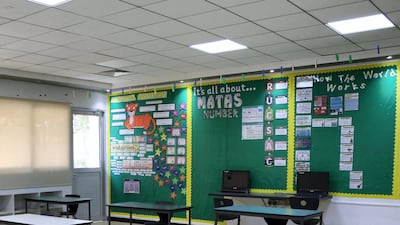
All desks in the classrooms have a distance of two metres. Courtesy: Jumeira Baccalaureate School -
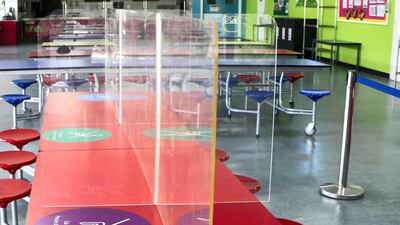
Plastic screens have been installed in the cafetaria to separate pupils. Courtesy: Jumeira Baccalaureate School -
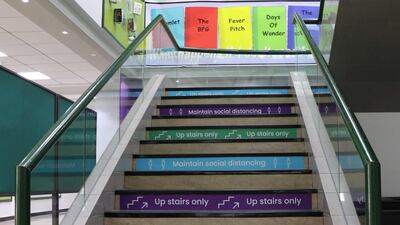
Markings on each step will help pupils remember not to get close to each other. Courtesy: Jumeira Baccalaureate School -
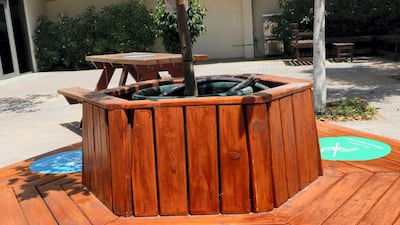
There are marking all around the school to remind pupils to maintain social distancing. Courtesy: Jumeira Baccalaureate School -

Several basketball hoops have been installed for pupils.Courtesy: Jumeira Baccalaureate School -
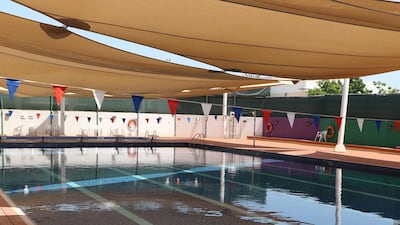
Lane markings will help pupils avoid coming in close contact with each other. Courtesy: Jumeira Baccalaureate School -
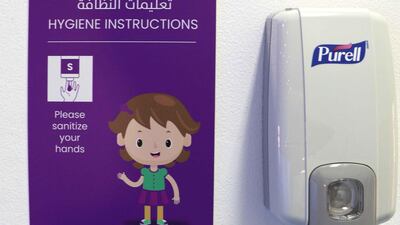
There are hand sanitiser stations at regular intervals so that pupils can clean their hands more often. Courtesy: Jumeira Baccalaureate School -
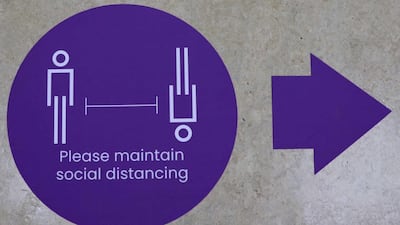
Markings show separate exit and entry points. Courtesy: Jumeira Baccalaureate School -
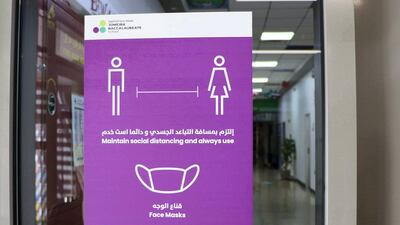
Markings to remind pupils the importance of precautionary measures. Courtesy: Jumeira Baccalaureate School -
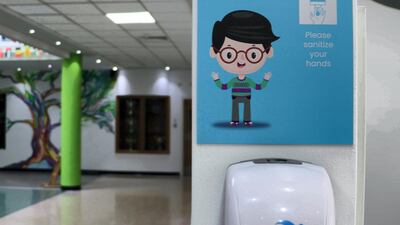
There are hand sanitiser stations at regular intervals so that pupils can clean their hands more often. Courtesy: Jumeira Baccalaureate School -
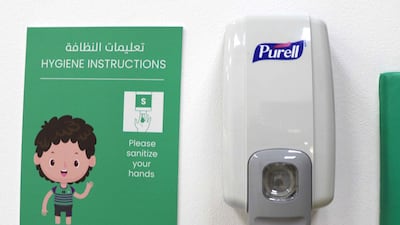
A hand sanitiser station outside a classroom. Courtesy: Jumeira Baccalaureate School -
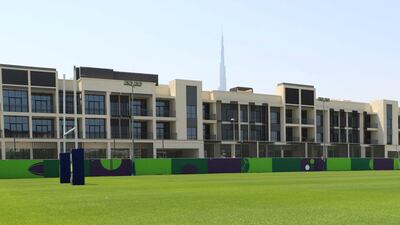
Marking to follow social distancing at the school. Courtesy: Jumeira Baccalaureate School -

Markings to show separate entry and exit points. Courtesy: Jumeira Baccalaureate School -

Floor markings at the school. Courtesy: Jumeira Baccalaureate School


What happens if pupils fall ill while at school
Any child who becomes sick at school will immediately be moved to a quarantine room, where they will be monitored by a school nurse.
Parents will be contacted to collect them immediately.
“If your child tests positive for Covid-19, you are mandated to inform the school so that they can take measures to secure the health of other pupils and staff who may have been exposed to the virus,” said the document.
School buses and drop-off
School buses will operate at 50 per cent capacity, and social distancing will be in place.
Children will be assigned seats on the bus for the entire term.
Parents and children with phones must download the AlHosn app.
“Parents will not be allowed on the school premises at all, unless they are there to support a child with disabilities. Exceptions may be made for the youngest children," said the document.
“Only one parent/guardian can accompany children outside the entrance to the school.
“If you accompany your child as they stand in the queue, you must wear a mask.”
Cleaning procedures
Schools will be required to carry out general disinfection and cleaning every 24 hours.
There should be hand washing and sanitising stations available around the premises.
"High-contact surfaces such as light switches, handrails, doorknobs, toilet seats etc will be cleaned and disinfected every hour," according to the guidelines.
"Toilets will be cleaned and disinfected every hour."

