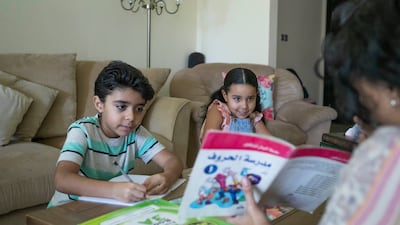
Abu Dhabi is to rank private schools on their efforts to promote UAE culture and tradition and encourage use of the Arabic language among Emirati pupils.
The Abu Dhabi Department of Education and Knowledge — the capital's private education regulator — on Friday launched the National Identity Mark, an annual school rating system aimed at measuring work being done to integrate core Emirati values into studies.
The first results will be released at the end of the current academic year.
The evaluations will encompass three central principles of culture, values, and citizenship.
The culture category covers history, heritage and the Arabic language, which has been earmarked as a focus area.
The values section comprises of respect, compassion, and global understanding.
Citizenship takes in topics such as a sense of belonging, volunteering, and conservation.
“We recognise the importance of cultivating a robust national identity that anchors our Emirati students in their culture,” said Sara Musallam, Minister of State for Early Education and Adek's chairwoman.
“The launch of the National Identity Mark and inspection framework will provide parents with valuable insights into the quality of national identity programmes within private schools.
“For many parents, the reinforcement of national identity by education is of critical importance as it helps instil in their children a sense of belonging and pride.
“By strengthening national identity through educational programmes, schools can support students to further appreciate their roots, traditions, and values. The National Identity Mark will increase transparency and accountability, while enabling parents to make informed decisions about their children's education,” she said.
“This directly supports the development of well-rounded individuals who are proud of their Emirati identity that are equipped to positively represent Abu Dhabi and the UAE on a global scale.”
New school league table
The National Identity Mark rankings will be separate from Adek's annual inspections, known as “Irtiqaa”, based on the wider academic performance of schools.
Schools will be ranked Outstanding, Good, Acceptable, or Weak, according to the quality of their national identity programmes.
Adek will initially prioritise those schools with the highest number of Emirati pupils in the first phase of the programme.
Schools without Emirati pupils can request evaluation if they have relevant programmes and activities promoting the country's heritage and culture for expatriate learners.
Instilling Emirati values
Sheikh Abdullah bin Zayed, Minister of Foreign Affairs and International Co-operation, has spoken of the need to integrate core Emirati values into curriculums and teaching methods from early years to higher education studies.
The Minister set out his vision while chairing a meeting of the Education and Human Resources Council in August.
Sheikh Abdullah said that Emirati history was full of notable achievements that could enrich children's knowledge and teach moral lessons while enabling them to become leaders.
During the meeting, Noura Al Kaabi, Minister of Culture and Youth, reviewed the national framework of Emirati cultural activities in schools.
It aims to develop Emirati national identity and cultural values in pupils through participation in activities, contests, events, school trips, and workshops during and after school hours.
The strategy is aimed at understanding of Emirati heritage traditions, social activities, the Arabic language, folk art and traditional sports, as well as Emirati literature.
In June 2022, Sheikh Dr Sultan bin Muhammad Al Qasimi, Ruler of Sharjah, urged teachers to promote Arabic in schools.
He stressed the importance of teaching Arabic to school pupils, focusing on the need to develop new teaching methods for the language as well as encouraging youngsters to learn it.
“The Arabic language is our belonging to the Quran,” he said in an address to teaching staff at the Sharjah Education Academy.
“The Arabic language is a stockpile of our history, our knowledge and our culture. The Arabic language is what holds firm our belief in our religion. The Arabic language is what unites us from the furthest corners of the Earth — from the Far East to the far West, we are united under one language.”
Learning Arabic in the UAE — in pictures
Book%20Details
%3Cp%3E%3Cem%3EThree%20Centuries%20of%20Travel%20Writing%20by%20Muslim%20Women%3C%2Fem%3E%3Cbr%3E%3Cstrong%3EEditors%3A%20%3C%2Fstrong%3ESiobhan%20Lambert-Hurley%2C%20Daniel%20Majchrowicz%2C%20Sunil%20Sharma%3Cbr%3E%3Cstrong%3EPublisher%3A%20%3C%2Fstrong%3EIndiana%20University%20Press%3B%20532%20pages%3Cbr%3E%3C%2Fp%3E%0A
Our legal consultant
Name: Hassan Mohsen Elhais
Position: legal consultant with Al Rowaad Advocates and Legal Consultants.
Confirmed%20bouts%20(more%20to%20be%20added)
%3Cp%3ECory%20Sandhagen%20v%20Umar%20Nurmagomedov%0D%3Cbr%3ENick%20Diaz%20v%20Vicente%20Luque%0D%3Cbr%3EMichael%20Chiesa%20v%20Tony%20Ferguson%0D%3Cbr%3EDeiveson%20Figueiredo%20v%20Marlon%20Vera%0D%3Cbr%3EMackenzie%20Dern%20v%20Loopy%20Godinez%0D%3Cbr%3E%3C%2Fp%3E%0A%3Cp%3ETickets%20for%20the%20August%203%20Fight%20Night%2C%20held%20in%20partnership%20with%20the%20Department%20of%20Culture%20and%20Tourism%20Abu%20Dhabi%2C%20went%20on%20sale%20earlier%20this%20month%2C%20through%20www.etihadarena.ae%20and%20www.ticketmaster.ae.%0D%3Cbr%3E%3C%2Fp%3E%0A
Tax authority targets shisha levy evasion
The Federal Tax Authority will track shisha imports with electronic markers to protect customers and ensure levies have been paid.
Khalid Ali Al Bustani, director of the tax authority, on Sunday said the move is to "prevent tax evasion and support the authority’s tax collection efforts".
The scheme’s first phase, which came into effect on 1st January, 2019, covers all types of imported and domestically produced and distributed cigarettes. As of May 1, importing any type of cigarettes without the digital marks will be prohibited.
He said the latest phase will see imported and locally produced shisha tobacco tracked by the final quarter of this year.
"The FTA also maintains ongoing communication with concerned companies, to help them adapt their systems to meet our requirements and coordinate between all parties involved," he said.
As with cigarettes, shisha was hit with a 100 per cent tax in October 2017, though manufacturers and cafes absorbed some of the costs to prevent prices doubling.
The specs
Engine: four-litre V6 and 3.5-litre V6 twin-turbo
Transmission: six-speed and 10-speed
Power: 271 and 409 horsepower
Torque: 385 and 650Nm
Price: from Dh229,900 to Dh355,000
Mercer, the investment consulting arm of US services company Marsh & McLennan, expects its wealth division to at least double its assets under management (AUM) in the Middle East as wealth in the region continues to grow despite economic headwinds, a company official said.
Mercer Wealth, which globally has $160 billion in AUM, plans to boost its AUM in the region to $2-$3bn in the next 2-3 years from the present $1bn, said Yasir AbuShaban, a Dubai-based principal with Mercer Wealth.
“Within the next two to three years, we are looking at reaching $2 to $3 billion as a conservative estimate and we do see an opportunity to do so,” said Mr AbuShaban.
Mercer does not directly make investments, but allocates clients’ money they have discretion to, to professional asset managers. They also provide advice to clients.
“We have buying power. We can negotiate on their (client’s) behalf with asset managers to provide them lower fees than they otherwise would have to get on their own,” he added.
Mercer Wealth’s clients include sovereign wealth funds, family offices, and insurance companies among others.
From its office in Dubai, Mercer also looks after Africa, India and Turkey, where they also see opportunity for growth.
Wealth creation in Middle East and Africa (MEA) grew 8.5 per cent to $8.1 trillion last year from $7.5tn in 2015, higher than last year’s global average of 6 per cent and the second-highest growth in a region after Asia-Pacific which grew 9.9 per cent, according to consultancy Boston Consulting Group (BCG). In the region, where wealth grew just 1.9 per cent in 2015 compared with 2014, a pickup in oil prices has helped in wealth generation.
BCG is forecasting MEA wealth will rise to $12tn by 2021, growing at an annual average of 8 per cent.
Drivers of wealth generation in the region will be split evenly between new wealth creation and growth of performance of existing assets, according to BCG.
Another general trend in the region is clients’ looking for a comprehensive approach to investing, according to Mr AbuShaban.
“Institutional investors or some of the families are seeing a slowdown in the available capital they have to invest and in that sense they are looking at optimizing the way they manage their portfolios and making sure they are not investing haphazardly and different parts of their investment are working together,” said Mr AbuShaban.
Some clients also have a higher appetite for risk, given the low interest-rate environment that does not provide enough yield for some institutional investors. These clients are keen to invest in illiquid assets, such as private equity and infrastructure.
“What we have seen is a desire for higher returns in what has been a low-return environment specifically in various fixed income or bonds,” he said.
“In this environment, we have seen a de facto increase in the risk that clients are taking in things like illiquid investments, private equity investments, infrastructure and private debt, those kind of investments were higher illiquidity results in incrementally higher returns.”
The Abu Dhabi Investment Authority, one of the largest sovereign wealth funds, said in its 2016 report that has gradually increased its exposure in direct private equity and private credit transactions, mainly in Asian markets and especially in China and India. The authority’s private equity department focused on structured equities owing to “their defensive characteristics.”
Timeline
2012-2015
The company offers payments/bribes to win key contracts in the Middle East
May 2017
The UK SFO officially opens investigation into Petrofac’s use of agents, corruption, and potential bribery to secure contracts
September 2021
Petrofac pleads guilty to seven counts of failing to prevent bribery under the UK Bribery Act
October 2021
Court fines Petrofac £77 million for bribery. Former executive receives a two-year suspended sentence
December 2024
Petrofac enters into comprehensive restructuring to strengthen the financial position of the group
May 2025
The High Court of England and Wales approves the company’s restructuring plan
July 2025
The Court of Appeal issues a judgment challenging parts of the restructuring plan
August 2025
Petrofac issues a business update to execute the restructuring and confirms it will appeal the Court of Appeal decision
October 2025
Petrofac loses a major TenneT offshore wind contract worth €13 billion. Holding company files for administration in the UK. Petrofac delisted from the London Stock Exchange
November 2025
180 Petrofac employees laid off in the UAE
Our legal consultant
Name: Hassan Mohsen Elhais
Position: legal consultant with Al Rowaad Advocates and Legal Consultants.
How to improve Arabic reading in early years
One 45-minute class per week in Standard Arabic is not sufficient
The goal should be for grade 1 and 2 students to become fluent readers
Subjects like technology, social studies, science can be taught in later grades
Grade 1 curricula should include oral instruction in Standard Arabic
First graders must regularly practice individual letters and combinations
Time should be slotted in class to read longer passages in early grades
Improve the appearance of textbooks
Revision of curriculum should be undertaken as per research findings
Conjugations of most common verb forms should be taught
Systematic learning of Standard Arabic grammar