Sheikh Dr Sultan bin Muhammad Al Qasimi, the Ruler of Sharjah, is threatening to cut funding to the emirate's professional football clubs. Photo: Sharjah Government Media Bureau

Emirati footballers back Sharjah Ruler's call to promote local talent


Salam Al Amir
  • English
  • Arabic

Emirati footballers have backed the Ruler of Sharjah's pledge to withdraw funding from clubs that fail to develop local talent.

Sheikh Dr Sultan bin Muhammad Al Qasimi said this week that financial support would "stop by the end of the month" if the emirate's football clubs did not up their game.

He delivered the warning during the live radio programme Al Khat Al Mubasher (The Direct Line) on Monday.

“Every club costs Dh50 million and they asked for an increase in the budget,” Sheikh Dr Sultan said.

“I want to see my children in these clubs. Even if they don’t bring results I want them to spend their time in the clubs.

“If my sons [Emiratis] are in the clubs then the financial support will continue. Otherwise it will stop by the end of the month.”

A task force has been set up by Sharjah sports chiefs to tackle the issue.

Players support Sharjah Ruler

Tariq Ahmed Al Hammadi, 34, a midfielder with Al Nasr in Dubai, said it was vital to improve Emirati participation in all sports.

“This is in favour of Emirati talent, all sports, and football in particular,” said the UAE international.

He said the number of Emirati football players has dropped significantly.

“It's not only in football, but across other sports too,” he said.

He said he was aware of a number of Emiratis who had given up the game after struggling to find clubs because of the influx of overseas talent.

“I know many talented players who have been through tough times to get into any local club but couldn’t because of a system that forced clubs to limit the number of Emirati players.

“The system allowed more residents and foreign players to register.

“Those Emirati players gave up and looked for regular jobs.

“Our children’s chances are slim if not for the Sheikh’s decision.”

UAE rules on overseas talent

  • Kuwait's Fahad Al Hajeri celebrates his team's 1-0 victory over UAE in their Arabian Gulf Cup Group B match at Al Minaa Olympic Stadium in Basra, Iraq, on January 10, 2023. Reuters
    Kuwait's Fahad Al Hajeri celebrates his team's 1-0 victory over UAE in their Arabian Gulf Cup Group B match at Al Minaa Olympic Stadium in Basra, Iraq, on January 10, 2023. Reuters
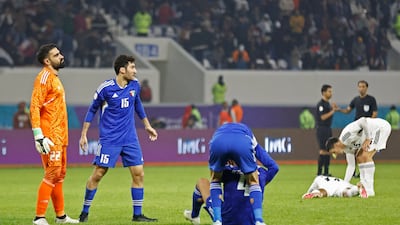
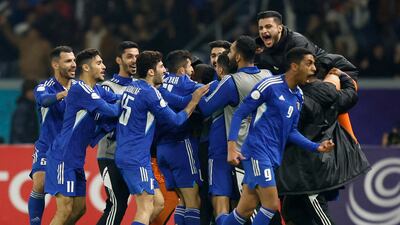
  • Kuwait's Khaled Hajiah celebrates with Hamad Al Qallaf and teammates after the match. Reuters
    Kuwait's Khaled Hajiah celebrates with Hamad Al Qallaf and teammates after the match. Reuters
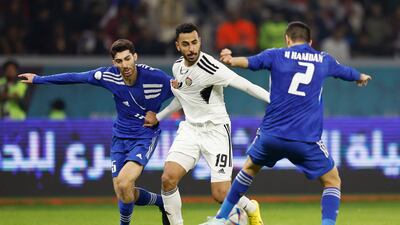
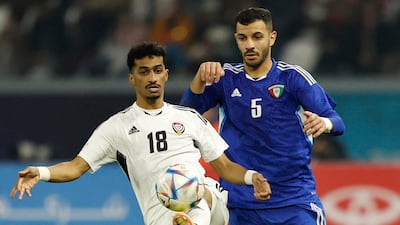
  • UAE's Khaled Ibrahim, centre, in action with Kuwait's Hamad Al Qallaf and Hassan Hamdan. Reuters
    UAE's Khaled Ibrahim, centre, in action with Kuwait's Hamad Al Qallaf and Hassan Hamdan. Reuters
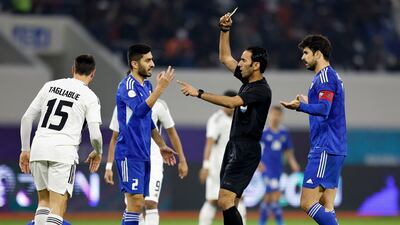
  • UAE striker Sebastian Tagliabue is shown a yellow card. Reuters
    UAE striker Sebastian Tagliabue is shown a yellow card. Reuters
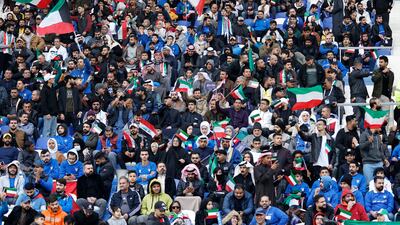
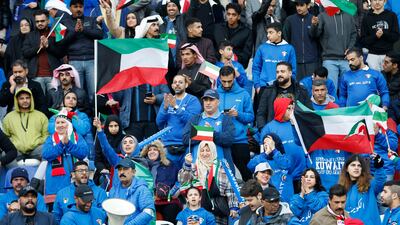
  • Fans in the stands before the match. Reuters
    Fans in the stands before the match. Reuters
  • UAE's' Abdullah Ramadan in action with Kuwait's Fahad Al Hajeri. Reuters
    UAE's' Abdullah Ramadan in action with Kuwait's Fahad Al Hajeri. Reuters
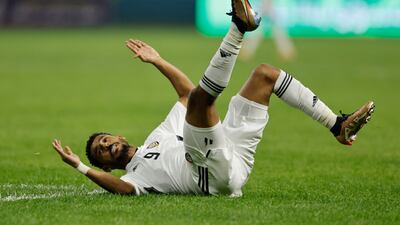
  • UAE's Harib Suhail takes a tumble. Reuters
    UAE's Harib Suhail takes a tumble. Reuters
  • Kuwait's Ahmed Al Dhefiri celebrates scoring in second-half injury time to win the match against UAE. Reuters
    Kuwait's Ahmed Al Dhefiri celebrates scoring in second-half injury time to win the match against UAE. Reuters
  • Kuwait's Khaled Hajiah in action with UAE goalkeeper Khalid Eisa. Reuters
    Kuwait's Khaled Hajiah in action with UAE goalkeeper Khalid Eisa. Reuters
  • Fans in the stands during the match. Reuters
    Fans in the stands during the match. Reuters

Last year, the UAE Pro League increased from four to five the number of foreign players allowed in squads.

The rulings also allowed for as many as five non-Emirati residents to be named in matchday squads.

The league allows for eight foreign and expatriate players to be selected in any squad, with up to six in a starting line-up.

In 2020, Brazilian-born Fabio De Lima and Caio Canedo and Sebastian Tagliabue, who is from Argentina, were granted UAE citizenship, freeing them up to represent the Emirates on the international stage.

The move was made possible after a change in regulations in 2017.

Sheikh Dr Sultan compared the UAE's history-making achievements in reaching the Fifa World Cup in 1990 with its disappointing display at the Arabian Gulf Cup, where the team crashed out in the group stage.

“I remember in the past we reached the World Cup in Italy and scored against Germany,” he said.

“We didn’t bring expatriates or foreigners. During the recent international tournament, we didn’t have good results.”

Waleed Hussain, in red shirt, during a UAE football match in Dubai. Satish Kumar / The National

Waleed Hussain, 30, a midfielder for Al Wahda in Abu Dhabi, said Emirati players need to be given the chance to shine in club football if they are to thrive for their country.

“I am very happy with the Sheikh’s decision,” he said.

Authorities take note

Any action taken by Sheikh Dr Sultan on sporting budgets would affect only clubs in Sharjah.

Football authorities in the emirate have already responded to his robust remarks.

A committee was established by Sharjah Sports Council after the radio broadcast to examine the issue.

The task force has announced that an indoor football tournament to be held in Sharjah will be open only to Emirati players.

“The first step was to announce an Emirati-only indoor football tournament,” said Mohammed Al Hammadi, member of the committee.

“The clubs taking part in the indoor football tournament were informed they have until September to make sure only Emirati players participate in the games.”

He said regular meetings will be held to assess ways to better serve home-grown talent.

“The number of foreign players differ from one club to another,” Mr Al Hammadi said.

“But we have an overall number of all players with a breakdown of foreign players, players who are residents and Emirati players.”

He said the committee would seek to encourage more Emiratis to join Sharjah's football clubs.

North Pole stats

Distance covered: 160km

Temperature: -40°C

Weight of equipment: 45kg

Altitude (metres above sea level): 0

Terrain: Ice rock

South Pole stats

Distance covered: 130km

Temperature: -50°C

Weight of equipment: 50kg

Altitude (metres above sea level): 3,300

Terrain: Flat ice
 

Indoor cricket in a nutshell

Indoor cricket in a nutshell
Indoor Cricket World Cup - Sept 16-20, Insportz, Dubai

16 Indoor cricket matches are 16 overs per side
8 There are eight players per team
9 There have been nine Indoor Cricket World Cups for men. Australia have won every one.
5 Five runs are deducted from the score when a wickets falls
4 Batsmen bat in pairs, facing four overs per partnership

Scoring In indoor cricket, runs are scored by way of both physical and bonus runs. Physical runs are scored by both batsmen completing a run from one crease to the other. Bonus runs are scored when the ball hits a net in different zones, but only when at least one physical run is score.

Zones

A Front net, behind the striker and wicketkeeper: 0 runs
B Side nets, between the striker and halfway down the pitch: 1 run
C Side nets between halfway and the bowlers end: 2 runs
D Back net: 4 runs on the bounce, 6 runs on the full

Mercer, the investment consulting arm of US services company Marsh & McLennan, expects its wealth division to at least double its assets under management (AUM) in the Middle East as wealth in the region continues to grow despite economic headwinds, a company official said.

Mercer Wealth, which globally has $160 billion in AUM, plans to boost its AUM in the region to $2-$3bn in the next 2-3 years from the present $1bn, said Yasir AbuShaban, a Dubai-based principal with Mercer Wealth.

Within the next two to three years, we are looking at reaching $2 to $3 billion as a conservative estimate and we do see an opportunity to do so,” said Mr AbuShaban.

Mercer does not directly make investments, but allocates clients’ money they have discretion to, to professional asset managers. They also provide advice to clients.

“We have buying power. We can negotiate on their (client’s) behalf with asset managers to provide them lower fees than they otherwise would have to get on their own,” he added.

Mercer Wealth’s clients include sovereign wealth funds, family offices, and insurance companies among others.

From its office in Dubai, Mercer also looks after Africa, India and Turkey, where they also see opportunity for growth.

Wealth creation in Middle East and Africa (MEA) grew 8.5 per cent to $8.1 trillion last year from $7.5tn in 2015, higher than last year’s global average of 6 per cent and the second-highest growth in a region after Asia-Pacific which grew 9.9 per cent, according to consultancy Boston Consulting Group (BCG). In the region, where wealth grew just 1.9 per cent in 2015 compared with 2014, a pickup in oil prices has helped in wealth generation.

BCG is forecasting MEA wealth will rise to $12tn by 2021, growing at an annual average of 8 per cent.

Drivers of wealth generation in the region will be split evenly between new wealth creation and growth of performance of existing assets, according to BCG.

Another general trend in the region is clients’ looking for a comprehensive approach to investing, according to Mr AbuShaban.

“Institutional investors or some of the families are seeing a slowdown in the available capital they have to invest and in that sense they are looking at optimizing the way they manage their portfolios and making sure they are not investing haphazardly and different parts of their investment are working together,” said Mr AbuShaban.

Some clients also have a higher appetite for risk, given the low interest-rate environment that does not provide enough yield for some institutional investors. These clients are keen to invest in illiquid assets, such as private equity and infrastructure.

“What we have seen is a desire for higher returns in what has been a low-return environment specifically in various fixed income or bonds,” he said.

“In this environment, we have seen a de facto increase in the risk that clients are taking in things like illiquid investments, private equity investments, infrastructure and private debt, those kind of investments were higher illiquidity results in incrementally higher returns.”

The Abu Dhabi Investment Authority, one of the largest sovereign wealth funds, said in its 2016 report that has gradually increased its exposure in direct private equity and private credit transactions, mainly in Asian markets and especially in China and India. The authority’s private equity department focused on structured equities owing to “their defensive characteristics.”

Packages which the US Secret Service said contained possible explosive devices were sent to:

  • Former first lady Hillary Clinton
  • Former US president Barack Obama
  • Philanthropist and businessman George Soros
  • Former CIA director John Brennan at CNN's New York bureau
  • Former Attorney General Eric Holder (delivered to former DNC chair Debbie Wasserman Schultz)
  • California Congresswoman Maxine Waters (two devices)
FFP EXPLAINED

What is Financial Fair Play?
Introduced in 2011 by Uefa, European football’s governing body, it demands that clubs live within their means. Chiefly, spend within their income and not make substantial losses.

What the rules dictate? 
The second phase of its implementation limits losses to €30 million (Dh136m) over three seasons. Extra expenditure is permitted for investment in sustainable areas (youth academies, stadium development, etc). Money provided by owners is not viewed as income. Revenue from “related parties” to those owners is assessed by Uefa's “financial control body” to be sure it is a fair value, or in line with market prices.

What are the penalties? 
There are a number of punishments, including fines, a loss of prize money or having to reduce squad size for European competition – as happened to PSG in 2014. There is even the threat of a competition ban, which could in theory lead to PSG’s suspension from the Uefa Champions League.

While you're here
AWARDS
%3Cp%3E%3Cstrong%3EBest%20Male%20black%20belt%3A%20%3C%2Fstrong%3ELucas%20Protasio%20(BRA)%3Cbr%3E%3Cstrong%3EBest%20female%20black%20belt%3A%20%3C%2Fstrong%3EJulia%20Alves%20(BRA)%3Cbr%3E%3Cstrong%3EBest%20Masters%20black%20belt%3A%3C%2Fstrong%3E%20Igor%20Silva%20(BRA)%3Cbr%3E%3Cstrong%3EBest%20Asian%20Jiu-Jitsu%20Federation%3A%3C%2Fstrong%3E%20Kazakhstan%3Cbr%3E%3Cstrong%3EBest%20Academy%20in%20UAE%3A%20%3C%2Fstrong%3ECommando%20Group%2C%20Abu%20Dhabi%3Cbr%3E%3Cstrong%3EBest%20International%20Academy%3A%3C%2Fstrong%3E%20Commando%20Group%2C%20Abu%20Dhabi%3Cbr%3E%3Cstrong%3EAfrican%20Player%20of%20the%20Year%3A%20%3C%2Fstrong%3EKatiuscia%20Yasmira%20Dias%20(GNB)%3Cbr%3E%3Cstrong%3EOceanian%20Player%20of%20the%20Year%3A%20%3C%2Fstrong%3EAnton%20Minenko%20(AUS)%3Cbr%3E%3Cstrong%3EEuropean%20Player%20of%20the%20Year%3A%3C%2Fstrong%3E%20Rose%20El%20Sharouni%20(NED)%3Cbr%3E%3Cstrong%3ENorth%20and%20Central%20American%20Player%20of%20the%20Year%3A%20%3C%2Fstrong%3EAlexa%20Yanes%20(USA)%3Cbr%3E%3Cstrong%3EAsian%20Player%20of%20the%20Year%3A%20%3C%2Fstrong%3EZayed%20Al%20Katheeri%20(UAE)%3Cbr%3E%3Cstrong%3ERookie%20of%20the%20Year%3A%3C%2Fstrong%3E%20Rui%20Neto%20(BRA)Rui%20Neto%20(BRA)%3C%2Fp%3E%0A
Specs

Engine: Dual-motor all-wheel-drive electric

Range: Up to 610km

Power: 905hp

Torque: 985Nm

Price: From Dh439,000

Available: Now

Updated: January 19, 2023, 1:15 PM