
Cosmin Olaroiu’s dismissal as UAE coach at the weekend means the national team are on the lookout for a 10th manager in the space of nine years.
Coincidentally, that is the amount of time Zlatko Dalic has been absent from the country.
The Croatia coach is said to top the UAE Football Association’s list of potential replacements for Olaroiu.

If that is to come to pass, they will have to wait till he completes his current assignment - the small matter of overseeing his homeland’s campaign at the World Cup in the United States, Canada and Mexico.
He has done an outstanding job with Croatia, a role he took up following a similarly successful stint with Al Ain, where he remains much beloved.
If Dalic does return to the UAE, he will find a landscape that is vastly different from that which he left behind in 2017. And he will have plenty of problems to solve.
Making sense of naturalisation
When the UAE went out of World Cup qualifying with defeat in Iraq last November, only one outfield player in the starting XI – midfielder Yahia Nader – had been born in the country.
The contrast to what had gone before was stark. Two years earlier, when the exhaustive process had begun with a 4-0 win over Nepal, there had been just two overseas-born players in the line-up.
That was the duo of Brazil-born forwards, Fabio De Lima and Caio Canedo, each of whom had had lengthy and distinguished stints in the UAE Pro League by that point.

Dealing with flux
Like many countries, the UAE are increasingly using Fifa’s eligibility rules to try to gain an edge. That has seen many foreign-born players who have been resident in the country for five years get their chance in the national team.
Clearly, that has expanded the player pool. But the constant flux has been problematic.
It used to be the case that the manager was changed when results were adverse, with someone new brought in to try to get a tune out of the same set of players. Now the players change as often as the coach.
Find a nucleus; stick to it
To pick one example, Nicolas Gimenez made his debut in a friendly in the last international window before the three-team qualifying play-off in Doha last year.
The Al Wasl midfielder was then installed in the key playmaker role for those matches, even though it was his first competitive assignment for the national team.
Successful international sides always have a core of established players with a substantial number of caps. Or at least time spent together.
UAE lose World Cup qualifier to Qatar - in pictures
-
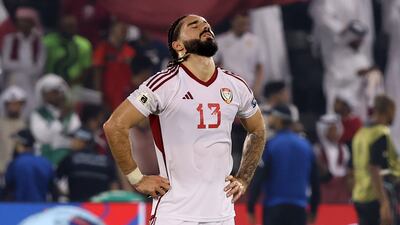
UAE's World Cup hopes suffered a big blow as they were beaten 2-0 by Qatar at the Jassim Bin Hamad Stadium in Doha on October 14, 2025. Chris Whiteoak / The National -

Dejected UAE defender Kouame Autonne after the match. Chris Whiteoak / The National -
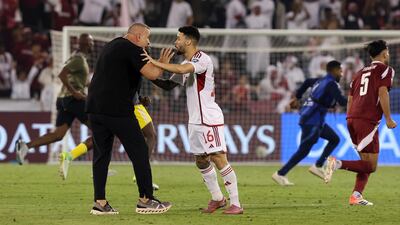
UAE coach Cosmin Olaroiu and Marcus Meloni after the match. Chris Whiteoak / The National -

Tarek Salman of Qatar is sent off late in the game. Chris Whiteoak / The National -
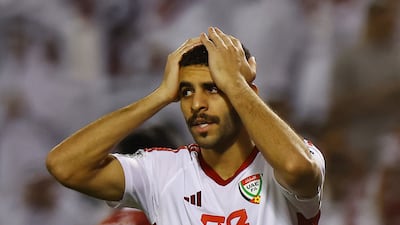
UAE's Sultan Adil after a missed opportunity. AFP -
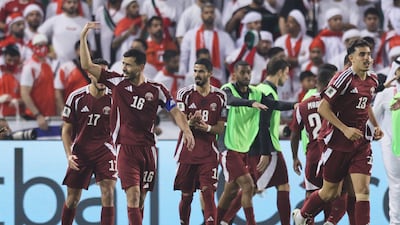
Qatar's Boualem Khoukhi, left, celebrates after scoring their first goal. AP -
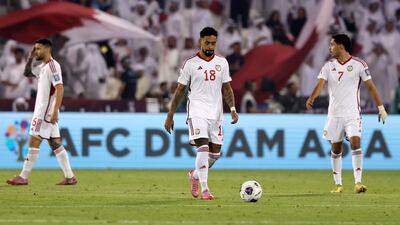
Dejected UAE players after the first Qatar goal. Chris Whiteoak / The National -
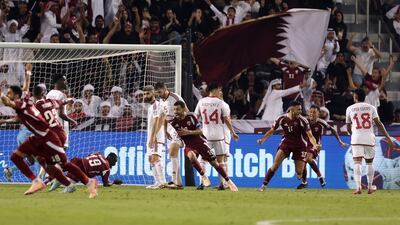
Boualem Khoukhi celebrates after scoring for Qatar. Chris Whiteoak / The National -
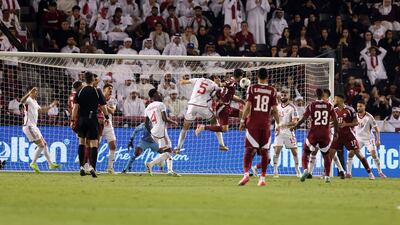
Boualem Khoukhi heads home to put Qatar 1-0 up. Chris Whiteoak / The National -
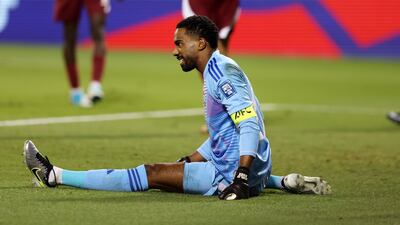
UAE goalkeeper Khalid Essa during the first half. Chris Whiteoak / The National -
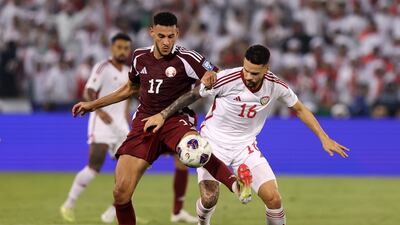
UAE's Marcus Meloni and Mohammad Naceur Al Mannai of Qatar battle for the ball. Chris Whiteoak / The National -
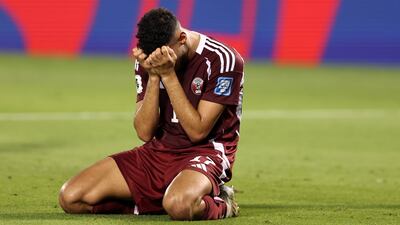
Qatar4's Mohammad Naceur Al Mannai after a chance goes begging. Chris Whiteoak / The National -
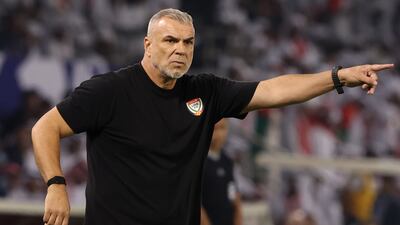
UAE manager Cosmin Olaroiu during the game against Qatar. Chris Whiteoak / The National -

Qatar's Mohammad Al Mannai is shown a yellow card by referee Ilgiz Tantashev. Reuters -
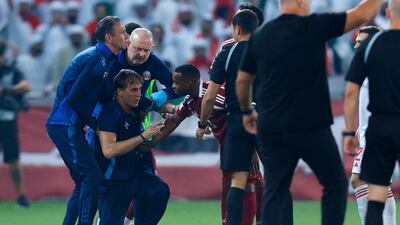
Qatar manager Julian Lopetegui is helped to his feet after being hit in the head by the ball. AFP -

The UAE team starting XI before the against Qatar. Chris Whiteoak / The National -
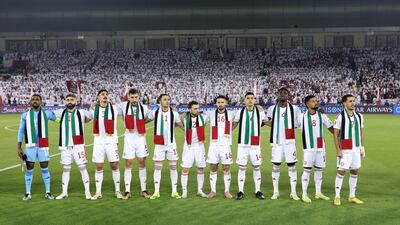
UAE players line up during the national anthems before the match. Chris Whiteoak / The National -
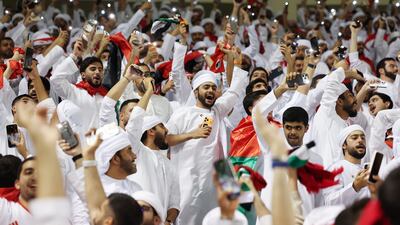
UAE fans before the game against Qatar. Chris Whiteoak / The National -
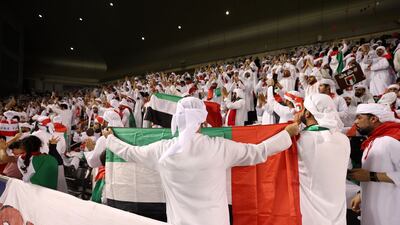
UAE fans before the game against Qatar. Chris Whiteoak / The National -

UAE fans outside the National Jassim Bin Hamed Stadium in Doha. Chris Whiteoak / The National -
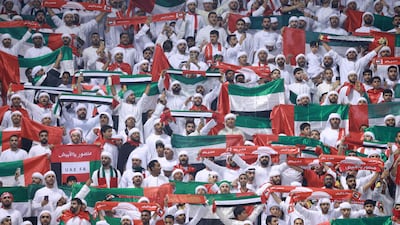
UAE supporters at Jassim Bin Hamad Stadium in Doha. AFP -
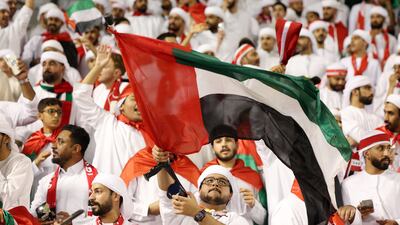
UAE fans in the National Jassim Bin Hamed Stadium in Doha. Chris Whiteoak / The National -
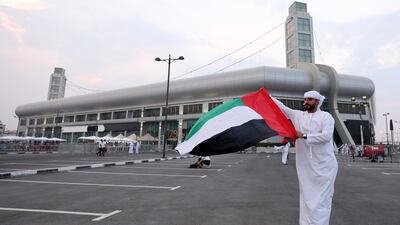
UAE fan outside the National Jassim Bin Hamed Stadium in Doha. Chris Whiteoak / The National


Having a consistent nucleus is crucial for success. The UAE themselves are evidence of that. The last time the national team claimed a trophy was at the Gulf Cup in Bahrain in 2013.
Yes, Mahdi Ali achieved it with a young set of players, who were relatively new to senior international football.
But Mahdi – who was the last UAE manager to stay in the role for longer than two years – had overseen the rise of that group from junior football to senior level, including qualification for the Olympics.
Attack
It seems glib to say the new coach needs to adopt a gameplan that is committed to front-foot, attacking football.
Obviously, every fan wants to see that from their team, and if it was that easy everyone would be doing it.
Olaroiu’s sides were reactive. It is part of the reason he has an outstanding record in finals as a club manager.

He is tactically astute and a crafty motivator, attributes which do seem ideally suited to international football.
The UAE matches he oversaw were almost all high-stakes and tension-addled, so hardly conducive to free-flowing attacking football.
But after a year in office, there were few signs of a discernible playing style focused on its own attacking merits, rather than one specifically tailored to counter the opposition.
Fans will be hoping his successor can address that.
Asian Cup
Upon announcing Olaroiu as coach in April 2025, the FA said he had been appointed until the 2027 Asian Cup.
It was obvious to everyone his main task, though, was to get the national team over the line to qualify for the 2026 World Cup.
That did not happen, and he has not made it as far as the Asian Cup, either.
That competition, in Saudi Arabia in January and February of next year, will be a big test for his successor.
Although the view should be a longer-term one - meaning building a side ready for a serious push for the 2030 World Cup - if the new man can survive the Asian Cup that will be the first mission accomplished.
The UAE face group matches against Vietnam, South Korea, plus the winner of a play-off between Lebanon and Yemen.
Progress from that group, plus a run deep into the knockout phase of the tournament, feels like a minimum requirement.

