

I was awoken by the call to prayer in Fes’ ancient Medina, the beautiful sound emanating from the nearby minarets. I looked at my phone and there were 62 new messages, including from the former Manchester United manager Ole Gunar Solskjaer, who has been in Manchester for New Year, doing normal things like going shopping and to the cinema with his wife.
He’s met many fans over the past few days, some telling him that he should come back to the club, something that is now a reality after Ruben Amorim lost his job.
Solskjaer received a call Tuesday morning and had talks with United, a club he played for with distinction for nine years and managed for almost three. United first wanted to establish if he was interested in returning to the club. He was.

The discussion went well and Solskjaer acknowledged that the other candidates mentioned were all good ones in his opinion and told United just that. I had messages and requests throughout the day from many outlets in many countries wanting me to speak about Solskjaer. I didn’t accept any of them.
I had pressing issues to sort, a bag full of toiletries to replace, including specific contact lenses and a sold-out train to Rabat with no ticket. Then I received a message from the organisers of the Africa Cup of Nations, the reason I'm in Morocco, stating: "Media ticket application declined". It continued: "After careful consideration, we regret to inform you that your media request has not been approved. Unfortunately, due to capacity constraints to the media tribune capacity we are unable to accommodate your request for access.”
I’d gone all the way to Morocco only to be denied media access to see a game on the day of the match. Not good.
I asked around and discovered there were 900 journalist requests for 150 seats. Priority was given to those from the competing countries, Algeria and the Democratic Republic of Congo. I was neither, but I was still surprised at the huge number of applications – far more than a major Uefa Champions League game.
I looked online to see that the game at the Moulay El Hassan Stadium was sold out, but I wasn’t giving up that easily. If no ticket showed up, I’d watch the game in central Rabat, Morocco’s capital.
But first, I had to get out of Fes’ medina, which is almost impossible to do alone on your first visit. It’s too big and too mazy. I was told that one way to get out was to follow the streets downhill until I could do that no more – and from there it would be possible to orientate myself. Not easy in a place where 150,000 people (and no cars) live.
-
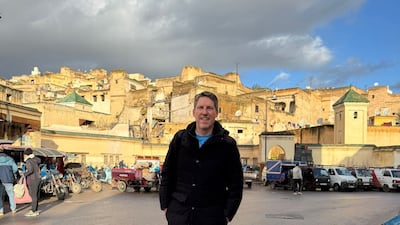
The National's Andy Mitten on trying to find his wya out of Fes' medina: 'It's almost impossible to do alone on your first visit. It’s too big and too mazy.' All photos: Andy Mitten for The National -
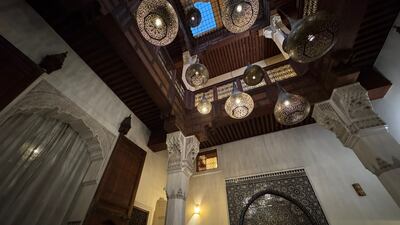
The ceramic-tiled riad in Fes where Andy based himself for the first leg of his trip to Morocco, a traditional living quarter owned by some British friends named Chaq Chaq. -
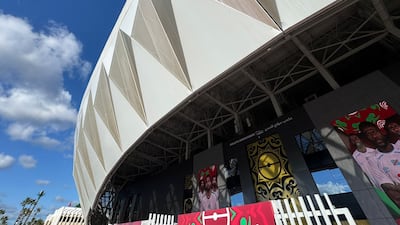
The Moulay El Hassan Stadium in Rabat was sold out for the Algeria-DR Congo Afcon quarter-final, and our correspondent had his media accreditation denied. -
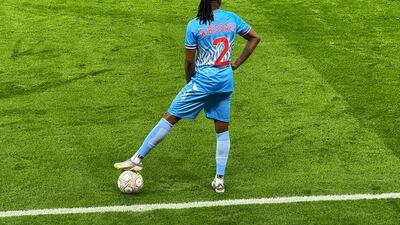
DR Congo's Aaron Wan-Bissaka, a player Andy Mitten knows well from his time at Manchester United. -
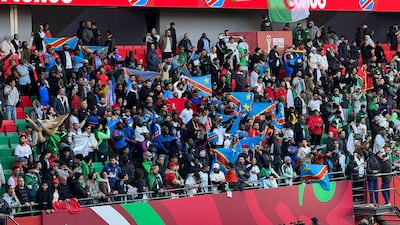
Democratic Republic of Congo fans may have been outnumbered by the Algeria counterparts but still made plenty of noise.


But first, the ceramic-tiled riad where I was staying. How did a traditional living quarter become owned by some British friends. I asked Andrew, one of the owners of the house, which he calls Chaq Chaq.
“Years ago, I was having drinks with some mates, and we wanted to do something to keep in touch as we were all having kids, moving house and beginning to drift apart,” he said. “The plan was to set up a side-hustle business, but then, randomly, one of my mates saw a news article about property in the Fes medina. We got on a Ryanair flight that weekend to check it out and ended up buying two houses between us.
"It sounds really flash, but they were pretty cheap at the time, mainly because the euro was at 1.5 to the [British] pound and they were absolute wrecks. We've only managed to do one up, which has become Chaq Chaq and it’s been a pretty crazy journey with enough mishaps to write a book. I love it though – I go out two to three times a year and always have a great time”.
Mishaps like?
“We hired a friend to manage the renovation, which was a bit silly, as he had no prior experience renovating a riad. The first thing he did was have five beds built in the medina, which he left in the top room, which didn't have a roof or a door. They got nicked straightaway. He then used internal plaster on the roof terraces' floors, which all the locals thought was mad. When we went there two months later, it had all cracked and started to separate from the roof. He also built 'traditional' bathrooms inside the actual bathrooms, which you couldn't stand up in and the water from the showerhead hit your chest.
"We hired a man to look after the house when we weren't there, but he turned out to be a local criminal. He moved his whole family in and eight of them lived in the bedroom on the bottom floor. I remember the first time we went back and went into the house and there was a fire on the floor and loads of chickens flying around. It was a nightmare, and we had to pay him loads of money to leave as he had squatter's rights”.
The riad and the five bedrooms are now stunning, but I needed help to get out of the medina and wouldn’t have a clue how to retrace my steps. A pharmacy was located and they sold almost everything I needed. At the train station, I paid €20 to travel the three-hour journey across a surprisingly green and wet central Morocco on a train where Songbird by Kenny G was piped through the speakers for 30 minutes. The train was manufactured in Derby, England. There were a lot of football fans on the train from the competing teams and I shared a carriage with two South Africans who’d seen their team exit to Cameroon on Sunday. There was a loud discussion on the next carriage in English and, seemingly, the solution to every problem in the world.
I was asked to get in touch with a South African journalist who has written a book that is likely to be of major interest. Turns out I’d already met him the night before in Fes, but we didn’t realise it.
The main train station in Rabat is big and modern. Morocco has built a major high-speed rail network and I plan to use it this week. I spoke to fans from Morocco, Algeria and Congo. All were happy and enthusiastic. That’s one of the ideas of tournaments like this, to bring people together, even fans from rival countries whose governments don’t see eye-to-eye, like Algeria and Morocco. Two female Algerian fans who spoke no English giggled when I asked if I could film them, before mustering enough words to state their love for their national team, the 'Fennecs'.
There were more chats with Solskjaer. He was proud that three of his former players – Aaron Wan-Bissaka, Axel Tuanzebe and Arthur Masuaku were in the DR Congo team. I managed to get a ticket for the game from a contact, but it wasn’t the media section so my plans of speaking to Tuanzebe, Wan-Bissaka and Algeria’s Rayan Ait Nouri were out. Instead, I was with the Algeria fans inside the small but perfectly formed Moulay El Hassan Stadium, which was rebuilt to hold 22,000 in 2024. It’s in a wealthy area close to embassies and I shared a taxi there with three Algerians who live in France.
The sun came out for the first time on the trip and the event was well organised. I received three more calls to speak about Solskjaer from media outlets in three countries but couldn't as I was walked the streets (and successfully located some new contact lenses).
Algerian fans easily outnumbered the Congo fans and I met several who, unable to cross the closed border with Morocco, travelled first to Tunisia before boarding a flight to Morocco. And while I’m happy in a new blue jumper which was a Christmas present, the colour matched the Congo shirt and people thought I supported them.
The game was 0-0, when, at half time, I received a tap on the shoulder.
“Andy?”
“Yes.”
“You used to play football with my brother Sebastian. I showed him a photo from my seat and he recognised you.”
The man is based in France and at the tournament to monitor any match fixing. His whole life is spent investigating illegal betting patterns and trying to bring perpetrators to justice. He works with a couple of investigative journalists I know and explained his job and the problem areas, the criminality, the scale of the problem and money involved and the regions where there are major issues.
He conceded that he can only ever touch the tip of a huge iceberg and does so because he’s paid to by authorities and feels passionately about the damage it does to sporting integrity. I was impressed by his drive and determination and the reality of his job. “The public don’t really care about financial crimes but it’s the public and society we’re protecting," he said.
Algeria scored the game’s only goal after 119 minutes of the 120 possible, a glorious team effort finished off beautifully by Adil Boulbina, a 22-year-old midfielder, following a counterattack. It was cruel for Congo but Algeria, the favourites in the game after winning their group, deserved it as they moved into the final eight.
I got back to a hotel – a modern one rather than an old house in the medina – and watched Ivory Coast defeat Burkina Faso 3-0 in the bar where I was surprised to see a man smoking a cigarette – and I grew up in Manchester when everyone smoked like chimneys.
Ivory Coast will play Egypt in Agadir on Saturday while Algeria will play Nigeria in Marrakesh. For me, it’s time to explore Rabat and Casablanca before Friday’s quarter-final between Mali and Senegal in Tangier.

