


Daniel Levy, the most divisive figure in Tottenham's 143-year history, has stepped down as club chairman after nearly 25 years.
His departure, which the club announced on Thursday night, was met with a mixture of utter shock and unbridled joy on Tottenham forums and group chats.
“I am incredibly proud of the work I have done together with the executive team and all our employees,” Levy told the club's website.
“We have built this club into a global heavyweight competing at the highest level, more than that, we have built a community.
“I was lucky enough to work with some of the greatest people in this sport, from the team at Lilywhite House and Hotspur Way to all the players and managers over the years.
“I wish to thank all the fans that have supported me over the years. It hasn’t always been an easy journey but significant progress has been made. I will continue to support this club passionately.”
Levy's legacy
Levy was, by a distance, the longest-serving chairman in the Premier League. After a quarter-of-a-century, Levy can, quite righty, point to towering achievements off the pitch, but few on it.
His vision turned a charmed White Hart Lane stadium into a £1 billion monolith that is now the envy of rival clubs and supporters. As well as hosting some of the world's best footballers for 10 months of the year, the Tottenham Hotspur Stadium is a must-stop venue for travelling rock bands and musicians and has surpassed the national stadium at Wembley as the go-to place for world-class boxing. The spectacular training headquarters at Hotspur Way in Enfield aren't too shabby either.
Despite their gilded surroundings, Levy's time at the club will be remembered for a lack of trophies and a boulevard of broken dreams. The sense that Levy prioritised financial windfall over title hauls. That gold was more important than silver.
Levy sacked 12 managers – six times as many trophies as Tottenham won during his tenure. The latest to fill the sharp prick of Levy's knife in his back was Ange Postecoglou, who was sent for and sent away 16 days after winning the Europa League at the end of last season.
We can debate the merits of that. The Australian ended Spurs' 17-year wait for a trophy, but presided over a club-record 22 defeats as Spurs finished a pitiful 17th in the Premier League. Fans can romaticise the achievement of winning Europe's second-most important club competition, but the reality is that football under Postecoglou was rank and results even worse.
-

Son Heung-Min lifts the Europa League trophy alongside teammates after Tottenham's victory in the final against Manchester United in Bilbao. Getty Images -
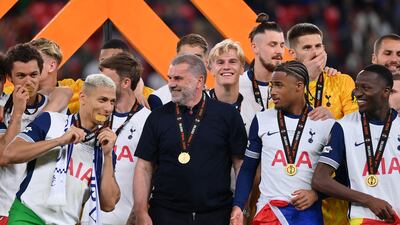
Tottenham Hotspur manager Ange Postecoglou on the podium after victory in the Europa League final. Getty Images -
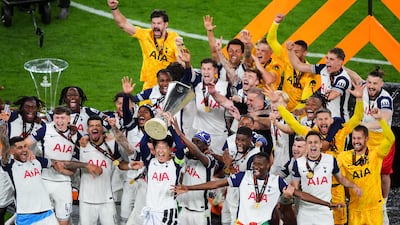
Tottenham Hotspur celebrate the end of their 17-year trophy drought. PA -

Manchester United's Luke Shaw and Harry Maguire with teammates after losing the final in Bilbao. Getty Images -
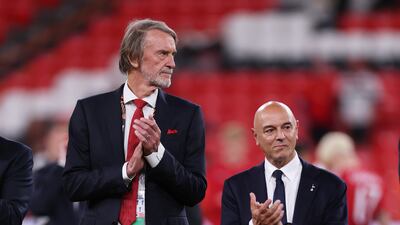
Jim Ratcliffe, co-owner of Manchester United, with Daniel Levy, chairman of Tottenham Hotspur, at the San Mames stadium. Getty Images -
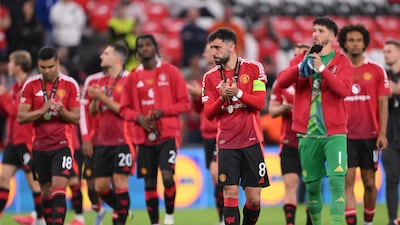
Bruno Fernandes acknowledges Manchester United fans. Getty Images -
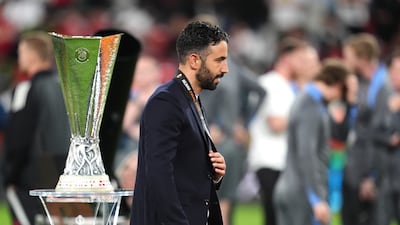
Manchester United manager Ruben Amorim walks past the Europa League trophy. PA -
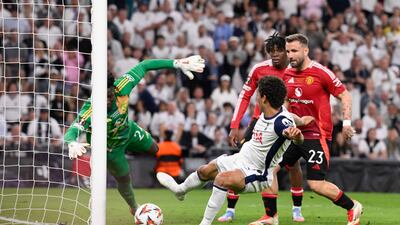
Tottenham Hotspur's Brennan Johnson scores the winning goal in Bilbao. AFP -

Tottenham Hotspur's Brennan Johnson celebrates scoring. Reuters


His successor, Thomas Frank, was the 17th and last permanent appointment of Levy's reign. The Dane has made an encouraging start to life in North London. Levy's departure is unlikely to have an adverse affect on the team. Though historically known to have had generally good relations with his players, axing the supremely popular Postecoglou was seen by some in the dressing room as the last straw. Ange loyalists, including captain Cristian Romero, are unlikely to shed many tears when they return after the international break.
Postecoglou's route out the door was a path well-trodden. Mauricio Pochettino was sacked five months after taking the club to a first Uefa Champions League final. What's glossed over is that Spurs were 14th in the league when the Argentine departed. Juande Ramos was binned eight months after winning the League Cup. Spurs won only three league games after that 2-1 win over Chelsea in the 2008 final. Martin Jol learnt of his sacking via text message from his nephew during a Uefa Cup match in 2007. He was late on the uptake. Everyone else at the ground already knew.
Brutal or just business? Either way, Levy was never shy about pulling the trigger. When he made a decision, he saw it through.
It's easy to forget the mess Spurs were in before Levy took the helm. A new century offered precious little to celebrate. Their best player, Sol Campbell, had left on a free transfer the summer before and joined hated rivals Arsenal. Spurs' best finish in the first eight seasons of the Premier League was seventh in 1994/95. The team were inferior, any gems picked off by rivals with more financial clout. Spurs were a non-factor, just one of 20 teams that made up the league.
Achievements
Never a popular figure with the natives, the chant "Levy out" was an overfamiliar chant during Levy's reign. It's hard to think of anyone so uniquely blamed for collective failure.
Under Levy, Spurs finished second (once), third (twice) and fourth (thrice) to establish themselves as top-four contenders, though only once genuine title contenders. They reached the 2019 Uefa Champions League final. They won the 2025 Europa League, to go with the 2008 League Cup. They reached 16 semi-finals and seven finals, not including the recent Uefa Super Cup.
A notoriously tough negotiator, Spurs no longer have to sell their best talent but still find it hard to keep hold of them. Genuine world-class players such as Dimitrov Berbatov, Luka Modric, Gareth Bale and Harry Kane came and went, with the club's inability to challenge for trophies always cited as a reason for them leaving.
History will be kind when Levy's achievements off the field are remembered - but there can be no escaping the failures on it.

