

For close to five years, Babar Azam and Mohammad Rizwan have been the faces of Pakistan cricket. The pair have played a significant role in numerous victories, none more memorable than their unbeaten partnership of 152 runs that handed Pakistan their first win against India in the ICC men’s World Cup of any format in Dubai in 2021.
Yet, for the third consecutive T20 International series this year, including a tour to New Zealand, a home series against Bangladesh, and the upcoming Bangladesh tour, neither player has been selected for the T20 squad.
The omission comes despite them being the top two run-scorers in the world in T20Is over the past five years. Rizwan has amassed 3,229 runs while Babar has 2,752, but they have done so at strike rates hovering just below 130, a figure which is seen as outdated in modern T20 cricket.
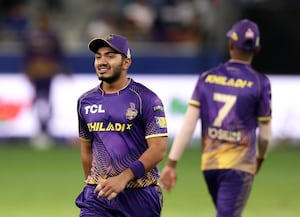
Starting from the tour of New Zealand earlier this year, Pakistan’s selection strategy for T20 cricket has had a noticeable shift. The focus has moved away from runs accumulation to intent, impact and strike rate.
As a result, the quickest two centuries in Pakistan's T20I history happened this year: Hasan Nawaz’s 44-ball ton in Auckland and Mohammad Haris’ 45-ball century in Lahore. In the recent series against Bangladesh, Pakistan also scored back-to-back 200s for the first time in seven years.
This new approach is also reflected in the recently selected squad for the Bangladesh series, which features five of the top seven T20 batters by strike rate since the start of 2024: Hasan Nawaz, Faheem Ashraf, Sahibzada Farhan, Mohammad Haris and Khushdil Shah.

The two from the top seven missing out are Azam Khan, largely due to fitness concerns, and Haider Ali, who appears to have been ignored after being given multiple opportunities in recent years. Though it can be argued perhaps Haider deserved another go as a late-order hitter, potentially in place of Hussain Talat.
The presence of Salman Agha and Talat, batters whose strike rates are relatively modest, suggests that Pakistan haven’t entirely abandoned the idea of including anchors. Among Pakistani batters with at least 500 T20 runs since 2024, Talat ranks 14th in strike rate (136.72), Agha sits 18th (133.44) and Babar, just a step behind, ranks 19th (132.20).
Agha might not be an explosive batter, but his leadership has been a driving force behind Pakistan’s move to high-intent batting and for that reason he does not occupy a specific spot in the batting order.
During the recent Bangladesh series, he had three 50s in four innings. Even so, he demoted himself to number five to provide a better combination to the team. That is something which Pakistan’s erstwhile captains were reluctant to do. Agha’s value as an off-spinning option only strengthens his place in the squad.
That said, it does not mean it is the end of the road for Babar and Rizwan in T20s. Both have been a part of Pakistan’s training camp in Karachi where Mike Hesson, the team's white-ball coach, threw some weight behind Babar.
“Babar is competing with one of the opening positions at the moment. We have Fakhar and Saim in those roles at the moment, so he is competing for that,” Hesson said.
Another factor that could go in favour of Babar is the next two important events: the T20 Asia Cup, for which UAE is the likely venue, and the T20 World Cup, where Pakistan will play all matches in Sri Lanka under the hybrid-model agreed with India. Both tournaments might produce a few games where totals close to 160 are par.
The scoring rates in UAE (8.03) and Sri Lanka (7.87) in T20s since the start of 2024 are modest compared to the other major host nations. Plus, the pressure of high-octane games in the global events might occasionally require a batting style where you need to occupy the crease.

In such environments, where power-hitting can be neutralised by a sticky pitch and scoreboard pressure, you might need more than one anchor in the team.
Recent history backs this: three of the past six matches in the knockout stages of T20 World Cup – the final in Melbourne in 2022 and the semi-finals in Guyana and Trinidad in 2024 – didn’t demand extraordinary strike-rates. All eight T20 World Cup clashes between India and Pakistan have produced low to moderate totals, the highest being India’s 160 in Melbourne in 2022.
Hesson’s remarks also hint that despite Sahibzada Farhan’s stellar form in 2025, in which he has most sixes (67) by a batter from Pakistan and four centuries, he may not be in the first choice XI.
With Haris and Hasan Nawaz now at number three and four positions, Agha fluctuating in the middle-order and Fakhar and Saim preferred as openers, Farhan might find himself on the fringes despite his stunning record. And if that happens, Babar and Rizwan might not just be competing with Saim and Fakhar but also Farhan.

Looking ahead, Pakistan have enough fixtures to optimise their squad before the 2026 T20 World Cup, scheduled for February and March in India and Sri Lanka. With at least 20 T20s, and up to 24 should Pakistan reach the Asia Cup final, Pakistan have ample opportunity for experimentation and refinement.
But as Pakistan do not have any domestic T20s before the T20 World Cup, the only way Babar and Rizwan can reclaim their positions is by doing through something extraordinary in ODI cricket, a format in which Pakistan are scheduled to play nine matches (three each against West Indies, South Africa and Sri Lanka), or by putting a strong show in the Big Bash League where the duo are set to debut in December.
Pakistan's upcoming T20 fixtures
July - Bangladesh (Away, 3 matches)
July-August - West Indies (Away, 3 matches)
August - Afghanistan (Home, 3 matches)
September - Asia Cup (Away, 2 to 6 matches)
October - South Africa (Home, 3 matches)
November - Sri Lanka (Home, 3 matches)
February - Australia (Home, 3 matches)
Pakistan’s squad for Bangladesh T20I series
Probable XI: Saim Ayub, Fakhar Zaman, Mohammad Haris (wk), Hasan Nawaz, Salman Agha, Khushdil Shah, Mohammad Nawaz, Faheem Ashraf, Abbas Afridi, Abrar Ahmed, Sufyan Moqim.
Remaining four: Sahibzada Farhan, Hussain Talat, Salman Mirza, Ahmed Danyal.

