
The death of Sultan Qaboos, the longest-serving ruler in the Middle East, marks the end of an era. He was father figure to Oman's more than four million residents and an elderly statesman who many leaders across the region looked up to. Sultan Qaboos held the reins for almost half a century, during which time he brought immeasurable progress to his country while playing a vital role in maintaining much-needed stability in this part of the world.
Indeed, it is important to remember Sultan Qaboos as the great moderniser of Oman and an important mediator between feuding neighbours, both in times of war and peace. He was the last of the founding members of the Gulf Co-operation Council, formed in 1981, during a period of great uncertainty brought about by the onset of the Iran-Iraq War.
His departure is a great loss to his country, the region and the wider world. But even as this is a time of mourning, it is important to celebrate his life and honour his legacy as one of the Arab world's great leaders.
Not long after succeeding his father at the age of 29 in July 1970, Sultan Qaboos ushered in a period of development in Oman. It is worth noting that up until this point, the country was mostly underdeveloped; it reportedly had just 12 hospital beds, 10 kilometres of surfaced roads and three primary schools – all of them for boys.
Within a short period, however, he invested the revenue generated from the country’s oil industry into building critical infrastructure, educational institutions, hospitals, banks, and air and seaports. During this period, Sultan Qaboos also united the country and championed a tolerant society that was home to not just Arabs but also descendants from the Indian subcontinent and East Africa. Another example of his progressive vision was his bold move to admit women to the orchestra more than three decades ago.
-
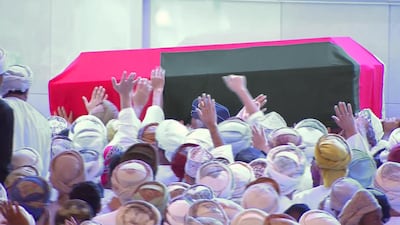
Omanis bid farewell to their leader during the funeral procession for Sultan Qaboos. AFP / Oman TV -
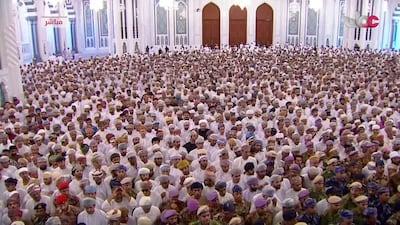
People attend a funeral service for Sultan Qaboos, at the Grand Mosque that bears his name in Muscat. Oman TV via AP -
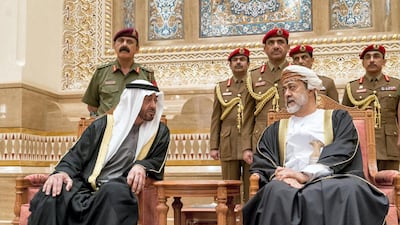
Sheikh Mohamed bin Zayed, Crown Prince of Abu Dhabi and Deputy Supreme Commander of the Armed Forces, left, offers condolences to Sultan Haitham in Muscat. MBZ/Twitter -
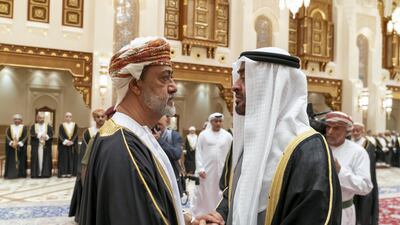
Sheikh Mohamed bin Zayed with Sultan Haitham. Ministry of Presidential Affairs -
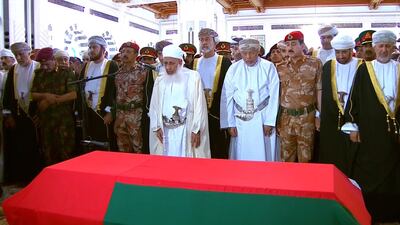
Prayers and funeral rites are held for Sultan Qaboos. AFP / Oman TV -
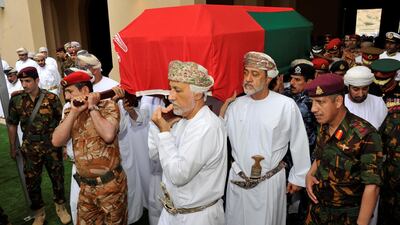
Oman's newly sworn-in Sultan Haitham bin Tariq Al Said carries the coffin of his cousin, Sultan Qaboos, during the funeral in Muscat. Reuters -
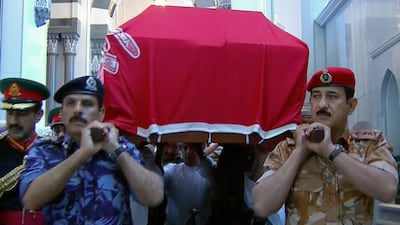
Members of the Omani military carry the coffin of Sultan Qaboos. AFP -
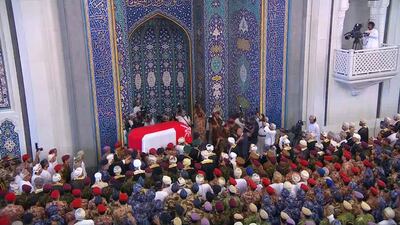
Omanis take part in the funeral of Sultan Qaboos at the Grand Mosque in the capital Muscat. AFP -
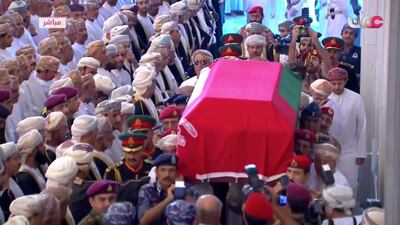
The coffin is carried to the Grand Mosque. Oman TV via AP -
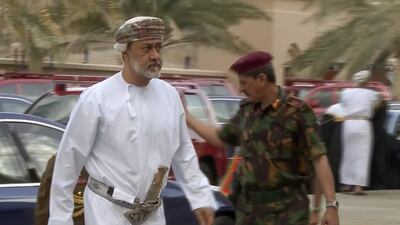
Sultan Haitham arrives at the Grand Mosque for the funeral. AFP / Oman TV -
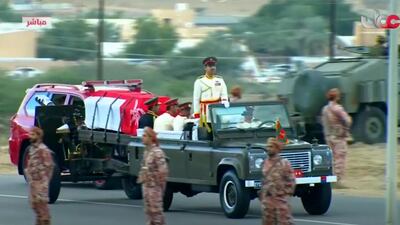
A motorcade carries the body of Sultan Qaboos. Oman TV via AP -

Sultan Qaboos had ruled Oman for almost 50 years, after coming to power in 1970. Oman TV via AP -
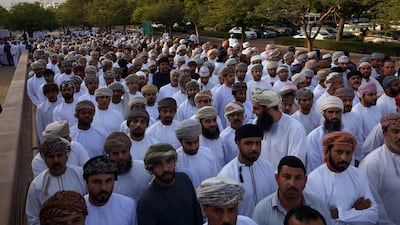
People gather in front of the Sultan Qaboos Mosque to perform funeral prayers. AFP -
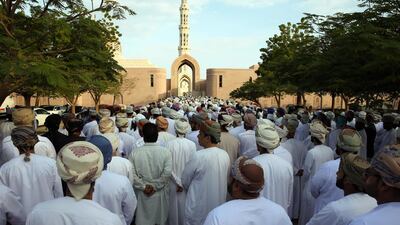
The streets of Muscat were packed as Omanis grieved over the death of Sultan Qaboos. AFP -
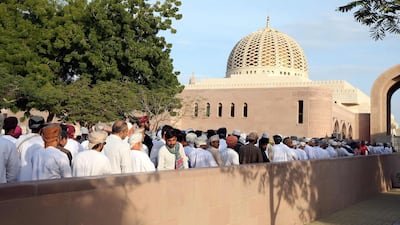
Authorities declared a 40-day mourning period in the country. AFP -
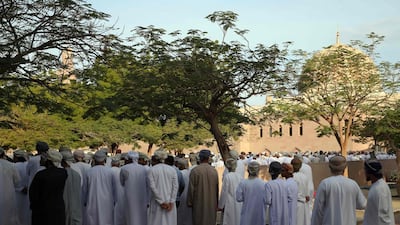
Omanis gather to enter the Sultan Qaboos Mosque to perform funeral prayers. AFP -
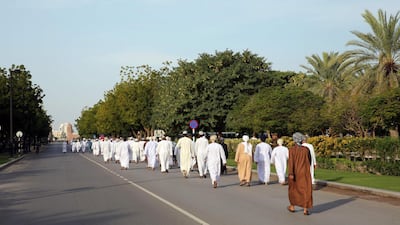
People walk towards the Sultan Qaboos Mosque to perform the funeral prayers. AFP -
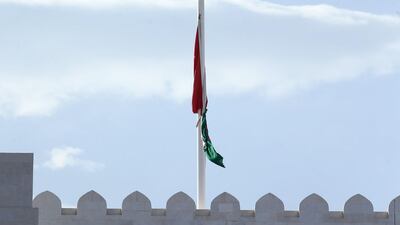
The Omani flag is seen at half-mast in the capital Muscat. AFP


A lover of the arts, Sultan Qaboos leveraged his country’s immense history and cultural heritage by turning it into a rarefied tourist destination, particularly for visitors who were genuinely interested in this part of the world. The Royal Opera House in Muscat, a vibrant cultural attraction since its opening in 2011, is one of many fruits of that vision.
Sultan Qaboos was famously a foreign policy pragmatist under whose leadership Oman maintained friendly ties with every country in the neighbourhood, refusing to take sides even during times of duress. He believed that such a positive approach was beneficial not just to Oman but to everyone in the Middle East. What makes his pragmatism even more laudable is that despite being a friend of the West and a military man – he was an alumnus of the Sandhurst Military Academy in Britain – he worked strenuously on the principle of pacifism even with awkward neighbours. It is telling that countries such as the UAE and Bahrain have declared official mourning for his death; his influence having been instrumental for the region and not just his within the borders of his own country.
Sultan Qaboos' greatest legacy, perhaps, will be the peaceful and stable Oman he has left behind. Despite the fact that no succession plan had been announced, former culture minister Haitham bin Tariq Al Said was named within hours of his death when a sealed envelope nominating him was opened. Sultan Qaboos' death will have been the moment that many Omanis had feared the most in their lifetime. However, given the state of the country today – especially when compared to the desperate situation it was in during the 1970s – there is no doubt that "the Sultan of love and wisdom", as Sheikh Mohammed bin Rashid, Vice President and Ruler of Dubai, referred to him, has left his country on firm and steady footing.

