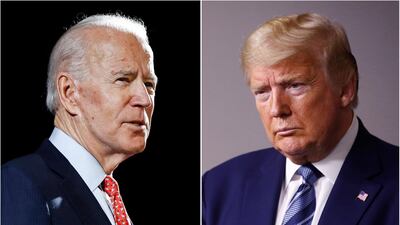

Every four years, world leaders and governments position themselves ahead of the US presidential election, either to directly influence the voting or to curry favour with the Republicans and Democrats by jockeying with one or both political parties and their presidential candidates.
It seems no different this year.
Three factors seem to undermine President Donald Trump's chances of getting re-elected in November: failure to prepare for the coronavirus outbreak in the US; economic devastation caused by Covid-19; and the killing of an African-American, George Floyd, while in police custody, thereby exposing once again racial divides in the country. Instead of consoling the victim's family and trying to bring Americans together, Mr Trump confronted the protesters who took to the streets in their thousands to demand justice following the incident.
-
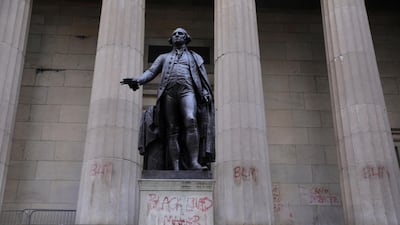
The Federal Hall in Manhattan, New York is seen marked with graffiti after protests against the death in Minneapolis police custody of George Floyd. Reuters -
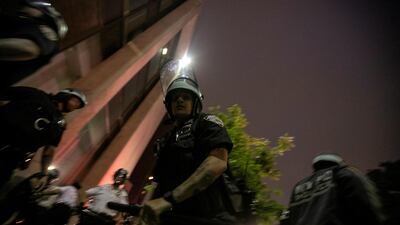
A NYPD policeman is seen during a protest in Brooklyn, New York City. Reuters -
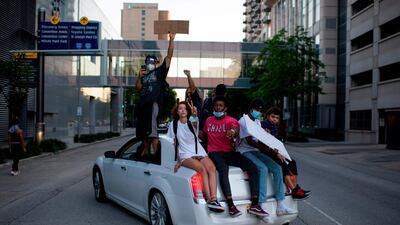
Protesters demonstrate during a peaceful march in downtown Houston, Texas. AFP -
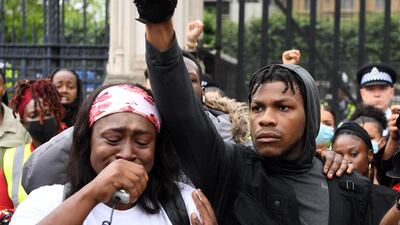
Protestors including British actor John Boyega, centre, raise their fists in Parliament square during an anti-racism demonstration in London. AFP -

British actor John Boyega speaks to protestors in Parliament square during an anti-racism demonstration in London. AFP -
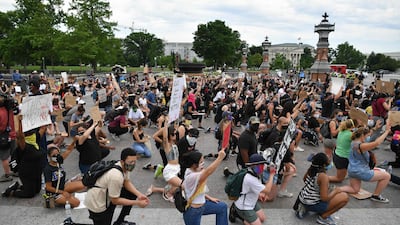
Protesters kneel to demonstrate against the death of George Floyd near the US Capitol, in Washington, DC. AFP -
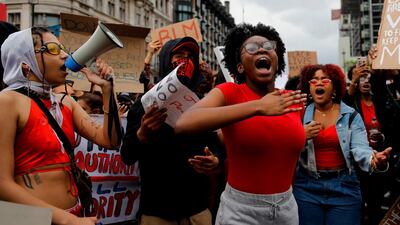
Protestors hold placards and shout slogans as they march during an anti-racism demonstration in central London. AFP -
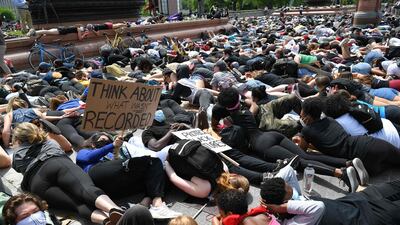
People lay down in protest for the death of George Floyd near the US Capitol, in Washington, DC. AFP -
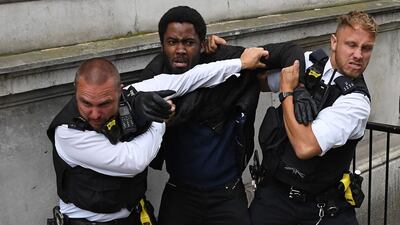
Police officers react as they attempt to detain a protestor near the entrance to Downing Street, during an anti-racism demonstration in London. AFP -
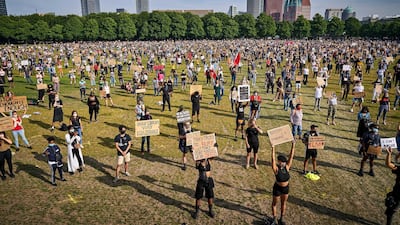
Protesters during a protest on the Malieveld in The Hague, The Netherlands. Organizer Black Lives Matter Netherlands organized the meeting in protest of violence against black people in the US and the death of 46-year-old George Floyd while in police custody. EPA -

Protestors scuffle with Police officers near the entrance to Downing Street, during an anti-racism demonstration in London. AFP -
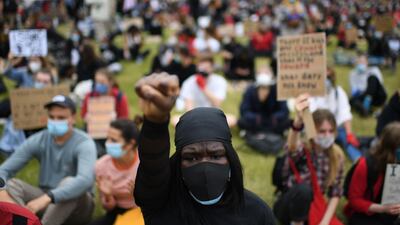
Protestors hold placards during a demonstration in London. AFP -
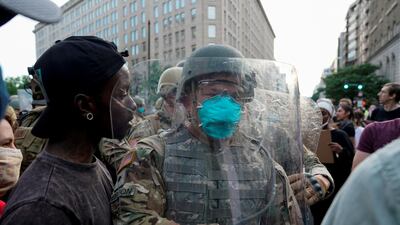
U.S. Army soldiers pass protesters as they arrive to maintain a perimeter during a rally against the death in Minneapolis police custody of George Floyd, near the White House, in Washington, U.S. REUTERS -
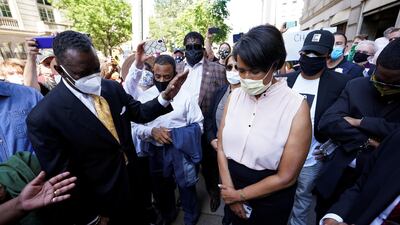
Washington, DC Mayor Muriel Bowser bows her head in prayer during a vigil as protests continue on the streets near the White House over the death in police custody of George Floyd, in Washington, U.S. REUTERS -
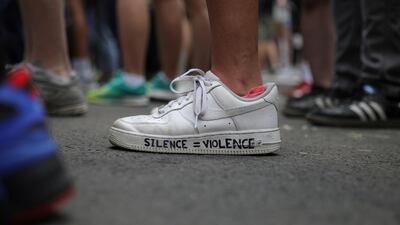
A demonstrator displays a message of protest on shoes as protesters rally against the death in Minneapolis police custody of George Floyd, near the White House in Washington, U.S. REUTERS -
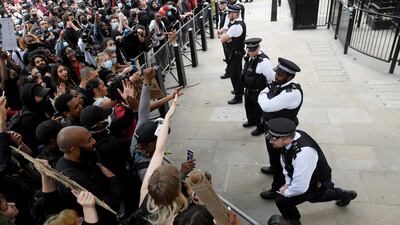
A police officer takes a knee in front of protesters near Downing Street during a "Black Lives Matter" protest following the death of George Floyd who died in police custody in Minneapolis, London, Britain. REUTERS -
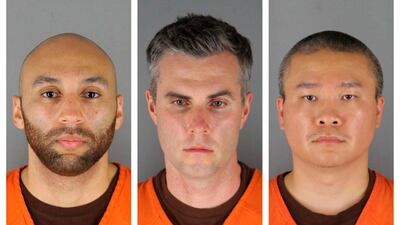
This combination of photos provided by the Hennepin County Sheriff's Office in Minnesota shows J. Alexander Kueng, from left, Thomas Lane and Tou Thao. They have been charged with aiding and abetting Derek Chauvin, who is charged with second-degree murder of George Floyd, a black man who died after being restrained by the Minneapolis police officers on May 25. AP -
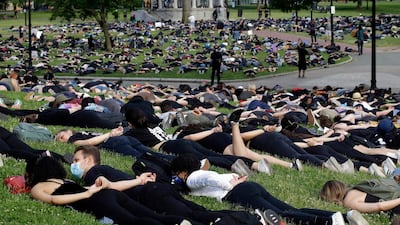
Hundreds of demonstrators lie face down depicting George Floyd during his detention by police during a protest against police brutality, on Boston Common. AP Photo -
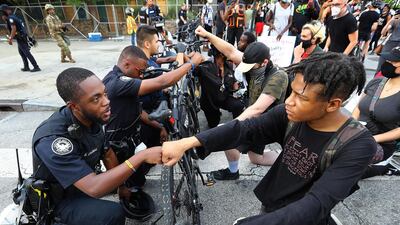
Atlanta Police Officer J. Coleman, left, and protester Elijah Raffington, of Sandy Springs, fist bump while an Atlanta Police bicycle unit blocking Marietta Street at Centennial Olympic Park Drive kneels down with protesters in a symbolic gesture of solidarity outside the CNN Center at Olympic Park, in Atlanta, during a protest sparked by the May 25 death of George Floyd in Minneapolis police custody. AP -

People continue to gather near the intersection of 38th and Chicago in front of the Cup Foods at the spot where George Floyd was arrested and who later died in police custody, in Minneapolis, Minnesota, USA. EPA


Mr Trump's tendency to place his traditionally white voter base above national interests has, therefore, made his path to re-election much trickier. And with his opponent Joe Biden in a seemingly better position of getting elected than he was a few months ago, the US foreign policy community is engaging in fresh policy discussions.
Foremost on the minds of many has been the issue of a rising China, as well as greater US engagement in south-east Asia. It is clear that neither Republicans nor Democrats want a military confrontation with Beijing, although the future of Taiwan vis-a-vis China remains, for some, the likely trigger point for an unlikely confrontation. However, any talk of war on social media diverges from the thinking of experts on US-China relations.
They include Robert Blackwill, a senior fellow at the think tank Council on Foreign Relations, who was once deputy national security adviser during the presidency of George W Bush, and Kishore Mahbubani, the former Singaporean envoy to the United Nations. During the fifth e-policy circle hosted by the Beirut Institute Summit in Abu Dhabi, Mr Blackwill and Mr Mahbubani agreed that a war between the world's two largest powers is unlikely.
But both experts believe that, in order for the US to engage more in Asia, it needs to disentangle itself from the Middle East.
In a recently published article titled The End of World Order and American Foreign Policy, Mr Blackwill wrote: "The Covid-19 crisis ought to mark the end of the post-9/11 era. The United States has overly invested in the greater Middle East, and Washington should stop trying to fix the most dysfunctional and self-destructive region on earth." He elaborated on this point during the e-policy discussion, making two policy prescriptions for the US in this region.
“First, the United States should stop starting wars in the Middle East for the foreseeable future. Second, the United States should not devote diplomatic capital to the Israeli-Palestinian dispute. The two-state solution is over. The reason, of course, is mostly Israel. It will bear the consequences of this, but it's a hopeless endeavour now for the United States to use diplomacy to try to solve that problem."
-

Mourners carry the body of Mohammed Hamayel, a 15-year-old Palestinian killed by Israeli forces, during his funeral in the West Bank village of Beita on March 11, 2020. EPA -

Relatives mourn for Mohammed Hamayel, who was shot during protests on March 11, 2020 against feared Israeli land confiscation south of Nablus city in the occupied West Bank . EPA -

Mohammed Hamayel's sister cries at his funeral. EPA -
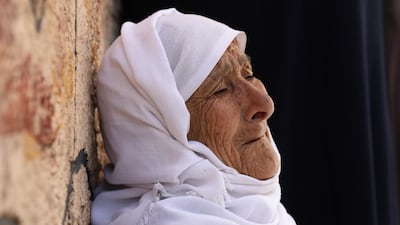
Mohammed Hamayel's grandmother grieves at his funeral in the village of Beita near Nablus city. EPA -
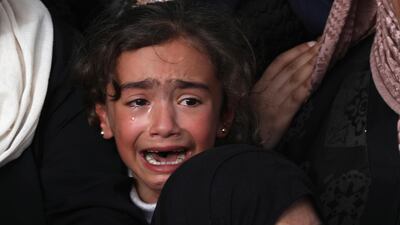
Mohammed Hamayel died after being shot in the face with live ammunition by Israeli soldiers, the Palestinian health ministry said. EPA -

Women watch the funeral of Mohammed Hamayel from a home in the West Bank village of Beita. AFP -
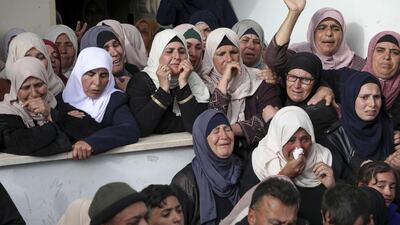
Palestinian women mourn during the funeral of Mohammed Hamayel. AFP -

Relatives mourn during Mohammed Hamayel's funeral. Reuters


Mr Blackwill also said that the Trump administration, particularly the President's son-in-law and White House adviser Jared Kushner, is squarely behind the Israeli bid to annex West Bank and the Jordan Valley. "If you're asking, is there any chance the United States would sanction Israel for its annexation policies, the answer is no. And it is even more stark than that. Which government proposed that Israel annex 30 per cent more of the West Bank? The answer is, the United States government – in the Kushner peace plan."
Mr Blackwill's central point, one that Mr Mahbubani agrees with, is that Asia deserves more investment from US decision-makers than the Middle East does. Both men urged the US to dedicate less diplomatic capital and resources in this region and, instead, pivot to Asia. Mr Mahbubani went further, suggesting that the Arab world also needs to engage more with Asia.
The former diplomat said that, despite being a possible centre of a future conflict, south-east Asia has a population of 615 million people and enjoys a great amount of diversity. "Asean has turned out to be the second most successful regional organisation in the world [because] we have succeeded in preventing wars in our region [and] created a culture of pragmatism," he said, while comparing it to decades of conflict in the Middle East. In Mr Mahbubani's view, an American exit from this region would only help the region's players to engage in soul-searching and come together.
However, two countries that would like to see a US withdrawal from the region are Iran and Turkey.
The Iranian regime, no doubt, wants to see the back of Mr Trump come presidential inauguration day in January, given his decision to place gruelling economic sanctions on Tehran after withdrawing the US from the 2015 nuclear deal. Nonetheless, it has two plans for both eventualities – a victory for Mr Trump and a defeat for him.

There is an assumption that a "President Biden", who as vice-president was partially responsible for the nuclear deal, would be a gift for Iran’s rulers – not just for the so-called moderates within the establishment but also the hardline Islamic Revolutionary Guard Corps, with the latter hoping to be freed of sanctions so that they can proceed with their expansionist plans across the Arab world.
The election of Mr Biden could also give President Recep Tayyip Erdogan an impetus to push his Muslim Brotherhood project in Arab countries, a vision that was met with little opposition during the presidency of Barack Obama.
The losers would, therefore, be the many millions of Arabs who are simply tired of sectarian strife in the region, which would only be exacerbated if the US chooses to turn a blind eye to the competing visions and actions of both the Brotherhood and the regime in Tehran.
Raghida Dergham is the founder and executive chairwoman of the Beirut Institute

