

Singapore's founding father and long-time leader Lee Kuan Yew once famously said: "Even if you are going to lower me into the grave and I feel that something is going wrong, I will get up." The late Mr Lee, who was prime minister of the city-state from 1959-90 before remaining in government as senior minister and then minister mentor until 2011, would almost certainly have been moved to do so had he been around to witness Singapore's recent general election.
For in it the ruling People’s Action Party (PAP), helmed since 2004 by his son Lee Hsien Loong, received its second worst vote in Singapore’s history as an independent state. The opposition notched up a record number of MPs. The Deputy Prime Minister, Heng Swee Keat, only squeaked a victory in his own constituency, leading many to assume that the PAP’s succession plans – Mr Heng was expected to take over before Mr Lee’s 70th birthday in 2022 – have been upended. After the shock of losing their first ever multi-member constituency (known as GRCs) in the 2011 election, the PAP lost a second last Friday.
Held during a pandemic that Prime Minister Lee called "the crisis of a generation", the election was supposed to return his party with a "strong mandate". Instead Mr Lee was returned in a weakened state. Could it be the PAP that now faces a crisis? Is it destined to follow the fate of the Barisan Nasional in neighbouring Malaysia – which had ruled the country since independence, but after a strong blow in a 2008 general election was finally voted out of office 10 years later?
-
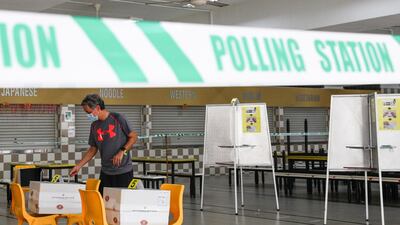
A voter casts his ballot at at the Chung Cheng High School polling centre in Singapore on Friday. Wearing masks and plastic gloves, Singaporeans began voting in a general election that is expected to return Prime Minister Lee Hsien Loong's long-governing party to power. AP Photo -

Singapore's Prime Minister Lee Hsien Loong arrives at a People's Action Party branch office, as ballots are counted during the general election, in Singapore on Friday. Reuters -
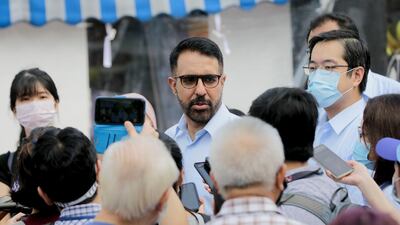
Opposition Worker's Party secretary-general Pritam Singh surrounded by members of the media during a campaign walkabout ahead of the general elections in Singapore last week. EPA -
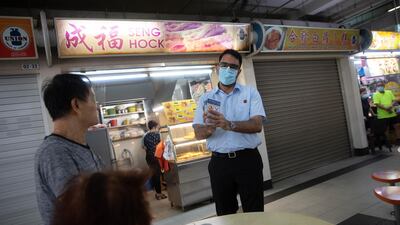
Pritam Singh, right, speaks to residents during his election campaign. EPA -
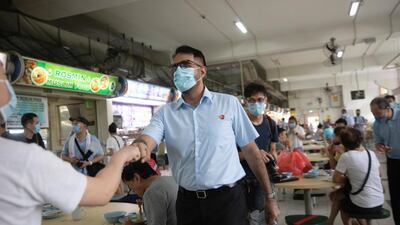
Pritam Singh fist bumps a resident during his election campaign. EPA -
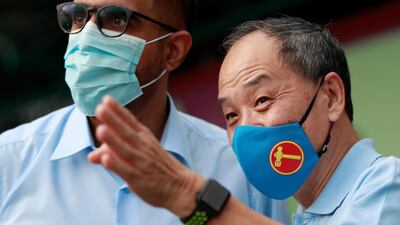
Pritam Singh, who took over the party's reins from Low Thia Khiang, right, will be named opposition leader on the floor of Singapore's Parliament. EPA -
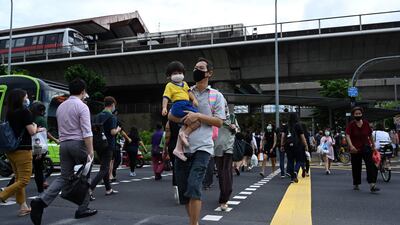
A man with a child crosses a street in Singapore this week. Singapore's Prime Minister Lee Hsien Loong called a general election "like no other" last week as the city-state struggles to recover from the coronavirus outbreak. AFP -
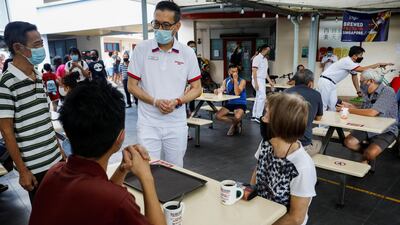
Raymond Lye and Ng Chee Meng of the People's Action Party (PAP) meet with residents during a walkabout ahead of the general election in Singapore on Sunday. Reuters -
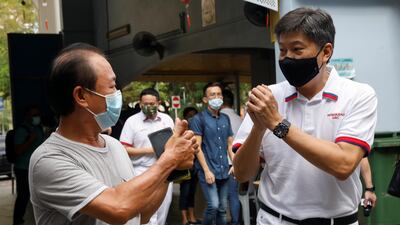
Ng Chee Meng of the PAP arrives for a walkabout ahead of the general election in Singapore on Sunday. Reuters -
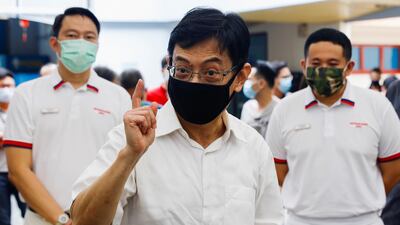
Heng Swee Keat of the PAP meets residents during a walkabout ahead of the general election in Singapore on Sunday. Reuters -
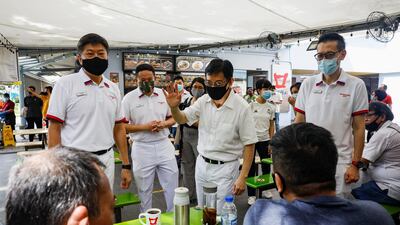
Ng Chee Meng, Heng Swee Keat and Raymond Lye of the PAP speak to residents during a walkabout ahead of the general election in Singapore on Sunday. Reuters -
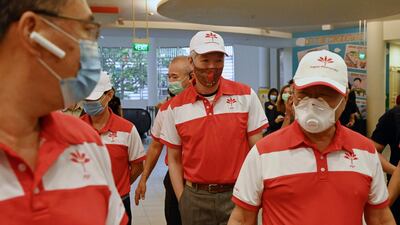
Lee Hsien Yang, brother of Singapore's Prime Minister Lee Hsien Loong, centre, arrives with Tan Cheng Bock, right, of the opposition Progress Singapore Party (PSP) at the Tiong Bahru Market for an event ahead of elections in Singapore on Sunday. AFP -
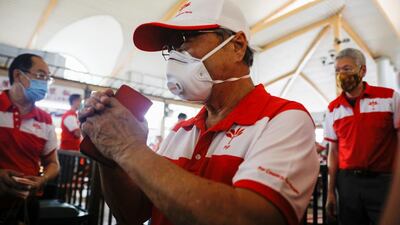
Tan Cheng Bock and Lee Hsien Yang of the PSP greet people during a walkabout ahead of the general election in Singapore on Sunday. Reuters -
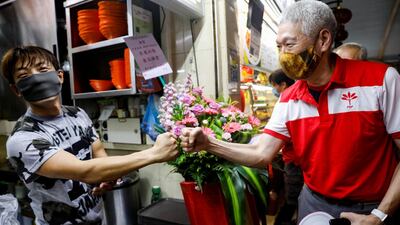
Lee Hsien Yang of the PSP greets a hawker during a walkabout ahead of the general election in Singapore on Sunday. Reuters -
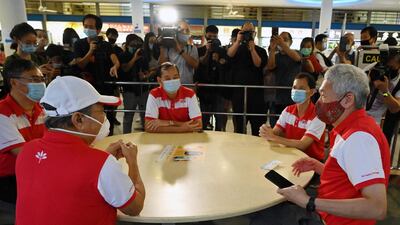
Lee Hsien Yang, right, chats with Tan Cheng Bock, left, at the Tiong Bahru Market in Singapore on Sunday. AFP -

Lee Hsien Yang, left, shows his membership card after been given it by Tan Cheng Bock, right, of the PSP at the Tiong Bahru Market in Singapore on Sunday. AFP -
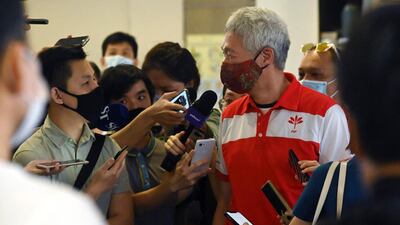
Lee Hsien Yang, talks to the media after been presented a membership with opposition PSP at the Tiong Bahru Market in Singapore on Sunday. AFP -
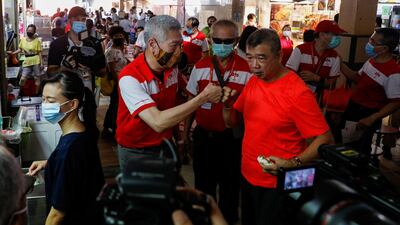
Lee Hsien Yang of the PSP greets people during a walkabout ahead of the general election in Singapore on Sunday. Reuters -

A PSP volunteer hands out leaflets at a food centre ahead of the general election in Singapore on Sunday. Reuters -

Lee Hsien Yang of the PSP attends a walkabout ahead of the general election in Singapore on Sunday. Reuters


That seems unlikely. The results of the poll were certainly an upset, but they must be seen in the context of a state where any dent in the PAP's dominance comes as a surprise. The party still won 61 per cent of the vote and 83 seats – compared to the Workers' Party's 10 seats, while the Progress Singapore Party will be allocated two non-constituency seats. Ruling parties in many countries would be delighted with so overwhelming a victory.
“The opposition have no expectations of getting into government,” comments my former colleague Shahriman Lockman of the Institute of Strategic and International Studies Malaysia. The long-term trend may be, as he says, that the PAP “just need to get used to the fact that they’re not going to get 70 per cent of the vote anymore".
That does not mean, however, that the PAP should rest on its somewhat diminished laurels. To his credit, Mr Lee is obviously aware of that. “The results show a clear desire for a diversity of voices in Parliament,” he said in a news conference after the election. “Singaporeans want the PAP to form the government. But they, and especially the younger voters, also want to see more opposition presence in Parliament.”
Mr Lee recognised Pritam Singh of the Workers’ Party as the official “leader of the opposition” – a title never accorded before – and said he would be provided with staff and resources. Singaporean commentators have long had carte blanche to say what they like about neighbouring countries, but Lee Kuan Yew’s attitude towards internal debate was brutal. “We decide what is right. Never mind what the people think," he once said; so the younger Mr Lee’s words and generous move are significant.

More worrying for the PAP is the relatively poor performance of their so-called 4G – fourth generation – politicians, of whom Deputy Prime Minister Heng was supposed to be the standard-bearer. Several won with thin majorities far lower than the 3G leaders, such as Mr Lee and his much-admired former deputy Tharman Shanmugaratnam, both of whom were elected with over 70 per cent of their constituency votes. If their popularity does not transfer to the generation that is due to take over the leadership, that does not bode well for the future.
Nor can the PAP bank for too much longer on the tranche of voters who remember the country before its independence in 1965. "If you knew what Lee Kuan Yew did for Singapore," – turning the country "from third-world to first", as Mr Lee also titled the second volume of his memoirs – is a point that has been made to me many times by older Singaporeans. But younger voters may take their prosperity and world-class education for granted.
And why shouldn’t they, you may ask? If the PAP does not make sure it is fully responsive to the wishes and dreams of younger generations, which includes allowing greater space for free speech and politics, why shouldn’t it one day lose – just as governments do in other normal countries?

Lee Kuan Yew's answer to that was that Singapore was not a "normal" country. He was concerned that if its citizens did not remember that, "Singapore will cease to exist". This view rests on both the external geo-political threats and the risk of internal failure unique to a small polity with no natural riches to sustain itself. As the diplomat and academic Kishore Mahbubani pointed out in his 2015 book, Can Singapore Survive?: "History is not comforting. Many successful city-states have disappeared from the face of the earth." And the attitude manifests itself in what the younger Mr Lee calls the "need to be both paranoid and paradoxically confident".
Mr Mahbubani voiced the PAP’s fear that if they lose, a populist government could irresponsibly fritter away the country’s vast reserves on “bonuses” and “entitlements” for citizens, which could win them elections for many years until the money ran out. “Once it runs out of resources designed to take care of Singapore through rainy days,” he wrote, “Singapore could collapse.”
So the election result will worry the PAP more than outsiders may think. They congratulate themselves on their responsibility and see themselves as the necessary guardians of this special state. And yet the voters appear to be less visibly grateful to them than before. Expect a long and perhaps anguished inquest into why the PAP did not do better, and whether opening the public square further could sow the seeds of their own destruction by empowering the opposition. If this seems over the top, you are failing to understand the mindset. As PM Lee put it in a 2014 lecture: “Anxiety is understandable, anxiety is even constructive… only the paranoid survive.”
Sholto Byrnes is a commentator and consultant in Kuala Lumpur and a corresponding fellow of the Erasmus Forum

