

“The little red dot” is a term Singaporeans are all too familiar with. Coined by Indonesia’s former president BJ Habibie in 1998, it referred to Singapore’s small size relative to his own country, which is roughly 2,500 times larger. Habibie later claimed he did not intend any offence by the epithet.
Singaporeans didn’t seem to take any either. Singaporeans feel perfectly secure about their country, and it is easy to see why. Since its separation from Malaysia in acrimonious circumstances in 1965, Singapore has not only remained independent and stable, but even flourished. Much of the credit is owed to the population’s acute awareness of the country’s small size, as well as its lack of natural resources and – at the time – goodwill from its neighbours to the north and south. All of this forced them to develop the drive to survive in the global marketplace.
The country's first prime minister, Lee Kuan Yew (known as LKY), led a team of economic opportunists who foresaw globalisation early and strove to reap its benefits. They converted the country into a thriving trade entrepot, manufacturing hub and global financial centre. As LKY put it, the country went from being "third-world to first" in less than two decades.

In a sense, Singapore was born into deep insecurity, but the experience of having to overcome it is what has made Singaporeans feel especially secure today – no matter what is said about them by their neighbours.
But one of the linchpins in LKY's strategy to maintain the country's prosperity and competitiveness, and to preserve moderate politics in its ethnically diverse population, was the structuring of Singapore as an essentially – though not officially – one-party state, with little tolerance for political dissent.
The house that LKY built remains intact, but it now finds itself buffeted by strong headwinds, from within and without and in more ways than one. Singaporeans will head to the polls on July 10. His People’s Action Party (PAP) is expected to win again (it has never lost an election) but feverish politicking in recent months suggests the ground beneath the country is slowly beginning to shift.
Worryingly for the ruling party, it comes at a time when Singapore finds itself in the crosshairs of external forces: a US-China trade war, rising economic nationalism in parts of Asia and the disruptions caused by the Covid-19 pandemic. Meanwhile, issues of race, immigration, the nature of government and fiscal prudence are all major talking points.
The symbolism of this election is inescapable.

For one, it is notable for its absentees. As the ruling party introduces 26 new faces, Goh Chok Tong, LKY’s successor and prime minister from 1990 to 2004, is retiring from politics after 44 years. So is his colleague and former minister, Khaw Boon Wan.
What is making bigger news on the island, however, is a family dispute that has spilled into electoral politics with potentially far-reaching consequences in the distant future. Lee Hsien Loong, Prime Minister since 2004 and the older son of the late LKY, is leading the PAP into a one-sided battle against a host of other parties, including the newly created Progress Singapore Party, which has, among its members, Mr Lee’s brother Lee Hsien Yang.
The younger Mr Lee has yet to confirm whether he will run as a candidate. But his decision to join politics following stints in the military and in business stems from a family dispute involving a house that the Lee family once lived in. In a nutshell, LKY wanted the house pulled down after his death in order to prevent it from becoming a museum to celebrate his cult of personality. But more than five years after his father's passing, the Prime Minister has kept it standing. It is widely speculated that he has done so in order to keep his father alive in the public memory and benefit from his reputation to win more elections.
True or not, the younger Mr Lee has objected to what he perceives as an abuse of their father's name and wishes.
-
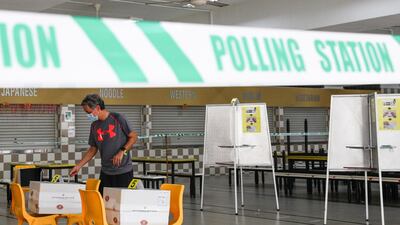
A voter casts his ballot at at the Chung Cheng High School polling centre in Singapore on Friday. Wearing masks and plastic gloves, Singaporeans began voting in a general election that is expected to return Prime Minister Lee Hsien Loong's long-governing party to power. AP Photo -

Singapore's Prime Minister Lee Hsien Loong arrives at a People's Action Party branch office, as ballots are counted during the general election, in Singapore on Friday. Reuters -
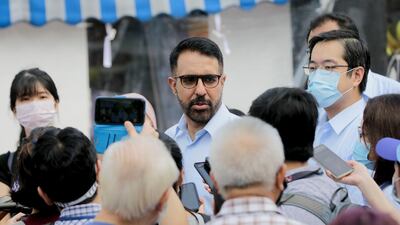
Opposition Worker's Party secretary-general Pritam Singh surrounded by members of the media during a campaign walkabout ahead of the general elections in Singapore last week. EPA -
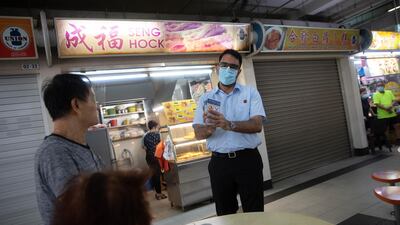
Pritam Singh, right, speaks to residents during his election campaign. EPA -
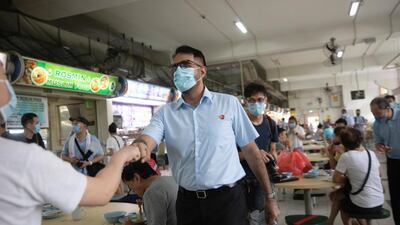
Pritam Singh fist bumps a resident during his election campaign. EPA -
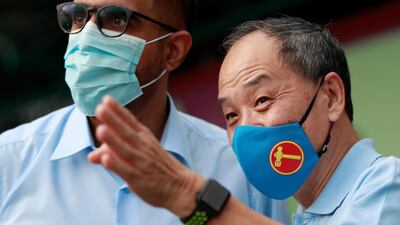
Pritam Singh, who took over the party's reins from Low Thia Khiang, right, will be named opposition leader on the floor of Singapore's Parliament. EPA -
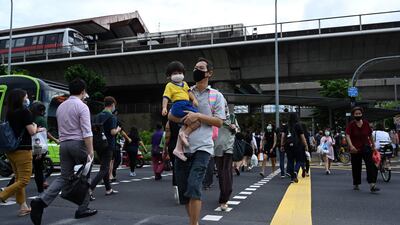
A man with a child crosses a street in Singapore this week. Singapore's Prime Minister Lee Hsien Loong called a general election "like no other" last week as the city-state struggles to recover from the coronavirus outbreak. AFP -
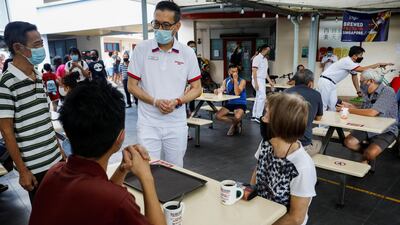
Raymond Lye and Ng Chee Meng of the People's Action Party (PAP) meet with residents during a walkabout ahead of the general election in Singapore on Sunday. Reuters -
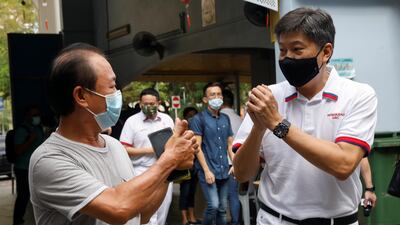
Ng Chee Meng of the PAP arrives for a walkabout ahead of the general election in Singapore on Sunday. Reuters -
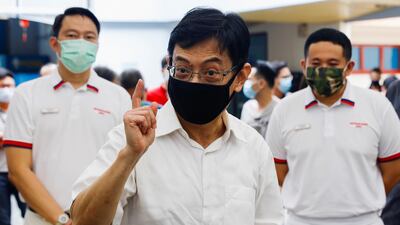
Heng Swee Keat of the PAP meets residents during a walkabout ahead of the general election in Singapore on Sunday. Reuters -
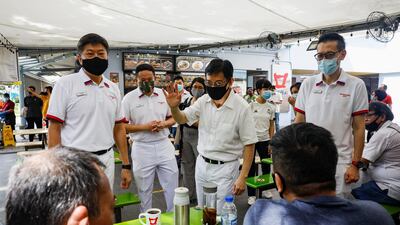
Ng Chee Meng, Heng Swee Keat and Raymond Lye of the PAP speak to residents during a walkabout ahead of the general election in Singapore on Sunday. Reuters -
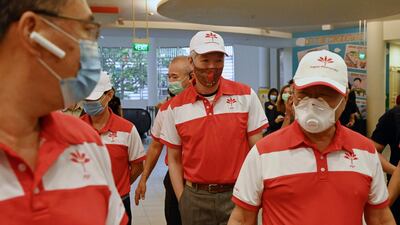
Lee Hsien Yang, brother of Singapore's Prime Minister Lee Hsien Loong, centre, arrives with Tan Cheng Bock, right, of the opposition Progress Singapore Party (PSP) at the Tiong Bahru Market for an event ahead of elections in Singapore on Sunday. AFP -
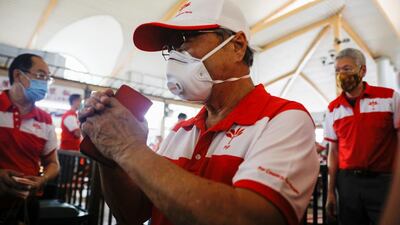
Tan Cheng Bock and Lee Hsien Yang of the PSP greet people during a walkabout ahead of the general election in Singapore on Sunday. Reuters -
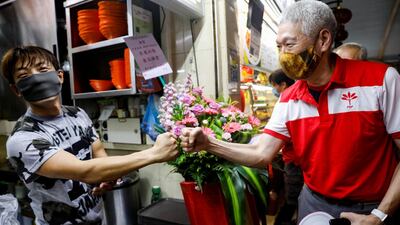
Lee Hsien Yang of the PSP greets a hawker during a walkabout ahead of the general election in Singapore on Sunday. Reuters -
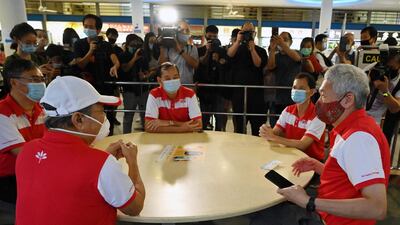
Lee Hsien Yang, right, chats with Tan Cheng Bock, left, at the Tiong Bahru Market in Singapore on Sunday. AFP -

Lee Hsien Yang, left, shows his membership card after been given it by Tan Cheng Bock, right, of the PSP at the Tiong Bahru Market in Singapore on Sunday. AFP -
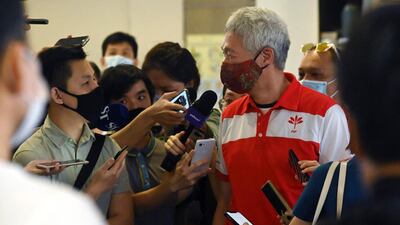
Lee Hsien Yang, talks to the media after been presented a membership with opposition PSP at the Tiong Bahru Market in Singapore on Sunday. AFP -
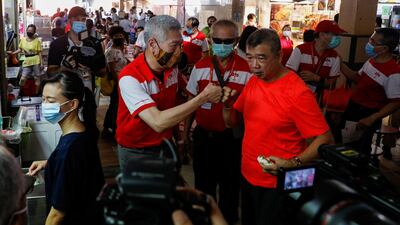
Lee Hsien Yang of the PSP greets people during a walkabout ahead of the general election in Singapore on Sunday. Reuters -

A PSP volunteer hands out leaflets at a food centre ahead of the general election in Singapore on Sunday. Reuters -

Lee Hsien Yang of the PSP attends a walkabout ahead of the general election in Singapore on Sunday. Reuters


Adding further intrigue to the battle of the Lees is the fact that the Prime Minister's brother has joined a party led by the popular Tan Cheng Bock; Dr Tan is a former PAP Member of Parliament who, in recent years, has become the government's most high-profile critic and a proponent for greater parity and accountability in national politics. The question worth asking is whether this joining of forces is the outcome of fissures among the political elite, which has over decades stood firmly behind the Lee family.
Time will tell, of course, but probably not in 2020.
The fact that the Prime Minister has called an early election – with a year left in his current term – reveals his quiet confidence in navigating choppy political waters. Unsurprisingly, he has sought to remind voters of the far choppier waters ahead, given the state of the global economy, and for the need for a steady hand at the wheel.
Singapore’s government has already won praise around the world for the steps it has taken to deal with the Covid-19 outbreak. The Prime Minister will also point to its announcement of a stimulus package equivalent of 20 per cent of GDP to deal with pandemic-related job losses. The fact that such a stimulus could be passed without making a serious dent on Singapore’s financial reserves, Mr Lee would justifiably say, is the result of the best practices, including fiscal discipline, adopted by successive PAP governments over five decades.

Regarding the larger questions being asked about Singapore's continued survival in a world in flux, the country's fundamentals remain strong. It has for some time been a hub for key industries, including bio-sciences, pharmaceuticals, robotics and semi-conductors. The Financial Times recently reported that multi-billion-dollar hedge funds and private equity firms from Asia, Europe and the US are poised to move assets there.
Most importantly, Prime Minister Lee will point out, it is the country’s political stability that has helped it to deal with many challenges in the past, including the oil shocks of the 1970s, the Asian financial crisis of the 1990s and the Great Recession of the 2000s.
It is this desire for stability, and the mindfulness of being a mere “red dot", that is likely to drive a majority of Singaporeans to vote for the PAP next month. Just how much of that vote shifts to the opposition in subsequent elections will depend on future global trends, but also on what Singaporeans want from their government beyond economic well-being.
Chitrabhanu Kadalayil is an assistant comment editor at The National

