


If the world is looking for a pivot-point to propel its recovery from the Covid-19 pandemic, participants in the Group of Seven summit in the UK must hope this weekend will provide it.
On the opening night in Cornwall on Friday, US President Joe Biden held the elite set of leaders in his thrall, according to one participant. The setting was the Eden Project, a large man-made rainforest – a symbolic place where Mr Biden addressed the threats of climate change. The pandemic has changed many things, but Mr Biden's discussion of the issue was in the tone of a father to an extended family. His words made "the hairs raise" on the back of the neck for some attendees.
Cornwall, as the venue for the G7 meeting, lends itself to epic thinking. “Is this Land's End?” asked Mario Draghi, the Italian Prime Minister, as he exchanged small talk with his British counterpart, Boris Johnson, at the family photo. While there is a nearby landmark with just that name, an alternative, cataclysmic interpretation of the remark seems appropriate.
The test set by Covid-19 has saturated this G7. The group is determined to show that it still holds the ring of the global economic and political landscape.
Under Mr Johnson's leadership, this year's G7 is looking for a new departure. Timing is on the British leader's side. He has not only brought the group to Cornwall to show that Global Britain can be a real force in the world, but the US is also asserting itself under its new leader.
Mr Biden has set out to put flesh on the bones of his international pledge that "America is back". While departing for the UK, he said he wanted the countries present to show they were “tight” with America.
Mr Biden is delivering the gift of physical presence to the summit, stressing the need for multilateralism after the go-it-alone isolationist approach of the previous president, Donald Trump.
The Biden team is on an eight-day trip to Europe, culminating in a showdown with Russian President Vladimir Putin in Geneva on Wednesday. A week is a long time for the leader of the US and this one is an investment for the rest of the presidency. The question is whether or not the rest of us will gain a future dividend from this weekend of discussions.
By seizing on the urgency of the pandemic, the G7 can hope to trail-blaze the global recovery. The hosts are hoping that by defining the themes of the recovery, the group overcomes its relative historic slide in importance. With clarity of leadership, there is an opening for the western countries and Japan to show the rest of the world that they are a vital forum for recovery.
This is why G7 is setting a new standard on vaccine distribution. Up to one billion doses will be made available. The global need is probably somewhere nearer seven billion doses but the summiteers hope their announcement represents a good start.
The meeting is addressing what both Mr Biden and Mr Johnson call the "build back better" agenda. There is a new push on development finance, in effect to push stimulus wider and longer from the richest economies to the developing and middle-income countries. The last big theme for the meeting, of course, is the climate agenda.
In all three areas, the real question is if the G7 can tee up transformative change to be delivered before the end of 2021.
The declaration, when it comes later on Sunday, will have relatively little to say on the traditional pillars of G7 foreign and security policy. In those terms, strands such as the Middle East Peace Process have been effectively eclipsed from the agenda. Clearly, the pandemic has set a new baseline for diplomacy while the climate agenda is now firmly rooted at the heart of global politics.
Communiques are a work of politics and Mr Biden wants to ensure that poorer countries can see a big offer from the rich. The failures of the post-2008 approach to recovery from the global financial crisis have been felt in domestic politics in his country and around the world. The current crisis is, therefore, an opportunity for a policy reset – as if to say austerity is a sin, not a virtue.
The group isn't on the same page on one particular issue, though.
The White House briefings on the fringes of the summit make clear how much they want to draw a recovery contrast with China. But for some of the participants, this is a divisive message. German Chancellor Angela Merkel has said that keeping channels open with Beijing is key to the global recovery. French President Emmanuel Macron is also not interested in falling in line, although he has sought to show that he is broadly on board with Mr Biden.

Using the reserves of the global institutions, where G7 countries hold many of the voting rights, Washington wants to make $100 billion available to recovery programmes. That is not only helping out with vaccine rollout but also backing new infrastructure with an emphasis on addressing climate challenges.
The US agenda is to “enable greener, more robust economic recoveries in vulnerable countries, and promote a more balanced, sustained, and inclusive global recovery”.
With the initiative to set a global minimum corporate tax, the G7 has sought to provide revenue streams to pay for the pandemic deficits. It will also provide words that marry this vision to its efforts to involve business and the private sector in the climate drive.
This is a summit with an unabashedly retro ideal of asserting the West and Japan. Given the stakes, it is a last chance to prove that the group can mobilise the resources to match its words.
Damien McElroy is the London bureau chief at The National
-
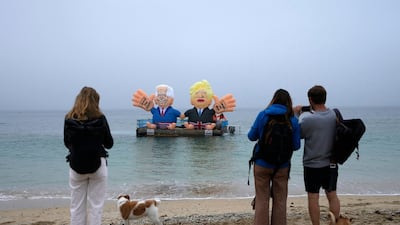
People watch from the beach as two giant balloons, depicting US President Joe Biden and British Prime Minister Boris Johnson, float on a dock in the harbour of Falmouth, Cornwall. AP Photo -

Freshly baked G7 Cornish pasties are placed in the window of a pastry shop in St Ives. AFP -

Climate activists dress in blue costumes as they demonstrate in St. Ives. AP Photo -

Protesters dressed as Pikachu characters demonstrate on Gyllyngvase Beach, calling on the Japanese government to stop burning coal by 2030, in Falmouth. Getty Images -

Members of the public visit the 'Mount Recyclemore' sculpture depicting G7 leaders at Sandy Acres, St Ives. EPA -
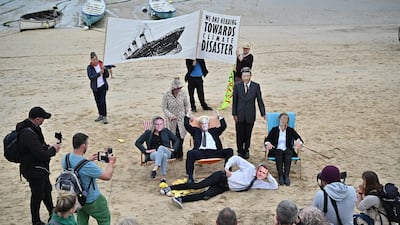
Extinction Rebellion protesters stage a "Stop Rearranging the Deckchairs" Titanic theatrical beach action in St Ives. Getty Images -
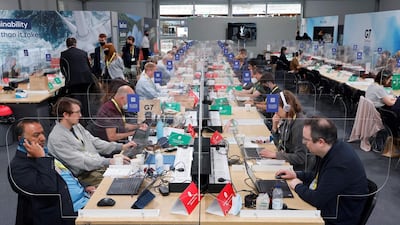
Members of the media work at desks screened-off due to Covid-19, in the media centre at Falmouth, Cornwall. AFP -
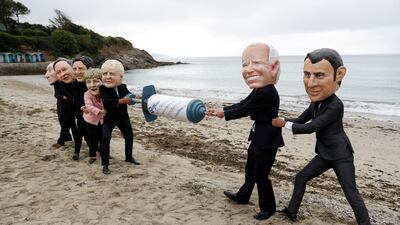
Oxfam activists with 'Big Head' caricatures of G7 leaders, during a protest at a beach near Falmouth. Reuters -
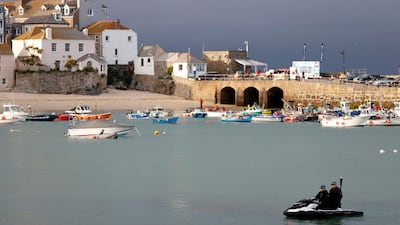
Officers from Britain's Metropolitan Police force sit on their jet ski as they patrol on the sea in St Ives. AFP -

Extinction Rebellion activists stage a "Wake-up Call" theatrical action in St Ives. Getty Images -
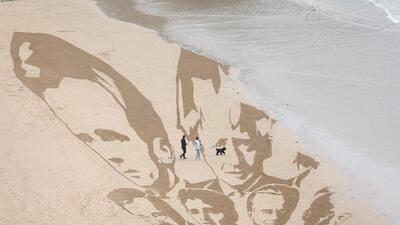
An incoming tide washes away a part of a giant beach sand artwork depicting the faces of the G7 leaders at Watergate Bay Beach, Newquay. Reuters -
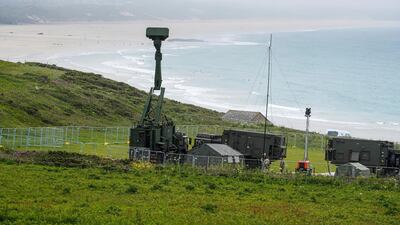
An RAF Giraffe Agile Multi Beam Radar looks down on Gwithian Bay from its location in a car park near St Ives, England. The radar is a coastal surveillance and tracking radar which can monitor air targets and warn against incoming rocket, artillery and mortar rounds. Getty Images -

The motorcade of President Joe Biden is driven through Carbis Bay, Cornwall. AFP -

A caricature of Boris Johnson is pictured between the handle bars of a motorbike in Carbis Bay. AFP -
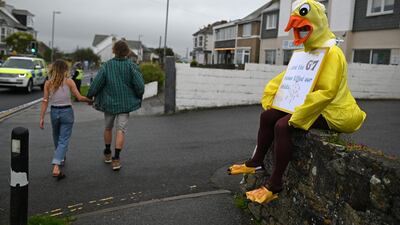
A local resident dressed as a chick, protests against the G7 summit in St Ives. AFP -
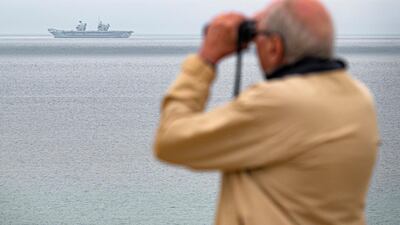
HMS The Prince of Wales aircraft carrier patrolling the waters off of St Ives. EPA -
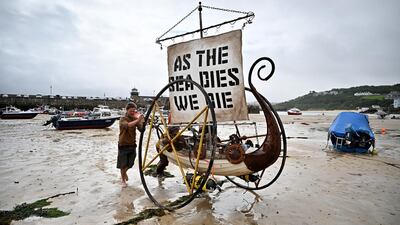
Extinction Rebellion stage a protest on the beach of St Ives. Getty Images



