

In recent times, there have been doubts about the true extent of progress made by various sectors despite globalisation and the emergence of the Fourth Industrial Revolution.
Let us take the example of the education sector. There is evidence to suggest that the classrooms of today are not vastly different from those that were in use a century ago, even in the most advanced countries. Given that this sector works on the basis of information-sharing and the encouragement of innovations and inventions to meet the demands of societies, setbacks to it in the wake of the coronavirus pandemic are likely to impact other sectors and society as a whole.
Meanwhile, we have seen first-hand the consequences of neglecting the healthcare sector in policy-making despite the continuous progress made in the various fields of scientific research. For far too long, the public has been preoccupied with accumulating material wealth and comforts while essentially sidelining necessities, such as the right to life and health care. The misplaced priorities seem to have exacerbated the ongoing global health crisis.
-
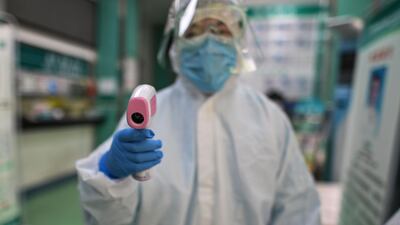
A medical worker prepares to check the temperature of an AFP photojournalist before a COVID-19 coronavirus test in Wuhan in China's central Hubei province. AFP -
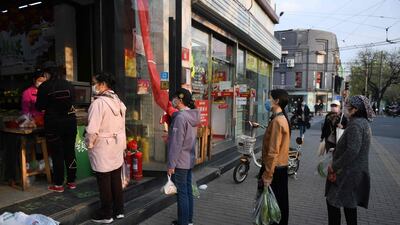
People queue up outside a fruit shop in Beijing. AFP -
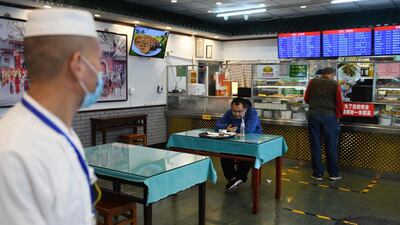
A man eats in a restaurant that has only one seat per table and markings on the floor to enforce social distancing in Beijing. AFP -
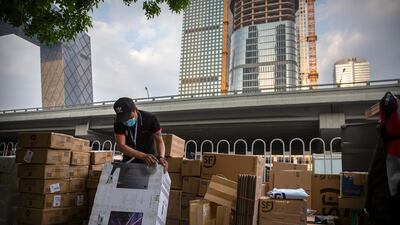
A delivery courier tapes a package along a road in the central business district in Beijing. AP Photo -
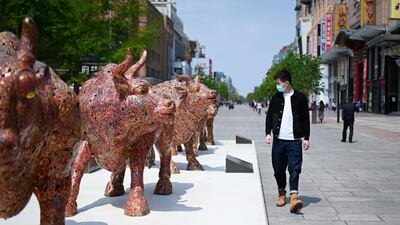
A man walks past bronze bull statues along a business street in Beijing. AFP -
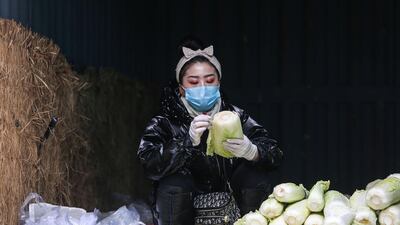
A vendor waits for customers at a market in Shenyang in China's northeastern Liaoning province. AFP -
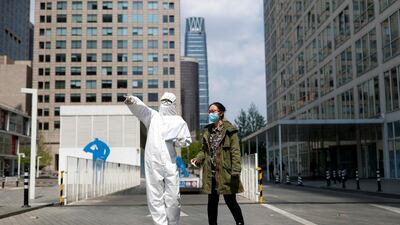
A security guard in Personal Protective Equipment suit gives directions to a passerby during lunch hour in Beijing's Central Business District. Reuters -
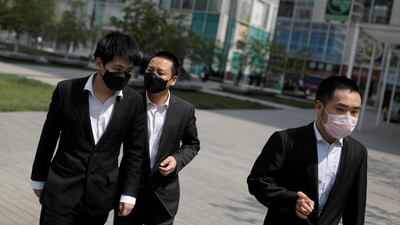
Office workers wear protective during lunch hour near Beijing’s Central Business District. Reuters -

Office workers wearing protective masks walk in a park as people practice boxing during lunch hour near Beijing's Central Business District. Reuters -
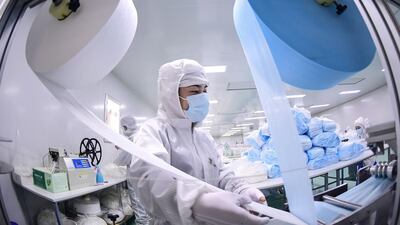
A worker produces face masks at a factory in Shenyang in China's northeastern Liaoning province. AFP


At the core of it, this crisis is directly linked to the issue of food security in China; it is simplistic to suggest that the outbreak and its fallout are just outcomes of Chinese tradition. After all, meeting the food demands of more than 1.4 billion people requires a whole new level of production. And overpopulation and economic growth (which relies on population growth) have both played a key role in shaping the complex world we live in today, along with all its challenges.
The issue is that despite our inter-connectedness, new trends and technologies that are the outcome of globalisation and the Fourth Industrial Revolution have yet proved incapable of dealing with the challenges we grapple with. Inefficient management and therefore ineffective utilisation of these technologies have narrowed the scope of their true advancements in times of crises.
For instance, there have been increasing concerns lately that the production of technology companies has exceeded demand to the extent that this could lead to a global economic crisis.
However, the fact remains that cutting-edge technologies are available to offer solutions to such things as food security, education, health care and employment preparedness. And regardless of current market trends, the basics of bridging the gap between supply and demand remain the same: good marketing, consumers’ awareness of their own needs, the ability of merchants to diversify and adapt quickly to market volatility and the accurate targeting of consumer segments.
In short, it boils down to preparedness.
Managing a crisis similar to the one we face today depends on the resilience and agility of the economic ecosystem to transform itself in order to overcome hurdles. In this context, commercial ventures assume great significance given that they are responsible for production and marketing.
Agile enterprises possess a flexible structure that enables the easy flow of information and direct collaboration among employees – regardless of their job functions and titles – to utilise opportunities as and when they emerge. In an evolving world, commercial ventures need to increasingly adopt this model to integrate sudden changes.

A pertinent question to ask is why individuals and commercial ventures would choose to limit themselves to one area of specialisation. Why would people grow their skills within a given specialisation or sector only to find themselves made redundant when demand within that sector falls and new market trends emerge? Why not consider acquiring multiple skills and engaging in freelance work? Such awareness and training should be equally the responsibility of individuals as of institutions, both public and private.
As the world continues to weather the storm that the pandemic has wrought, some sectors are witnessing massive demand while the reverse is true for others that are laying off their workers. This problem could have been avoided had workers and commercial ventures been enabled to explore and diversify into new areas.
To be sure, there are some promising developments under way. The UAE, for example, has allowed taxi drivers to deliver online orders, including groceries, to residents following a decline in demand for ferrying people due to the quarantine measures that were put in place. We must work on similar mechanisms to make other sectors of the economy more flexible and resilient.
The steps taken by the global economy have sometimes been found wanting, making the optimal utilisation of innovations difficult to achieve. There is a need, therefore, for workers and institutions alike to become more flexible and agile – because bureaucratic and conventional thinking are simply not enough in today’s world.
Mohammed Alardhi is executive chairman of Investcorp, chairman of Bank Sohar and was longest-serving native head of the Royal Air Force of Oman

