
Trade agreements are powerful tools for economic growth. By enhancing the competitiveness of exports, a nation can drive productivity, catalyse innovation and expand critical or emerging sectors. This is why the UAE moved to connect our ecosystem to the world’s most important economies in 2021 – and why we continue to explore closer ties with high-growth markets around the world.
Increasingly, though, we understand that the real value of a trade deal emerges through unlocking the growth potential of foreign direct investment and private-sector partnerships that follow in its wake. Our Comprehensive Economic Partnership Agreement programme, which has facilitated record flows of resources, merchandise and services to 40 nations on six continents, is now evolving to translate access into sustained, long-term mutual benefit.
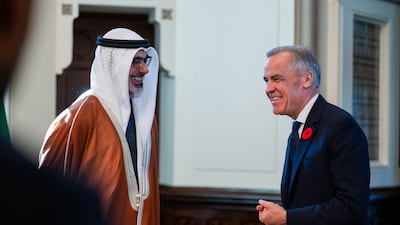
The Cepa with Canada, which we signed this week, is a key milestone in this process. More than just another addition to our trade network, this deal embodies our wholly integrated approach to economic partnerships, one in which trade policy, investment and business engagement work in parallel. Removing trade barriers isn’t the goal, it’s the first step in building and scaling economic opportunity.
Every export requires infrastructure. Before a shipment reaches its customer, it will rely on warehouses, freight corridors, port terminals and local supplier networks. Investment in these assets strengthens the competitiveness of entire business ecosystems, creating opportunities for a broad range of companies. This is where trade policy and strategic investment work together.
Importantly, it also means recognising that a manufacturer may now have access to a new market but can’t leverage it without the distribution network required to serve it efficiently. It means understanding that an entrepreneur may identify demand but lacks the financing, local expertise or strategic partners to realise the opportunity.
We have seen this in action in India. Following the signing of our Cepa, in 2022, DP World pledged $5 billion to strengthen its integrated supply-chain network, a commitment that built on the $3 billion it had already invested across three decades. The stated objectives include lowering logistics costs, supporting local manufacturing and expanding access to global markets. This investment is designed to improve connectivity, increase efficiency and support industrial growth. Its benefits extend far beyond any single project.
While commercial relationships can – and often do – predate trade agreements, our Cepa programme has delivered the confidence, certainty and regulatory harmony that encourage businesses to pursue larger ambitions and form deeper partnerships. In India, our private sector is now accelerating its investments in integrated food production, logistics networks and energy production because they see how our Cepa has secured bilateral trust and opportunity. This isn’t a by-product, it’s the objective.
Our deal with Canada will provide another real-life case study. The forthcoming Cepa will add impetus to the investment framework that has committed $50 billion in capital to sectors such as energy, artificial intelligence, logistics and mining by delivering the complementary foundations for trade, investment and industrial co-operation.
The task of the Ministry of Foreign Trade has shifted in parallel. Signing a trade deal is simply the first, albeit important step in the process; the real work is to coalesce other ministries, institutions, sovereign wealth funds and the investment community to ensure these frameworks translate into commercial outcomes. That means identifying opportunities early and approaching implementation with a clear focus on growth from the very beginning.

The ministry’s work post-signing must be fully focused on connecting businesses whose capabilities, capital and expertise can support new projects, new investments and new sources of growth. When trade, investment and business engagement reinforce one another, economic relationships gain momentum: commercial success encourages further investment; new investment expands productive capacity; and these opportunities attract new participants and deepen co-operation.
The greatest potential of this approach, however, extends beyond any single bilateral relationship. Every new partnership should strengthen not only the relationship between the UAE and a specific country, but also the value of the wider network available to businesses operating within it. A Canadian technology company could work alongside a UAE investor and an industrial partner in another Cepa market. An entrepreneur may use the UAE as a base from which to develop partnerships across several regions. These outcomes are not automatic. They require commercial judgment, investment and compliance with the regulations of each market. Yet they illustrate the scale of the opportunity before us.
The UAE has long been recognised as a gateway to regional and global markets. Our ambition today is broader. We aim to be a platform where businesses can grow, invest, innovate and build partnerships that extend across a number of markets.
Ultimately, by combining open trade with targeted investment and stronger commercial connections, we can ensure our partnerships deliver sustainable growth and shared prosperity for many years to come. In doing so, we can redefine what globalisation means – and what it can deliver. Our Cepa with Canada is another opportunity to demonstrate it.

