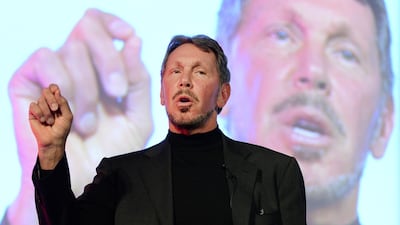

The widespread roll-out of artificial intelligence will eventually lead to universal income and will make "everyone wealthier", the executive chairman and chief technology officer of Oracle said on Tuesday.
The ubiquitous use of robots across different industries and sectors will enable people to be more productive, Larry Ellison said in a wide-ranging discussion at the Oracle AI World event in Las Vegas.
"We decided to get better tools, and we're going to build better systems ... The tools make people much better, makes us much more productive," he said.
Highlighting examples of robotic surgeons and autopilot on planes, Mr Ellison said the tech will replace some jobs but also reduce costs.
With the government taxing "everything we produce ... we need to change from taxing human labour to taxing value-added tax returns", he said. "A lot of companies have value-added tax. So when the robots add value, all the value that the robots add is cash, and we can have universal product income."
While it will take more than a decade to come about, "eventually, robots will do more and more work that we don't want to do - but they're adding value".
"We are on track [to get] healthier and wealthier because of AI - and with the right taxation systems and the right computer systems - all of that is critical," Mr Ellison said.
While the concept of AI eventually creating a system of universal income has been touted in the past, it has not gained universal acceptance.
In a report in May, the International Labour Organisation stressed that universal basic income funded by the government is not the answer to the impact of AI on the labour market.
The report by the UN body disputed claims by tech chief executives that AI will devastate labour markets catastrophically and that the productivity gains it generates will make such transfers noninflationary.
"Both claims are empirically weak, and the second does not follow from the first even if the first were true," it said.
For universal basic income to work, AI needs to expand supply in the sectors in which people will spend the new income, it said. The composition of productivity gains "does not support this".
"The state can increase the number printed on every cheque. Whether the goods and services that determine real welfare, housing, health, quality food, care, are available in sufficient quantity at stable prices depends on supply-side conditions that AI improves only partially and unevenly," the report added.
Cancer cure
The impact of AI on the healthcare sector in particular is expected to be extremely significant, Mr Ellison said.
"AI's great gift to the world will be ... [that] most cancers will be gone in five years, and certainly 10 years," he said. And cures won't be only for the very wealthy.
An increase in the number of clinical trials and the quicker development of drugs supported by AI will make them reach markets faster, he explained
"We think drug discovery is going to go through a golden age. But that's only half the problem. You get the drugs. You next have to get the drugs where you distribute them in such volume that the prices come down," Mr Ellison added.
Some of the current innovations on the healthcare side also enable earlier diagnoses.
For instance, with an "AI-enabled metagenomic test, we can do a much better job of diagnosing and catching sepsis early before it kills you very fast in the hospital", he said.
DNA tests will also help providers detect cancer early on, while also distinguishing any false positives to ensure early treatment and better therapeutic care.
When the quality of care goes up globally, "the overall cost per patient goes down dramatically", he added.