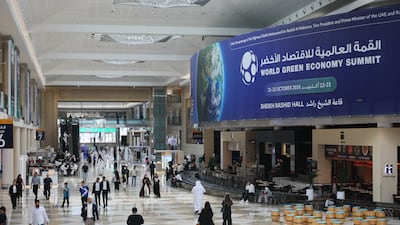
Artificial intelligence was the main topic of conversation for almost everyone on day two of Dubai’s Water, Energy, Technology and Environment Exhibition (WETEX), which is taking place this week at Dubai World Trade Centre. Ask whether AI belongs at a green energy event, and almost everyone agrees that while it currently consumes too much water and drives up electricity demand, the answer is not to stop using it, but to keep pursuing new solutions AI itself can help generate.
The more interesting question – the one that companies from Lucy Electric to PwC Middle East and Thermax Limited were all working on – is what AI looks like when it is designed specifically to make the energy and water system work better rather than harder.
The central challenges surfacing at WETEX are the speed of AI deployment and the pace at which energy infrastructure can be built to support it.
The human in the loop
Wissam Mahfouz, partner for technology consulting at PwC Middle East, spent his morning leading a roundtable on resilience asset management that brought together representatives from the Dubai Electricity and Water Authority (DEWA), Abu Dhabi's Emirates Water and Electricity Company (EWEC), TAQA, Siemens and Hitachi. The session, he said, produced the kind of conversation that the day-to-day professional world rarely allows.
"Usually in day-to-day life, we don't have that opportunity to bring them all together," he said. One point raised by DEWA stood out: "Let's work all into partnership together to find the right solution."

Mr Mahfouz believes AI enhances humans. "If, as a consultant, a year ago, before AI, I was to do an analysis, it would have taken me one week, two weeks to run the analysis, come up with the report. Today, with certain models, I can do that analysis with the help of AI in two hours, three hours. It didn't replace me. I'm still there."
The technology will improve on its own terms, he added. "Technology always accelerates through adoption. Today AI consumes a lot of energy and water. But in two or three years down the road, it will be more efficient." Particularly with the UAE's plans to feed data centres through solar power, he said.
Predicting failure before it happens
At Lucy Electric's stand, general manager Charbel Zouein was explaining a system called Synapse to a steady stream of utility visitors. The platform monitors underground power cables. "Through machine learning and digital twin simulation it mirrors what the hardware is going through," Mr Zouein said, "and lets a company like DEWA know that there's a 90 per cent chance in the next two weeks this cable will fail – so go do preventive maintenance rather than let it fail and you run for an unplanned shutdown."
The company is also using WETEX to showcase its next-generation switchgear range – compact medium-voltage distribution units using a proprietary atmospheric gas instead of sulphur hexafluoride (SF6), whose global warming potential is several thousand times greater than carbon dioxide. "The new technology has zero risk of causing global warming because of accidental leakage," Mr Zouein said.
The case for inevitable progress
Ashish Bhandari, managing director and chief executive of Thermax Limited, arrived at WETEX with a broader brief. The company operates across clean energy, clean water and air pollution control. "When we talk about the Middle East right now, we're talking about resources, stability, energy conservation, resource availability,” Mr Bhandari told The National. “At the heart of it are two things, which are energy and water. And this event, in a way, is central to both of those dialogues."

Thermax is showcasing its Edge Live platform – a digital solution using machine learning and AI to help customers extract more performance from existing assets in energy, water and air pollution infrastructure. But the detail that drew most interest from visitors, Mr Bhandari said, was a newer application in desalination.
Standard desalination produces clean permeate and the brine reject pumped back to sea. Thermax's argument is that the reject stream contains commercially valuable salts that can be recovered and sold to chemical industries. "We are making a case that you should do advanced processing of desalination rejects," Mr Bhandari said. "Recover the salts and start to use it in chemical industries."
On the broader AI debate, Mr Bhandari said, “Progress is something you can't stop. Just the way you can't say stop driving cars or stop using air conditioning – AI is not something that we can stop. It's the nature of human progress."
The more useful question, he argued, is how to make AI less resource-intensive. "Investment in AI will happen. You just have to make sure that it happens in a way that you are hurting the environment in the least way possible."
The infrastructure question
The companies building the physical layer beneath the AI economy were making the same point. Chris Ren, chairman of Sunten Electric Equipment Co, which supplies transformers to DEWA, said AI has entered the product development roadmaps of almost every major manufacturer. Siemens, he noted, has integrated AI into automation systems to the point of cutting labour requirements by roughly half in some applications. "That's very impressive," he said.
Sunten is investing in research and development focused on transformers designed specifically for AI data centre requirements. “It's the future. AI is coming. We have to face it," he said. The clean energy alignment, for him, is structural: data centres can sit anywhere, while renewable energy is often generated away from urban centres, so putting the two together makes geographic sense. "Clean energy is a 100 per cent match with AI. AI needs power, and clean energy.”
Chirag Patel, managing partner and director at Emirates Transformer & Switchgear, which has supplied DEWA and regional utilities for more than 40 years and is now expanding into data centres and renewable energy, described the exhibition as the place where long-term investment strategy gets tested against customer reality. "Customers actually drive the direction we need to go," he said. "We invest for the long run."
Investing in the long run is what each of these companies is doing, through the Synapse system, the new switchgear, the salt-recovery desalination unit, the AI data centre transformer. Each is a response to a demand of the future.
As Mr Mahfouz put it: "We're focusing on AI as a negative, but there are lots of positives in terms of decarbonisation, clean energy targets to reduce emissions. And if people can take that away from the various companies that are here, it will be good."
This page was produced by The National in partnership with WETEX and WGES.

