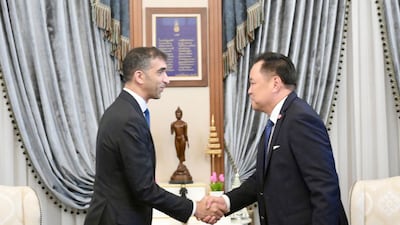
The UAE and Thailand have concluded negotiations for their Comprehensive Economic Partnership Agreement, which is expected to remove trade barriers and boost bilateral relations.
The countries began talks on the deal in 2023 and launched a joint business council the same year.
As part of the negotiations, they discussed avenues to enhance trade, investment and opportunities to expand co-operation, the ministry of Foreign Trade said in a statement on Thursday.

In the coming phase, the UAE and Thailand will finalise the legal and technical procedures required for the agreement to be signed and implemented, it said.
The Cepa is expected to accelerate trade flows, unlock new investment opportunities and strengthen private sector co-operation in priority sectors, including advanced manufacturing, logistics, food security, digital trade, renewable energy and precious metals.
“The conclusion of negotiations … embodies our shared commitment to building stronger economic bridges between South-East Asia and the Middle East,” said Minister of Foreign Trade Dr Thani Al Zeyoudi
“Thailand is one of the most dynamic and diversified economies in the region, and this agreement will open new avenues for companies, investors and entrepreneurs in both countries to expand and access high-growth markets.”
The Cepa builds on strong ties between the UAE and Thailand. Bilateral non-oil trade in the first half of 2026 jumped by more than 75 per cent year-on-year to $10.2 billion. Trade last year also grew more than 65 per cent to $12.3 billion.
The UAE's key non-oil exports to Thailand include gold, aluminium and other industrial goods.
“These figures reflect the growing integration of the two economies and the scale of opportunity the agreement can unlock,” the ministry said.
“By reducing trade barriers, enhancing market access and stimulating investment flows, the Cepa will support our long-term economic objectives and generate new opportunities across a wide range of strategic sectors,” Dr Al Zeyoudi added.
The UAE has signed 38 Cepas with trading partners as it seeks to boost investment ties, expand its non-oil economic base and broaden exports. The Cepa programme is a key pillar of the UAE's foreign trade agenda, which aims to increase non-oil foreign trade to Dh4 trillion ($1.1 trillion) by 2031.