

“Not our war” seems to be the British government catch-phrase for the Iran war. Where that leaves King Charles III as he visits the US in a week’s time is in an impossible situation.
King Charles has decades of experience straddling diplomatic awkwardness, but this visit is one for the dustbin of history. There is little sense, for example, that the British monarch will exercise some persuasion on US President Donald Trump, who is caught in a cycle of escalation with Iran. The ceasefire that currently allows for a diplomatic process through Islamabad is hanging by a thread.
King Charles and Queen Camilla could be on their way to the US with events spiralling rather than calming down. It is not the usual backdrop for a royal trip. Some commentary might even remark on the irony of the visit, which is designed to mark the 250th anniversary of American independence. That independence was wrought from Britain after US settlers revolted against the Crown’s habit of imposing taxes to pay for European wars.

As the country that did so much to establish the American nation, the UK is rightly keen to show its involvement in the anniversary as a gesture of shared goodwill. King Charles will become the second British monarch to address a joint gathering of the US Congress, after his mother spoke in the Capitol in 1991.
Following that grand occasion, the royal couple will travel to the White House for a state dinner. Mr Trump has good reason to bask in the ceremonial niceties that stem from hosting the British royals. It is known that he has been buoyed by two state visits to the UK and the attention of the royals. Indeed, he has known King Charles for years, and the monarch appears to be able to handle the Trump personal relationship well.
After that, the royals will undertake some engagements that will lay down important markers of the US-UK partnership in recent decades. Even though London has officially skipped the current US war effort, it has not been immune from its spillover. Alongside French President Emmanuel Macron, UK Prime Minister Keir Starmer has sought to build an international maritime coalition that would ensure safe passage for vessels through the Strait of Hormuz once the hostilities have ceased – and now presumably when the US blockade ends.
Mr Trump has angrily lashed out at Mr Starmer’s government for refusing to allow its bombers to use the Diego Garcia airbase at the outset of the war last month. He has doubled down on his criticism by describing the UK’s decision to agree a leaseback on Diego Garcia as an act of “great stupidity”. This is not the language of normal diplomacy that precedes a state visit.
To keep an even keel to the itinerary undertaken by the royals, the planners have looked to cultural and military underpinnings of the time-honoured “US-UK special relationship”. This is despite the fact that, when Mr Trump was asked about it by a reporter last week, his first response was: “What’s that?” After the state banquet, the royals will lay a wreath in Washington to mark the military relationship between the two countries.
Then off to New York City, where the King and Queen’s engagements will not only visit modern ties across the Atlantic but also recognise later this year the 25th anniversary of the 9/11 attacks. The couple will commemorate those who lost their lives in the terror attacks on the city and meet serving first responders and the families of victims.
A visit to a grassroots community organisation “working to mentor children and young people affected by food insecurity through a sustainable urban farming after-school initiative” seems more in tune with New York Mayor Zohran Mamdani than Mr Trump.
-
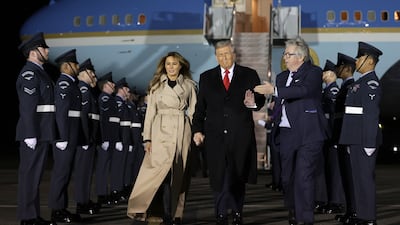
US President Donald Trump and first lady Melania Trump leave presidential flight Air Force One after arriving at Stansted Airport outside London for a state visit to the UK. Getty Images -

A helicopter of the US presidential flight arrives at Windsor Castle in Berkshire during the state visit by President Donald Trump. Getty Images -
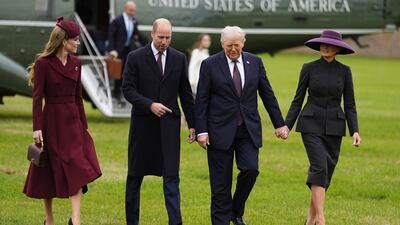
Prince William, Prince of Wales and heir to the British throne, and Kate, Princess of Wales, left, receive President Donald Trump and first lady Melania Trump at Windsor Castle. AP -
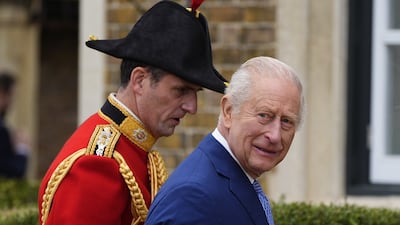
King Charles III, right, and an officer of the Sovereign's Escort at Windsor Castle, before the arrival of US President Donald Trump and first lady Melania Trump on September 17, 2025. Getty Images -
US President Donald Trump and first lady Melania Trump arrive for a state visit at Windsor Castle in Berkshire, England. Getty Images -

Prince William, Prince of Wales and heir to the British throne, and Kate, Princess of Wales, receive US President Donald Trump and first lady Melania Trump at Windsor Castle. PA -
Kate, Princess of Wales, Queen Camilla and US first lady Melania Trump at Windsor Castle. PA -
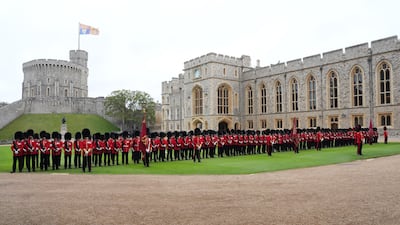
US President Donald Trump and first lady Melania Trump receive a ceremonial welcome at Windsor Castle during a state visit to the UK. Getty -
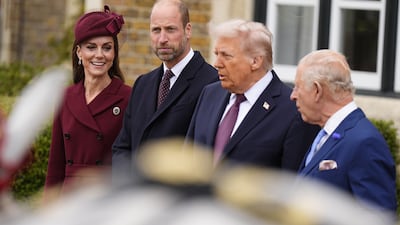
King Charles III, Prince William, Prince of Wales and heir to the British throne, and Kate, Princess of Wales, with US President Donald Trump at Windsor Castle. PA -
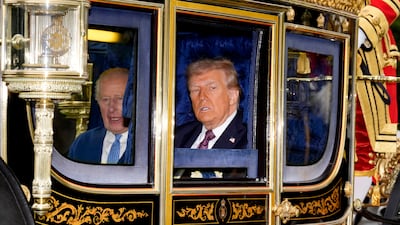
King Charles III and US President Donald Trump during the carriage procession to Windsor Castle, Berkshire. PA -
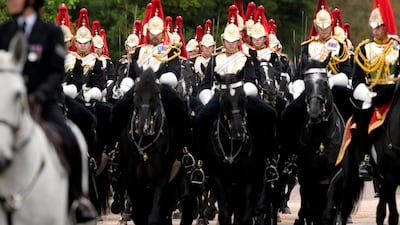
Members of the Household Cavalry Mounted Regiment at Windsor Castle before the arrival of US President Donald Trump and first lady Melania Trump on the first day of their second state visit to the UK. PA -
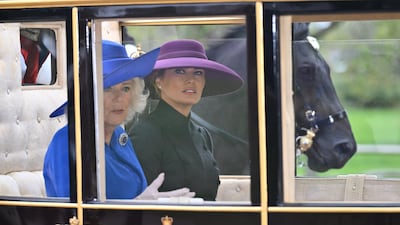
Queen Camilla and first lady Melania Trump during the carriage procession to Windsor Castle, Berkshire. PA -

A supporter of US President Trump outside Windsor Castle. EPA


Also on the agenda is a visit to the state of Virginia where the royals will meet its Appalachian communities, both at the heart of the settlement that created America and the grassroots of the Maga coalition that Mr Trump built to secure his presidency.
It is possible as royals to straddle many worlds. The British have a sure touch in putting together royal visits that are many-sided. And it was always known that the Trump presidency was going to be a roller-coaster for the US and the rest of the world. After his mother made a much-admired visit to the US to mark the 200th anniversary of the republic in the 1970s, it is known that King Charles felt it incumbent to do so again.
For all these reasons, it is sensible for people of goodwill to want to see a high-profile and smooth visit to the US by the British monarch next week. However, the Iran war means that it won’t be happening in an atmosphere of ordinary times, but instead set against a global backdrop of suffering and shortages. King Charles can’t ignore this context. His official remarks will be closely scrutinised for the royal attitude to the conflict and any division with Mr Trump.
It’s a high-wire act but also one that will make little difference to the course of the conflict in the Middle East.

