


Although Lebanon was not invited to the Sharm El Sheikh summit on October 13, Lebanese officials are watching closely how the end of the hostilities in Gaza progresses, as this may affect their own highly uncertain situation.
A clear sign of the link came on the same day as the summit, when Lebanese President Joseph Aoun told a group of journalists: “The general atmosphere today is one of settlements, therefore it is necessary to negotiate [with Israel]; as for the form of the negotiation, this will be determined at the [proper] time.”
A week later, the interim US envoy to Lebanon, Tom Barrack, appeared to support this view, when he tweeted: “The second leg [of Israel’s northern security framework] must be the disarmament of Hezbollah within Lebanon and the beginning of security and border discussions with Israel.” Without this, he warned, “Hezbollah’s military arm will inevitably face major confrontation with Israel at a moment of Israel’s strength and Iran-backed Hezbollah’s weakest point”.
Since the administration of former US president Joe Biden facilitated a ceasefire in Lebanon last November, the situation has been one of no war, no peace. To reach an agreement, the US gave Israel a side letter allowing it to strike against supposed Hezbollah threats. This effectively meant the ceasefire was imposed on one side. Meanwhile, the Lebanese authorities were urged to disarm Hezbollah, and in the absence of disarmament, the Israelis have continued to bomb Hezbollah and civilian sites in Lebanon as well as target the group’s members.
When Mr Barrack presented a timetable for Hezbollah’s demilitarisation in the summer, the Lebanese approved his plan and were hopeful this would lead to a curtailing of Israeli attacks. However, the envoy failed to secure Israeli buy-in for his plan, leading the Lebanese to declare it dead, though not their intention to enforce a state monopoly over weapons. Mr Barrack had no White House or State Department support in his talks with Israel, and he is soon expected to hand the Lebanon file over to someone else.
The US point-man on Lebanon policy will reportedly be the newly appointed ambassador in Beirut, Michel Issa. Mr Issa grew up in Lebanon and is close to US President Donald Trump. Lebanese media reports have suggested the Americans may be preparing a new plan for the country, one that complements the Barrack proposal and that is inspired by Mr Trump’s plan for Gaza.
Given that the Gaza and Lebanese situations are different, what would this mean? Some media reports suggest that the step-by-step mechanism inherent in the Gaza plan – in which the actions of one side lead to corresponding actions by the other – are part of it. They also point to the fact that the US plan appears to include the principle of direct negotiations between Lebanon and Israel, hence the importance of Mr Aoun’s and Mr Barrack's remarks.
The Lebanese are still adamant that even if Lebanon and Israel speak to each other, negotiations should take place through the Americans. In other words, officially at least, there has been no acceptance of direct negotiations, and it was noticeable that Mr Aoun was evasive on this matter. For the Lebanese, the October 2022 agreement over a maritime border is a good model to follow, as it involved indirect negotiations.
What would such negotiations cover? Certainly, they would seek to finalise the land border, with Lebanon and Israel still disagreeing over 13 points along the boundary. It would certainly also include security arrangements, with a high likelihood that Israel would seek an early warning capability inside Lebanon, perhaps even try to impose a Lebanese border zone empty of inhabitants.
The US assumption last year, advanced by the Biden administration’s envoy Amos Hochstein, was that delineating the land border would remove any excuse for Hezbollah to pursue its resistance in the south on the grounds that Israel was occupying parts of Lebanon. The Trump administration appears to agree with this approach.
-
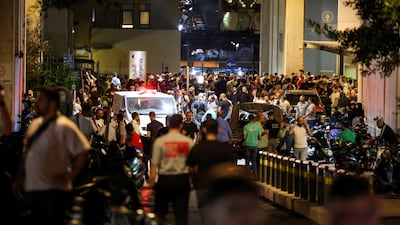
Panic at a Beirut hospital after thousands, including Hezbollah fighters and medics, were injured when the pagers they used to communicate exploded across Lebanon. Several people were killed. Reuters -
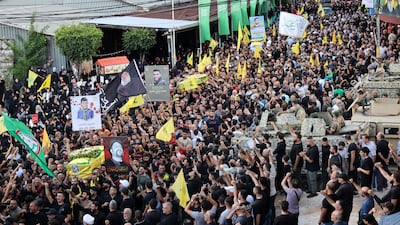
Mourners in Beirut's southern suburbs carry the coffins of people killed after hundreds of paging devices exploded, in a mass funeral on September 18, 2024. AFP -
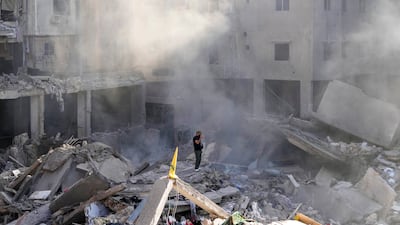
A man stands on the rubble of buildings near the site of the assassination of Hezbollah leader Hassan Nasrallah in Beirut's southern suburbs on September 29, 2024. AP -
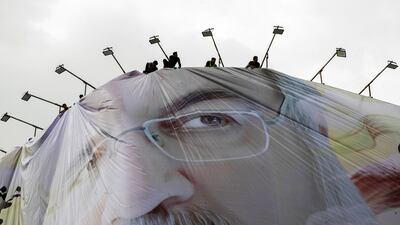
Workers drape a building in a vast banner depicting Nasrallah in Tehran, two days after his assassination by Israeli forces in Beirut. Getty Images -
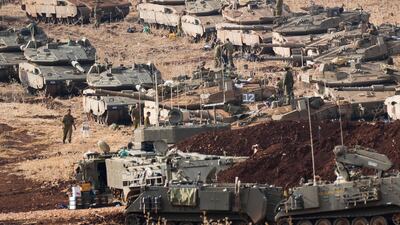
Israeli soldiers work on tanks at a staging post near the border with Lebanon on October 1, 2024. AP -

Israeli soldiers rest in an operation zone near Naqoura, southern Lebanon on October 13, 2024, after a ground invasion was launched. Getty Images -

People take cover by a roadside in Tel Aviv as a siren sounds after Iran fired a salvo of ballistic missiles at Israel. Reuters -

Iranian-launched projectiles being intercepted by Israel above Jerusalem on October 1, 2024. AFP -

The aftermath of a rocket salvo in Petah Tikva, near Tel Aviv, on November 24, 2024. Hezbollah said it launched the missiles from Lebanon at an Israeli army intelligence base. AFP -
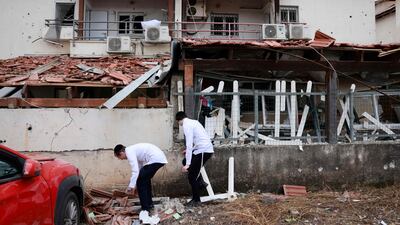
Residents in Petah Tikva check the damage after the rockets were fired from Lebanon. AFP


The Gaza deal also had other implications, this time for Hezbollah. The fact that Hamas signed off on an arrangement that included its disarmament and the return of hostages will have an echo on the Lebanese scene. As Mohanad Hage Ali of the Carnegie Middle East Centre noted: “The Lebanese government can go to Hezbollah and say, ‘Your strategic ally agreed to a plan that includes disarmament, why can’t you?’”
One could point out that Hamas has not agreed to disarmament, but it is undeniable that the group is locked into a plan explicitly calling for this. If it doesn’t implement the Trump road map, we will probably return to a state of war, one in which Hamas no longer has any leverage through the hostages it previously controlled.
However, Gaza may also have other repercussions in Lebanon. Two years of a vicious Israeli onslaught on the territory failed to destroy Hamas, which last week sought to reassert its authority by publicly executing opponents. Indeed, to reach a deal, the US negotiated directly with senior members of the organisation. So, what does this mean for a military solution to Hezbollah’s weapons in Lebanon? It is now far more difficult for those who desire such an outcome to make the case that it would go smoothly.
Hamas’s ambiguous position on the Gaza deal is hardly surprising. No political-military organisation willingly signs off on its own elimination. Hezbollah cannot be expected to do so either. If the Americans end up somehow accepting this reality in Gaza, principally because Mr Trump does not want his ceasefire plan to be undermined, it will be difficult for them to take a hard line when it comes to Lebanon.
A resort to simplistic military outcomes is not the way to go, and more imaginative approaches are needed to break the deadlock over Hezbollah’s weapons. If the Lebanese move towards negotiations with Israel on border demarcation, the group’s margin of manoeuvre will narrow.
Only by advancing patiently, through a process that seeks political solutions and avoids violence, might a resolution be found in Lebanon.

