


Late last month, ballistic missiles from Russia along with a hail of drones attacked Ukraine’s capital, Kyiv. It was a heavy night; the sky lighting with dramatic shadows of Ukrainian anti-aircraft weapons doing their best to intercept Russia’s weapons. It was the first night in a few years that I went down to the bomb shelter to sleep.
At about 3am, the noise was too close to where I am staying, so I descended the stairs to the underworld. It’s a place most Ukrainians have learnt to live with for the past three years. The terrible irony is that the attack on the capital happened hours after the largest prisoner exchange between Russia and Ukraine. Nearly 1,000 prisoners of war were released from captivity and came home, reunited with family.
For a brief moment, there was hope.
In Kyiv, once people came out of the shelters (and many – so used to attacks – stay in bed, hoping for the best), there was much talk of an upscale to the war, with Moscow putting maximum pressure ahead of the ongoing negotiations. There were projections of heavy bombing to come in Kyiv, Kharkiv, Kherson and other parts of Ukraine. Indeed, Russia launched one of its largest air attacks on the country about a week ago.
Following the initial round of failed peace talks in Istanbul, the Russian leadership wanted to send a strong message before the current round of negotiations. The Kremlin also sought to demonstrate its drone capacity – fibre optic drones that are even deadlier than the earlier generation, which could creepily chase soldiers in their cars and through doors.
This week, however, Kyiv launched a surprise drone attack on several Russian air bases hosting nuclear-capable strategic bombers. Several experts say that Ukraine has delivered a heavy blow to the Russian military. This dangerous escalation to the war has made serious negotiations even more urgent. While the two sides did meet in Istanbul this week, there was sadly no breakthrough other than a deal to swap more prisoners.
The war has cost so many lives. According to the Kyiv Independent, it is now estimated that Russia has lost more than 900,000 troops. According to the report, it has also lost 10,852 tanks, 22,622 armoured fighting vehicles, 49,639 vehicles and fuel tanks, 28,201 artillery systems, 1,395 multiple launch rocket systems, 1,169 air defence systems, 372 air planes, 336 helicopters, 37,177 drones, 28 ships and boats, and one submarine. This is not including the losses following Ukraine’s recent drone strikes.
Meanwhile, the Russian economy is in tatters.
There is no doubt Ukraine has made enormous sacrifices for the western world – with loss of life and territory, as well as economic and humanitarian hardship. But all wars must end justly; and negotiations must be fair.
What Moscow has so far proposed will never be accepted by Ukraine’s embattled leadership – or its people. Russia’s requests have not changed from the start of the war: no Nato membership for Ukraine; a “Kremlin-friendly” government in Kyiv; complete ownership of Crimea; and control of the four provinces presently under its occupation.
Ukraine, having lost an estimated 300,000 people fighting against all of the above, will never give in to those demands. “Too much has been lost to even consider giving up the [Temporarily Occupied Territories of Donbas],” one Ukrainian friend told me last week. “Even suggesting it means you are something like a traitor.” “Too many young men and women have died to accept negotiations that only fuel Moscow’s colonialism,” said another.
A walk through Maidan Square, the site of the 2014 Revolution for Dignity in Kyiv, shows exactly how painful Ukraine’s sacrifice has been. Hundreds of blue and yellow flags sit next to photos of some of the fallen – men, women, most very young. There are sections for foreign fighters – French, American British and others – and families wander, placing flowers near the flags. It’s a sombre place and a reminder of what Ukraine has at stake.
Ukrainians are weary. They see negotiations largely as a joke – a chance for US President Donald Trump to exercise his “art of the deal” – in this case, getting enormous financial payback in Russia. He posted on Truth Social after speaking with Russian President Vladimir Putin last month, saying: “Russia wants to do largescale [sic] TRADE with the United States when this catastrophic ‘bloodbath’ is over, and I agree. There is a tremendous opportunity for Russia to create massive amounts of jobs and wealth. Its potential is UNLIMITED.”
-
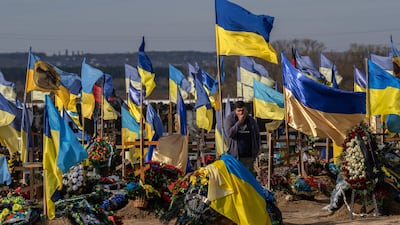
To mark the third year of the Ukraine-Russia war, The National looks back at some of the striking images captured during the conflict. Getty Images -
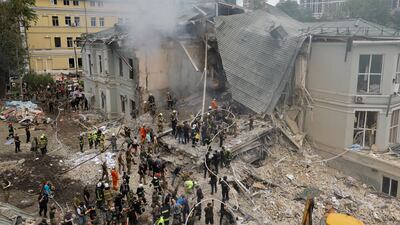
Ukrainians working at the site of a rocket strike on the 'Okhmadyt' children's hospital in Kyiv in 2024. EPA -
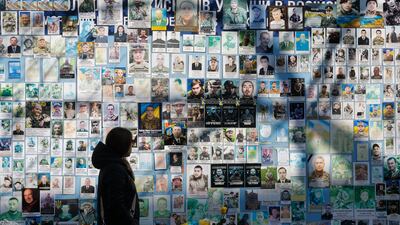
A woman walks past a memorial wall dedicated to fallen defenders of Ukraine in downtown Kyiv in 2024. EPA -
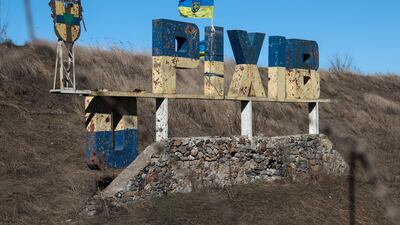
A damaged town sign in Orikhiv, near the frontline in the Zaporizhzhia region, in 2024. EPA -
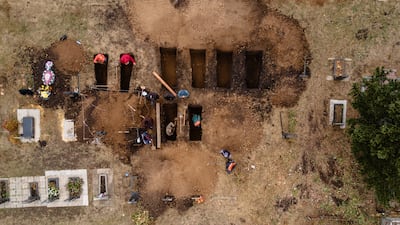
Gravediggers prepare the burial site for victims of a Russian missile strike in Hroza in 2023. Getty Images -
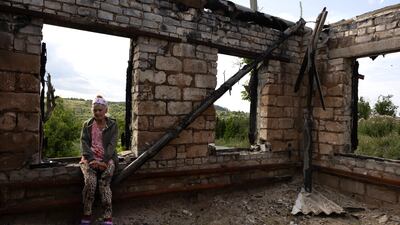
Widow Lubov Doroshenko, 67, returns to her destroyed home in 2023 in Bohorodychne. Getty Images -

A Ukrainian serviceman of the 24 Separate Mechanized Brigade fires a mortar towards Russian positions, at an undisclosed location in the Donetsk region in 2023. EPA -
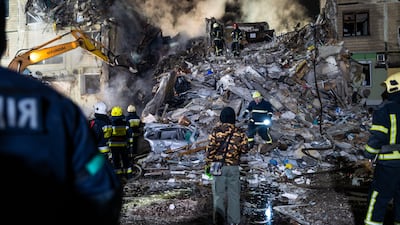
Emergency workers search the remains of a residential building that was struck by a Russian missile in Dnipro in 2023. Getty Images -
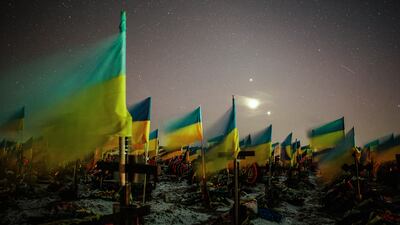
Ukrainian national flags waving over the graves of fallen Ukrainian soldiers in a military cemetery in Kharkiv in 2023. EPA -
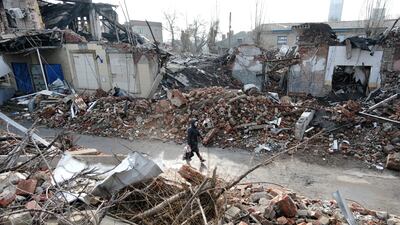
A woman walks by destroyed buildings 20 miles west from the front lines of fighting in the Donetsk Region in 2023. Getty Images -
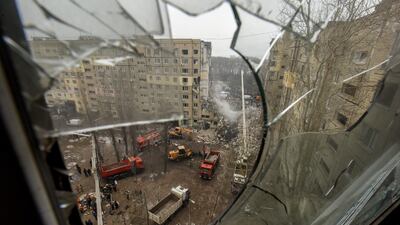
A view taken through the broken glass of a window overlooking the site of a damaged residential building in Dnipro in 2023. EPA -
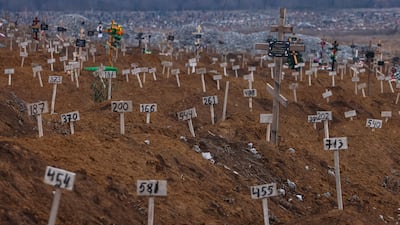
Numbers mark the graves of unidentified people killed during fighting at the cemetery in Mariupol in 2022. EPA -
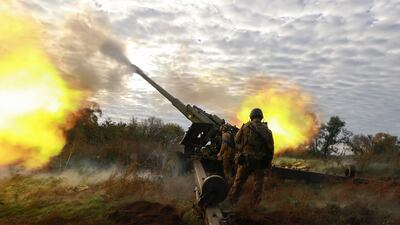
Ukrainian servicemen shoot from a captured Russian 152, 4mm howitzer Msta-B on a front line near Kupyansk city in 2022. EPA -
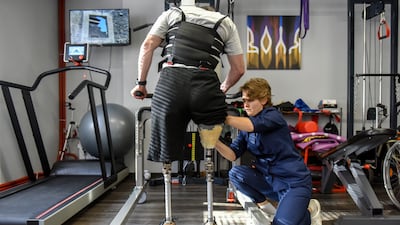
A prothesis is adjusted on an Azov Regiment serviceman at a rehabilitation centre in Kyiv in 2022. EPA -
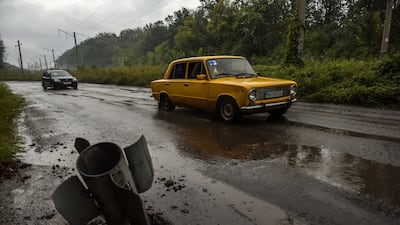
Cars drive past the shell of a rocket in Shevchenkove, Kharkiv region, in 2022. EPA -
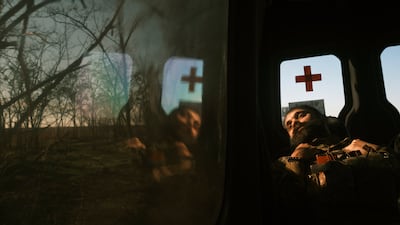
A Ukrainian serviceman rests while travelling with a team of humanitarian volunteers in the Kherson area in 2022. EPA -
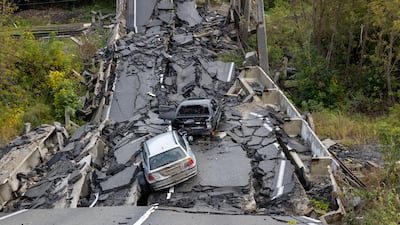
A destroyed bridge in Kupiansk in 2022. Getty Images -
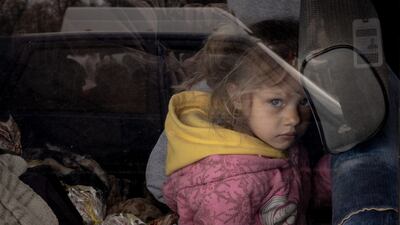
A girl arrives at an evacuation point for people fleeing Mariupol, Melitopol and the surrounding towns under Russian control in 2022. Getty Images -
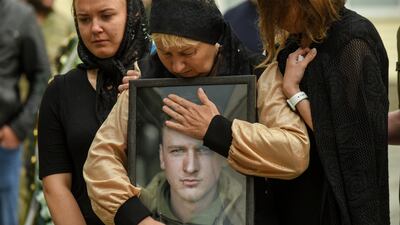
The mother of Ukrainian serviceman Andrii Verkhoglyad holds her son's portrait during his funeral ceremony at St. Michael's Golden-Domed Monastery in Kyiv in 2022. EPA -
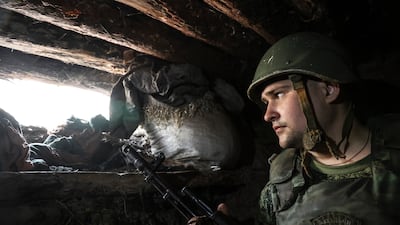
Self-proclaimed Donetsk People's Republic militia monitors a section of the road near Avdiivka, Donetsk region, in 2022. EPA -

Firefighters work to extinguish a fire at a warehouse after it was hit by Russian shelling in Kharkiv in 2022. Getty Images -
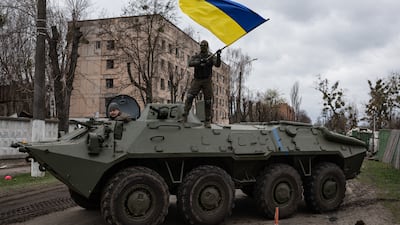
A Ukrainian soldier waves the Ukrainian national flag while standing on top of an armoured personnel carrier in Hostomel in 2022. Getty Images -
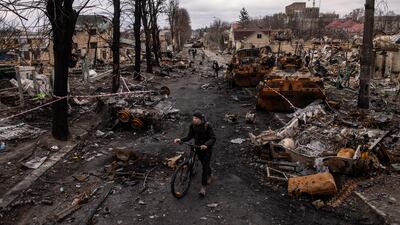
A man pushes his bike through debris and destroyed Russian military vehicles in Bucha in 2022. Getty Images -
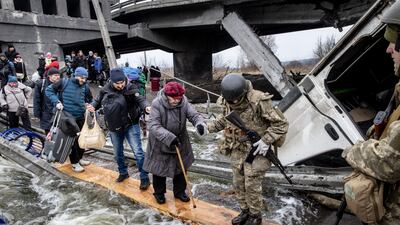
Residents of Irpin flee heavy fighting in 2022. Getty Images -
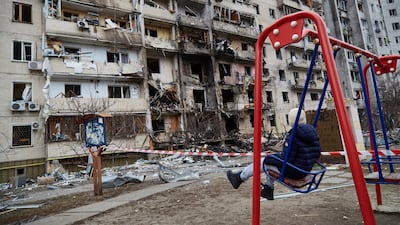
A child on a swing outside a residential building damaged by a missile in Kyiv in 2022. Getty Images


Meanwhile, key European powers – who are terrified of what they see as Russia’s expansion goals – are looking at fresh sanctions on Moscow. Suggestions that negotiations be held in the Vatican and mediated by Pope Leo XIV have been called “a bit vulgar” by Russian Foreign Minister Sergey Lavrov. Mr Lavrov apparently is more focused on continuing “technical” talks in Istanbul this week.
I would like to say there is hope that the war will end soon, but everything I see from the ground tells me that is not going to happen.
In Kharkiv last week, I spent time with the police who in addition to their normal duties, are now tasked with investigating war crimes – nearly 183,000 incidents in Ukraine, according to the Office of the Prosecutor General. Kharkiv is only 40 kilometres from the Russian border, and it has been hit badly. Half of the pre-war population of 2 million people have fled; and Moscow is said to want to take both Kharkiv and Sumy regions quickly.
Seeing the police work in their basement bomb shelters, identifying victims in mass graves using mobile DNA units, made me see the tenacity and the courage of the Ukrainian people.
Every day at 9am, in the western city of Lviv, people stop in their tracks to pause in remembrance of those who have fallen in this war. Cars halt; even on the trains, people pause and rise, silent for one minute. It’s a moving moment and a reminder of how war destroys society at every level; how decent diplomacy must prevail to sit and negotiate how they will end.
Even if the Trump administration is losing patience with the war, and is now focused on the Middle East, the rest of the world should not. Ukraine deserves all the help it can get to bring this terrible war to an end.

