


History will not be kind to Joe Biden’s US presidency when it evaluates his administration’s handling of Israel’s genocidal war on Gaza. At best, his response will be considered weak and feckless. At worst, he will be seen as enabling, or even being complicit in, the crimes committed.
Examples of both the fecklessness and complicity abound. On April 4 this year, The New York Times ran a story under the headline: “President Biden told Prime Minister Benjamin Netanyahu that future US support ‘will be determined’ by how Israel treats civilians in Gaza.”
The story noted that: “President Biden threatened on Thursday to condition future support for Israel on how it addresses his concerns about civilian casualties and the humanitarian crisis in Gaza, prompting Israel to commit to permitting more food and other supplies into the besieged enclave in hopes of placating him.
“During a tense 30-minute call with Prime Minister Benjamin Netanyahu of Israel, Mr Biden for the first time leveraged US aid to influence the conduct of the war against Hamas that has inflamed many Americans and others around the world.”
After the call, Secretary of State Antony Blinken reportedly said: “If we don’t see the changes we need to see, there’ll be changes in policy.”
That was seven-and-a-half months ago. During the intervening months, 12,000 more Palestinians have been killed in schools, hospitals and mosques where they sought safety. Crowded tent sites of desperate refugees have been bombed and Israel has continued to block deliveries of humanitarian aid. The administration’s “threat” was for nought.
Then on October 13, Mr Blinken and Secretary of Defence Lloyd Austin wrote to the Israeli government expressing their concern with the “dire” humanitarian situation in Gaza, citing the isolation of the northern part of the territory, repeated eviction orders, the blocking of humanitarian assistance, targeting aid workers, and a range of other Israeli policies that have had an adverse impact on Palestinians.
They said that the US was giving Israel 30 days to improve the humanitarian situation and protection of civilians in Gaza or face unstated consequences.
After the Democrats lost the elections in November, some commentators assumed that now facing no political pressures, Mr Biden might use his remaining time in office to make some bold moves to address the crisis in Gaza that could challenge both Mr Netanyahu and the incoming administration of Donald Trump. But four actions taken by the Biden administration during the past week demonstrate that such hopes were in vain.
-

Mr Netanyahu meets with US Vice President Kamala Harris. EPA -
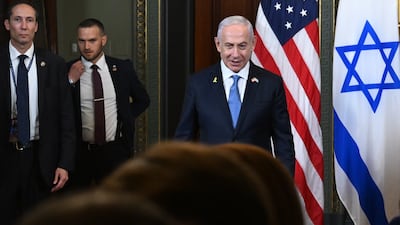
Mr Netanyahu at the White House. EPA -

Mr Netanyahu greets Ms Harris. EPA -
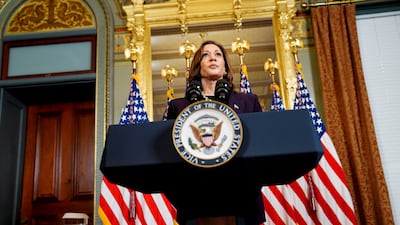
Ms Harris attends a press conference. Reuters -

Ms Harris speaks to the press. AFP -
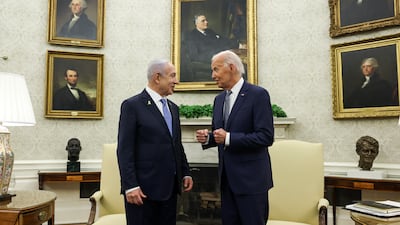
Israeli Prime Minister Benjamin Netanyahu, left, speaks with US President Joe Biden during a bilateral meeting at the White House. EPA -

Mr Netanyahu was hosted by Mr Biden a day after he delivered an address to a joint meeting of the US Congress. EPA -

Mr Netanyahu and Mr Biden. EPA -
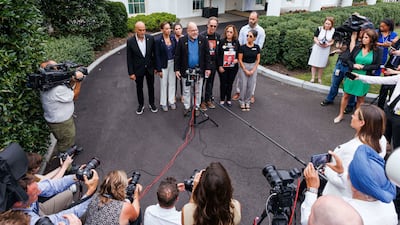
Relatives of American hostages being held by Hamas speak to members of the media outside the White House. Bloomberg -

Demonstrators gather during a pro-Palestinian rally on the day Mr Netanyahu met with Mr Biden and Ms Harris. Reuters


As the one-month deadline given by the Blinken-Austin letter approached, US and international aid groups and officials within the Biden administration charged with humanitarian matters communicated to the secretaries that the situation in Gaza had worsened; shipments of food, water and medicines remained intolerably inadequate; aid workers were still being threatened; and there was impending famine.
With winter approaching, they warned the humanitarian crisis would only grow more desperate. Nevertheless, on November 12, the US issued what was seen as a delusional passing grade to Israel for “improvements” in Gaza.
Last Wednesday, after months of negotiations on a new UN Security Council ceasefire resolution, the US issued yet another veto, stymieing the international community’s efforts to end the war.
As disturbing as the veto may have been, even more troubling was the patently false reason for it. They claimed that they opposed the resolution because it failed to call for an immediate release of Israeli hostages, ignoring the fact that the resolution specifically calls for an “immediate, unconditional and permanent ceasefire and the release of all hostages”.
Also last Wednesday, the US Senate voted on three separate bills opposing billions in US weapons to Israel. The senators supporting these bills argued that supplying these weapons was in clear violation of US laws restricting such shipments when the recipient country uses them to put the lives of civilians at risk or to impede humanitarian assistance.
Ignoring the factual basis of the charges and evidence of violations of US laws, the White House issued “talking points” to senators, charging that: “Disapproving arms purchases for Israel at this moment would … put wind on the sails of Iran, Hezbollah and Hamas.” It was deeply troubling that the White House would stoop to “Hamas-baiting” leading senators of their own party.
And then the following day, the International Criminal Court issued arrest warrants for Mr Netanyahu and former Israeli defence minister Yoav Gallant, charging them with being criminally responsible for acts including murder, persecution and starvation as part of a “widespread and systematic attack against the civilian population of Gaza”. In response, Mr Biden issued a statement denouncing the decision, saying that the “arrest warrants against Israeli leaders is outrageous … we will always stand with Israel against threats to its security”.
And so, it appears that Mr Biden will end his term without a change of heart or policy. In just the past month, he rejected several opportunities to distance himself from Israeli policies. Because he rejected each of them, he will “own” this war. It will be his legacy.

