


Last month, I attended the annual Yalta European Strategy (YES) summit, which brings together many of Europe and North America’s defence communities. The topic this year was clear: Ukraine must win.
Hovering in the background, however, was the constant image of former US president Donald Trump swooping down to end western support for their defence (were he to win the presidential election in November), and the bloody ongoing wars in the Middle East.
In many ways, despite Ukrainian President Volodymyr Zelenskyy’s embattled pleas at the UN General Assembly earlier this month to continue helping his country, Israel’s war in Gaza and Lebanon – and the fear of a full-scale one with Iran – has dominated the news and many a policymaker’s attention.
And yet the consensus at YES was that Ukraine must win.
There are strategic reasons for holding Ukraine’s frontlines, beyond the moral question of a neighbour whose sovereign territory has been invaded and must be defended. Ever since Russia launched a full-scale invasion against what they believe to be a Nato frontier two years ago, most European capitals have supported Kyiv from the first day of the war.
Ukraine is the US’s top recipient of foreign aid, followed by Israel. It is the first time a European country has achieved that since the Marshall Plan, the initiative then US president Harry S Truman launched to help rebuild the continent after the Second World War.
According to a recent report by the Council on Foreign Relations, most of the aid sent to Kyiv goes towards procuring defence weapons, training personnel and gathering intelligence to defeat Russia, which has one of the world’s most powerful militaries.
But as the US presidential election rolls closer, with the shadow of Mr Trump – a Ukraine sceptic – lurking, many voters and several members of Congress are questioning why Washington is pouring so much money into the Ukrainian government’s coffers. Isn’t it a European security issue, many ask?
According to the CFR, it should not be only Europe’s problem. “Nato allies are particularly wary of being pulled directly into the hostilities, which could dramatically raise the risk of a nuclear war. However, as the fighting has progressed, many donor governments have shed their reluctance to give Ukraine more sophisticated assets, such as battle tanks and modern fighter aircraft,” the report said.
Since Russia’s full-scale invasion, the EU has been united for Ukraine, with the bloc providing more than €88 billion ($96.3 billion) in economic, humanitarian and military support. It has also imposed sanctions on Russian individuals and worked to fight disinformation from the Kremlin.
Victor Pinchuk, the Ukrainian billionaire who hosts the YES summit in Kyiv each year, wrote in Politico that, if “the West doesn’t help back Ukraine, your lives will not be the same”. This year, he went so far as to claim that Russian troops could be on the streets of several European capitals if more military aid didn’t reach Ukraine.
If Mr Trump wins in November, there is uncertainty around whether he will return to the “America First” isolationist policies of his previous term. But in an interview with journalist Fareed Zakaria at the YES summit, Mike Pompeo, secretary of state in the previous Trump administration, suggested that this wouldn’t happen.
In geopolitical terms, he said, Ukraine must win for the US, as well as for Europe, to be secure. America needs strategic partners, he insisted, which runs contrary to Mr Trump’s previous threats of pulling out of Nato. “Keep in mind that there can be no American security without Ukraine’s victory and strong European security,” Mr Pompeo added.
Let’s assume the worse-case scenario for Ukraine and its western supporters: its troops cannot push Russia back, and they lose. Many more Ukrainians would flee – which appears to be part of Moscow’s strategy – with Europe being the most likely destination. Another influx of refugees would prove costly for their host countries (at the last count, there are about 6.3 million Ukrainians living outside the country).
As Mr Pinchuk pointed out, “if, for example, five million more Ukrainians flee as Russia advances, it would cost Europe billions of euros more per month additionally”.
-
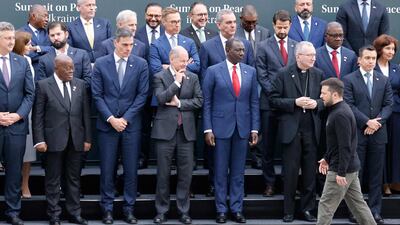
Ukrainian President Volodymyr Zelenskyy joins heads of states and country representatives during the Ukraine peace summit at the Burgenstock resort, near Lucerne, Switzerland, on June 15. AFP -
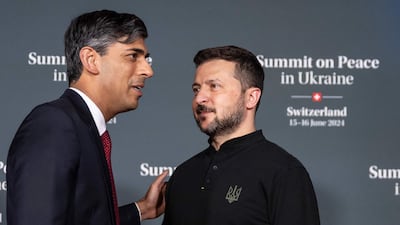
British Prime minister Rishi Sunak, left, is welcomed by Mr Zelenskyy. AFP -
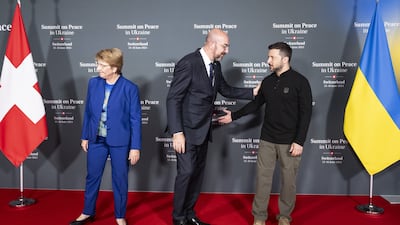
Swiss Federal President Viola Amherd, left, with Charles Michel, President of the European Council, centre, and Mr Zelenskyy. EPA -
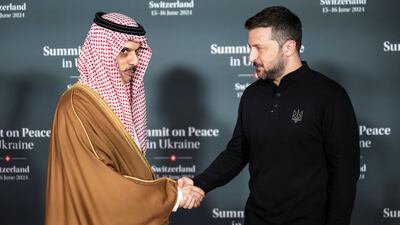
Saudi Arabia's Minister of Foreign Affairs Faisa bin Farhan Al Saud is welcomed by Mr Zelenskyy. Reuters -
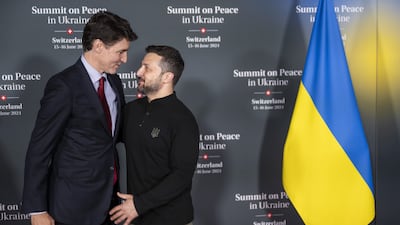
Canadian Prime Minister Justin Trudeau, left, with Mr Zelenskyy. EPA -
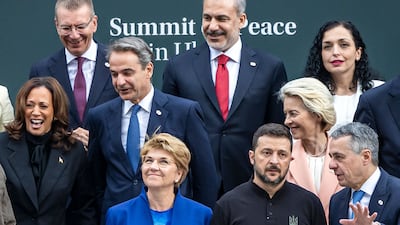
US Vice President Kamala Harris, middle left, Greece's Prime Minister Kyriakos Mitsotakis, middle, Swiss Federal President Viola Amherd, bottom left, Turkish Minister of Foreign Affairs Hakan Fidan, top centre, Mr Zelenskyy, bottom right, President of the European Commission Ursula von der Leyen, middle right, and Swiss Foreign Minister Ignazio Cassis, bottom right. AFP -
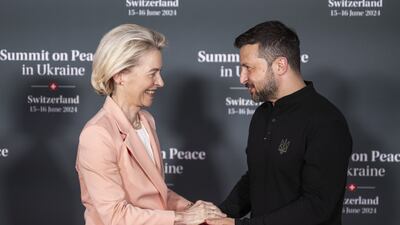
Mr Zelenskyy welcomes Ms von der Leyen. EPA -
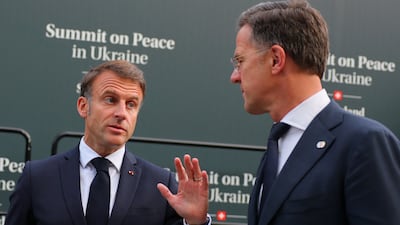
French President Emmanuel Macron speaks with Dutch Prime Minister Mark Rutte. Reuters -
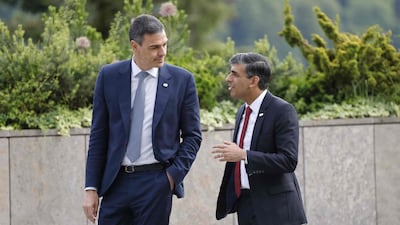
Spain's President Pedro Sanchez, left, and Mr Sunak walk to the podium for a photograph with heads of states and country representatives. AFP -
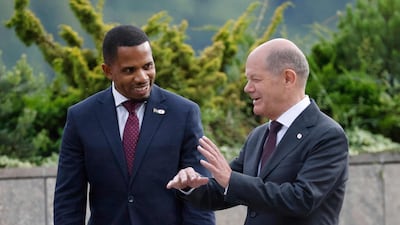
German Chancellor Olaf Scholz, right, with Gambia's Minister of Information Ismaila Ceesay. AFP -
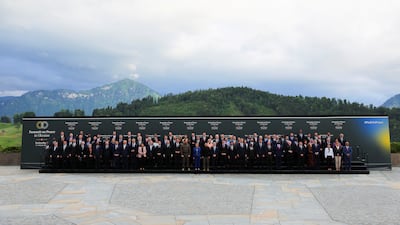
World leaders pose for a family photo at the summit's opening ceremony. Reuters -
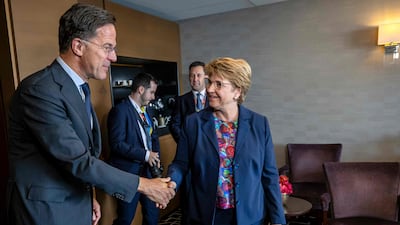
Ms Amherd welcomes Mr Rutte. AFP -
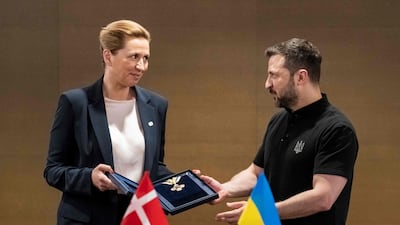
Mr Zelenskyy awards Denmark's Prime minister Mette Frederiksen with the 'Order of Freedom of Ukraine' title before a meeting on the sidelines of the summit. AFP -
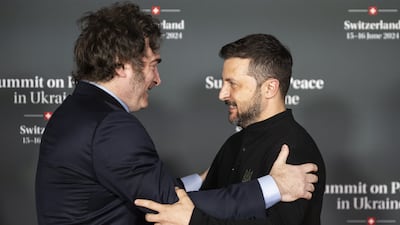
Mr Zelenskyy welcomes President Javier Milei of Argentina. EPA


Ukrainians are said to be hardworking and often highly educated. After war broke out in 2022, several European countries opened their doors to them. They put their children in schools, offered them language training, and helped find them jobs. It was an extraordinary show of solidarity.
Many of my neighbours, here in France, opened spare bedrooms to strangers. I have never seen this happen before, even during the wave of refugees and migrants pouring into Europe during the Syrian civil war. It is no secret that Ukrainian refugees were treated far better than African or Middle Eastern refugees who were brutally turned away from the Eastern European borders in 2015.
Down the line, this could be problematic, causing rifts for future generations of new immigrants.
There are other major consequences to Ukraine losing the war.
The Baltic states are likely to be under constant threat. With Estonia, Latvia, Lithuania and Finland having already experienced Russian invasions in the past, their peoples are anxious. Political parties sympathetic to Moscow are on the rise in some of these countries. It is no coincidence that Kaja Kallas, Estonia’s prime minister until July, has been chosen to replace the departing Josep Borrell as the EU’s foreign and security policy chief.
Then there is Moldova, just a few hours’ drive from the Ukrainian port of Odesa, a country already in conflict with Russia over the state of Transnistria. President Maia Sandu recently said: “There is nothing more important than helping Ukraine win the war.”
Georgia, a former Soviet republic like Moldova and some of the Baltic states, is equally vulnerable. As this deeply divided country goes to the polls later this month, a pro-Moscow political party called Georgian Dream has unleashed a propaganda campaign.
All this is to say that for Europe to ensure its peace and security, it has no option but to continue supporting Ukraine – with or without America’s help. The EU has already taken a decisive lead in this regard, but there is a long way to go yet.

