

With protests shaking Iran and US President Donald Trump warning of harsh consequences, one question looms: will Washington respond with military action, or the restraint many Iranians say cost them international backing during former president Barack Obama's administration?
Mr Trump warned last week that Iran’s leaders would be “hit very hard” if security forces continued killing protesters. But a diplomatic solution could also be in the works. A senior Iranian official said on Monday that Foreign Minister Abbas Araghchi had been in contact with Steve Witkoff, Mr Trump’s special envoy for the Middle East.
The President’s comments come only six months after he ordered strikes on three Iranian nuclear sites, reviving speculation that military action could again be possible. Iran’s leadership has dismissed Mr Trump’s talk as bluster.
He also announced that any country that does business with Iran will be subjected to a tariff rate of 25 per cent on any business conducted with the US.
"Effective immediately, any country doing business with the Islamic Republic of Iran will pay a tariff of 25 per cent on any and all business being done with the United States of America," Mr Trump said in a post on Truth Social.
Ali Larijani, secretary of Iran's Supreme National Security Council, said Mr Trump’s warnings should not be taken seriously. “Trump says things like this a lot,” he said, adding that Iran would eventually “settle accounts” with the US and Israel.
The US has no carrier strike groups in the Middle East or Europe after moving its largest aircraft carrier to Latin America, emphasising the gap between Washington’s talk and its military position.
White House press secretary Karoline Leavitt said on Monday that “air strikes would be one of the many, many options that are on the table for the commander-in-chief”.
“Diplomacy is always the first option for the President,” she told reporters at the White House. “He's made it quite clear he certainly doesn't want to see people being killed in the streets of Tehran and, unfortunately, that's something we're seeing right now.”
For Iranians risking arrest or death on the streets, whether American pressure will become action carries deep historical weight.
Many point to the Obama administration’s lack of public support for the 2009 Green Movement as a missed opportunity to back the democratic aspirations of the Iranian people.
Iranian activist Masih Alinejad told The National last week that Mr Obama and another former president, Joe Biden, were so focused on striking agreements with Tehran over its nuclear programme that they sidelined popular demands for political change.
-

Anti-government demonstrators and supporters of exiled Iranian crown prince Reza Pahlavi outside the Houses of Parliament in London. EPA -

Iranians during a protest in Tehran on January 9. AFP -
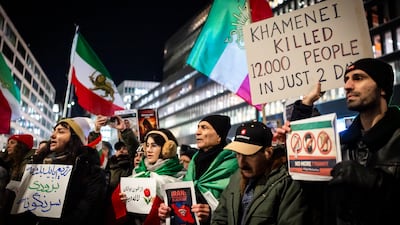
Protesters attend a rally in Zurich on January 13 in support of the nationwide mass demonstrations in Iran. EPA -

A screengrab shows body bags lying outside Kahrizak Forensic Medical Centre in Tehran, after deadly protests across Iran. Reuters -

Activists attend a rally in support of the protesters, in Los Angeles, California. AFP -

Protesters burn a picture of Iran's supreme leader Ayatollah Ali Khamenei outside Downing Street, in London. AFP -

Demonstrators gather in Paris to support the Iranian people amid the anti-government protests in Iran. AFP -
Smoke rises from a mosque as protesters gather amid evolving anti-government unrest in Tehran, Iran, on Friday. Reuters -
Protesters gather amid evolving anti-government unrest in Tehran, Tehran Province, Iran, on Friday. Reuters -
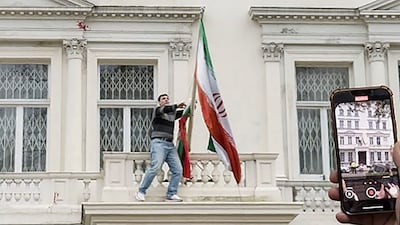
A protester pulls down the Iranian flag from the balcony of Iran's embassy in central London on Saturday. AFP -
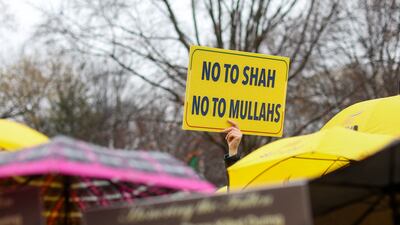
A person holds a placard, as demonstrators and activists rally in support of nationwide protests in Iran, outside the White House in Washington. Reuters -
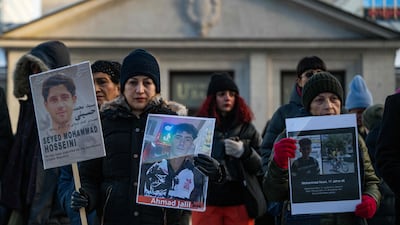
Protesters display placards featuring portraits of Iranians executed by the Iranian regime, during a rally in Berlin on Saturday. AFP -
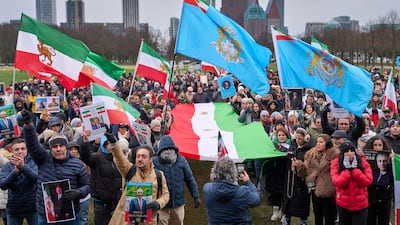
People protest in solidarity with demonstrations in Iran at Malieveld Square, Netherlands on Saturday. AFP


Analysts say Mr Trump now appears caught between confrontation and making a deal.
Gissou Nia, an Iranian-American human rights lawyer, said the President’s refusal to meet Reza Pahlavi, the exiled crown prince, suggests he may be looking for influence in negotiations instead of openly backing regime change.
If military action were to come, experts say it would probably be limited.
Ray Takeyh, an Iranian-American former State Department official, told a panel at the Council on Foreign Relations that any strikes would probably be aimed at the Islamic Revolutionary Guard Corps or other security forces involved in repressing protesters.
Others warned of the risks of intervention. Sanam Vakil, director of Middle East and North Africa Programme at Chatham House, said Mr Trump is keen to distinguish himself from Democratic predecessors by indicating support for protesters, but that outside pressure could backfire.
“President Trump is trying to accomplish a couple of things,” she said. “At least symbolically, provide support for the protesters to continue their momentum. Time is certainly not on side … if Trump did intervene … it could equally play further into the hands of a regime that is paranoid, and this would build further unity and propel them forward to crack down further.”
Some senior aides in Mr Trump's administration led by Vice President JD Vance are urging Mr Trump to try diplomacy before strikes against Iran, The Wall Street Journal reported on Monday, quoting US officials.
Vali Nasr, an Iranian-American political scientist, said Mr Trump has little appetite for nation-building, sending ground troops or engineering regime change. Mr Nasr suggested his instinct is to pressure existing regimes to behave differently, rather than replace them outright.
“He really doesn't want to get his hands dirty and a performative strike … he wants to play the Venezuela card of trying to bully the Islamic Republic to buckle in,” he explained. “He is interested in regimes that are there doing what he’s asking them to do.”
But that strategy, Mr Nasr warned, could miss the deeper political crisis now unfolding inside Iran. “This is a protest movement in Iran that is making it clear they want the elites of the system to no longer be in power, and so just moving the pieces around or empowering the IRGC isn't necessarily going to solve the political legitimacy piece.”

