


Live updates: Follow the latest on Trump's Gulf trip
President Donald Trump upended more than a decade of US foreign policy on Syria when he said he would lift sanctions against Damascus, a game-changing move that dramatically alters the nation's economic and diplomatic position.
The Trump administration had until now insisted that any sanctions relief would be determined by the pace of reforms in Syria, after the Hayat Tahrir Al Sham rebel group overthrew the regime of Bashar Al Assad in December.
But Mr Trump cast that deliberative process aside as he visited Saudi Arabia, saying he would lift all sanctions at the request of Crown Prince Mohammed bin Salman and that it is now Syria's “time to shine”.
“Oh, what I do for the Crown Prince,” Mr Trump said at Tuesday's US-Saudi Investment Forum, where delegates loudly applauded his announcement.
He also said he made the decision after discussions with Turkish President Recep Tayyip Erdogan, whose government has pushed for the sanctions to be lifted.
Further underscoring Mr Trump's new approach, he said he planned to meet Syrian leader Ahmad Al Shara in Saudi Arabia on Wednesday. The meeting is especially remarkable given that Mr Al Shara remains the member of a US-designated terrorist organisation because of past ties to Al Qaeda.
The White House and State Department provided no time for when sanctions would be lifted. The US has a complex mix of sanctions, terrorist designations and export controls against Syria aimed at choking off its banking, export and other sectors during the country's civil war, although some of the oldest measures predate the outbreak of violence in 2011.
Aaron Zelin, the Gloria and Ken Levy Fellow at the Washington Institute for Near East Policy, predicted there would be some quick sanction cuts, allowing for an infusion of cash and investments, most likely from Gulf states.
“There still remains a lot of questions, even if Trump made this declarative statement,” Mr Zelin told The National.
He described the developments as a “net positive” for Syria, in a sentiment echoed widely. Syrians took to the streets and celebrated into the night in Damascus and elsewhere after Mr Trump's announcement.

Lebanese President Joseph Aoun said Mr Trump's “bold move represents another step on Syria's path towards recovery and stability".
The Syrian Emergency Task Force, which works to help build democracy in Syria, said it had played a significant role in nudging the Trump administration to scrap the sanctions, including meeting Mr Al Shara for more than three hours to discuss the importance of a Syria-US partnership.
“With this announcement, there is hope,” Mouaz Moustafa, the SETF's executive director, told The National.
He said the most crucial first move would be to lift sanctions on Syria's central bank and waive the Caesar Act, a set of measures imposed by the US Congress during the Assad era.
That relief “would allow for a huge amount of both reconstruction and humanitarian efforts inside the country, and would save the Syrian economy from the eventual collapse that they were doing", Mr Moustafa said.
Sanctions relief will also make it much easier for humanitarian and aid groups to work in Syria.
“What Trump has done is actually saved Syria, and in a way, saved the whole Middle East, by keeping this key, geopolitically very important country together,” Mr Moustafa said.
The UN, which has pushed for sanctions relief on Syria, said the move was "important".
It will “help the reconstruction of Syria [and] help the Syrian people recover from more than a decade of conflict, a decade of underinvestment,” UN spokesman Stephane Dujarric said.
The announcement also marks a major personal win for Mr Al Shara, who has been unable to keep all of Syria under government control, including during sectarian attacks against civilians from the Alawite minority in the north-west.
Critics accused a transactional Mr Trump of being lured into making concessions to Syria by a reported offer for him to build a massive Trump Tower in Damascus. That comes after criticism over his willingness to accept a $400 million “gift” from Qatar – a Boeing 747 that would be used as Air Force One.
“It wouldn't be surprising that the Syrian government recognises how to deal with Trump,” Mr Zelin said. “Whether that's something that American citizens want … is another matter.”
Mr Trump's announcement also will lead to changes in Syria's relationships with its neighbours. Israel appears to have been cut out of the decision and has retreated on some of its rhetoric against Mr Al Shara's administration.
“We might see a different tack [from Israel],” Mr Zelin predicted. “It could also lead to broader negotiations related to initially a non-aggression pact and then something that then is negotiated eventually related to potentially joining the Abraham Accords or their own specific peace agreement.”
Unlike his predecessor Joe Biden, Mr Trump has shown that he is willing to seek regional deals and consensus without including Israel.
In what some commentators are portraying as a snub to Israeli Prime Minister Benjamin Netanyahu, Mr Trump is not scheduled to visit Israel after his Gulf tour ends on Friday.
-
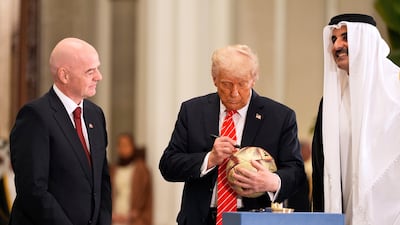
US President Donald Trump signs a football with Qatari Emir Sheikh Tamim and Fifa President Gianni Infantino at Lusail Palace in Doha. AP -
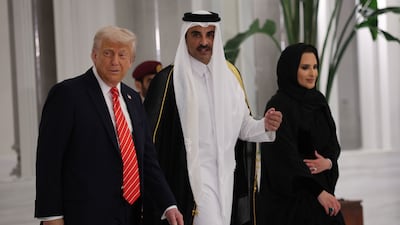
Mr Trump with Sheikh Tamim, Emir of Qatar, and his wife, Sheikha Jawahir, before a state dinner at Lusail Palace. Getty Images -
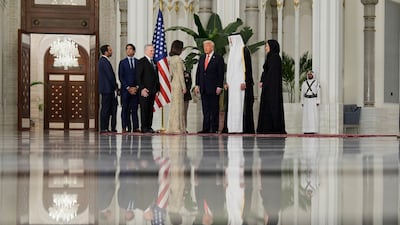
Mr Trump, Sheikh Tamim and Sheikha Jawahir with guests before the state dinner at Lusail Palace. AP -
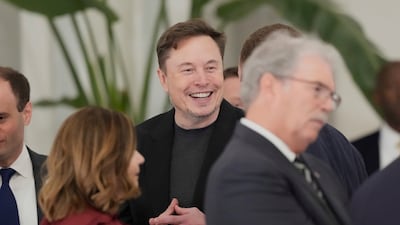
Elon Musk arrives at Lusail Palace. AP -

Sheikh Tamim welcomes Mr Trump at the Amiri Diwan in Doha, Qatar. AP -
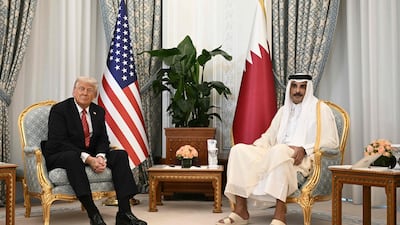
Sheikh Tamim with Mr Trump in Doha. AFP -
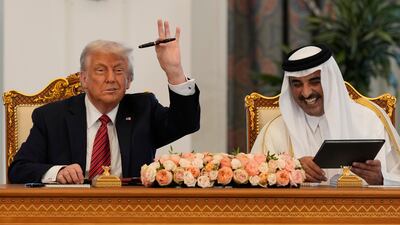
Mr Trump holds up a pen given by Sheikh Tamim as they exchange documents during a signing ceremony at the Amiri Diwan. AP -
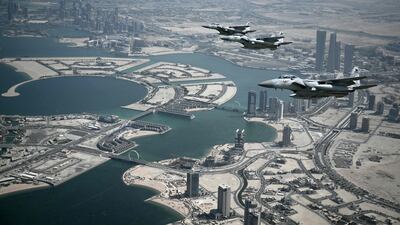
Qatari Air Force F-15s escort Air Force One carrying Mr Trump, as it prepares to land in Doha. AFP -

Sheikh Khaled bin Mohamed, Crown Prince of Abu Dhabi, Saudi Crown Prince Mohammed bin Salman and Sheikh Tamim, Emir of Qatar, are among GCC leadership at a meeting with Mr Trump. Reuters -
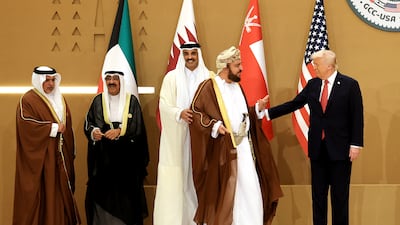
Mr Trump with GCC leaders. Getty Images -

Mr Trump speaks at the summit. Reuters -

Syria's President Ahmad Al Shara, left, shakes hands with Mr Trump. AP -
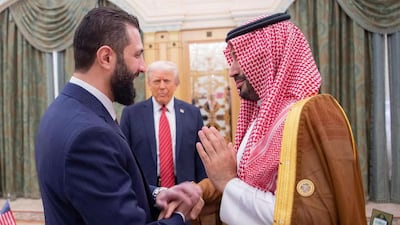
Prince Mohammed, right, shake hands with Mr Al Shara, as Mr Trump looks on. AP -
The Saudi Crown Prince and Mr Trump view a model of a new city in Saudi Arabia. AP -
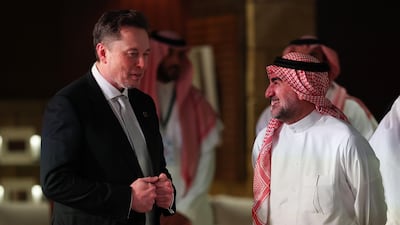
Elon Musk and Yasir bin Othman Al Rumayyan, governor of the Public Investment Fund of Saudi Arabia, view an exhibit in Saudi Arabia's old district of Diriyah. Getty Images -
Prince Mohammed and Mr Trump at the Saudi-US Investment Forum in Riyadh. Reuters -
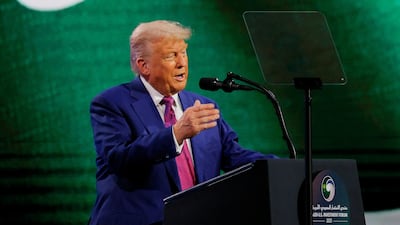
Mr Trump speaks at the forum, held during his official visit to the Gulf region. Reuters -

Billionaire Elon Musk takes part in a panel at the Saudi-US Investment Forum. EPA -
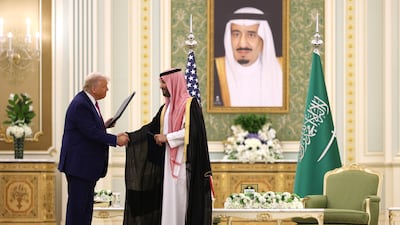
Prince Mohammed and Mr Trump during a signing ceremony in Riyadh. Getty Images -
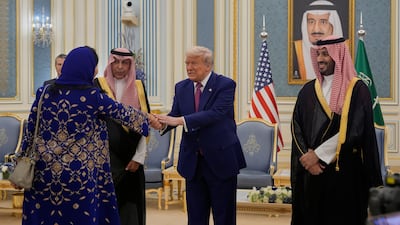
Mr Trump greets Princess Reema bint Bandar, Saudi ambassador to the US. AP -
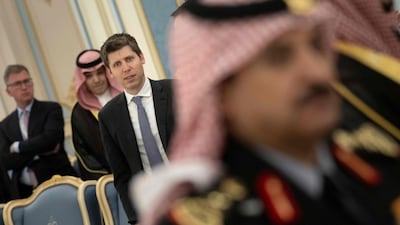
OpenAI chief executive Sam Altman waits to meet Prince Mohammed in the Saudi capital. AFP -

Prince Mohammed alongside Mr Trump during an arrival ceremony at King Khalid International Airport, in Riyadh. Reuters -
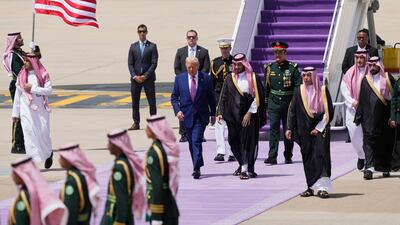
Prince Mohammed walks alongside Mr Trump. Reuters -
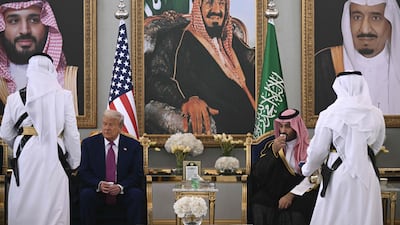
The Saudi Crown Prince and Mr Trump sit down for coffee. AFP



