


The police crackdown on pro-Palestinian student camps and arrests of those calling for divestment from Israel amid the war in Gaza threaten the US role in advocating democracy worldwide, experts say.
Human rights experts have highlighted the dichotomy between US condemnation of repression elsewhere, like Russia and Iran, and the mass arrests of peaceful protesters in the US over the past month.
“The recent crackdowns on free speech on campus highlight US hypocrisy,” Thomas Becker, legal and policy director at the University Network for Human Rights, told The National.
“While the US criticises other governments for their response to demonstrations, it deploys police on campuses, where they have arrested and physically attacked students, professors and passers-by.”
Whenever US President Joe Biden this month addressed the student movement, he failed to mention the university-ordered police response, instead emphasising the need to combat on-campus anti-Semitism and hate speech.
“I support peaceful, non-violent protest,” he said at a commencement speech at Morehouse College in Georgia, where he also spoke about calling for an immediate ceasefire.
“Your voices should be heard, and I promise you I hear them.”
In his Morehouse speech and in White House comments, Mr Biden did not speak about police actions on the largely peaceful protest gatherings. His administration, however, has been vocal about police crackdowns in other countries.
The US has condemned and even issued sanctions over the suppression of protests elsewhere, such as anti-war demonstrations in Russia and anti-government movements in Iran.
“This is an issue of practising what we preach more than an issue of double standards,” Raed Jarrar, advocacy director at Dawn, a non-profit supporting democracy and human rights in Mena, told The National, pointing to US support of Israel despite possible human rights violations.
“I think the perception of the United States at this moment is that the US is acting like an abusive parent who tells his kids 'do what I say, not what I do.'”
The last time the US faced mass protest was in 2020 after the police killing of George Floyd, a black man. Mr Biden, at the time a presidential candidate, said it was “unacceptable” for law enforcement “to escalate tensions or resort to excessive violence”.
He also criticised then-president Donald Trump as being “more interested in power than in principle” when he called for repression of demonstrations.
Mr Jarrar said Mr Biden has not mentioned incidents of police brutality over the past month because it would have forced him to admit a level of responsibility. In addition, the protests are directly connected to his foreign policy.
“It was because, honestly, I think President Biden has to take full responsibility for the police reaction in the same way that our government criticises the top officials in the Iranian or Cuban or Russian or Chinese governments,” he said.
US credibility at stake
With commencement season in full swing, police clearings of student camps continue while a couple of universities have cancelled or reformatted graduation events over security concerns.
Protests in California and New York have recently escalated to occupy campus buildings and increase pressure for universities to reach agreements on Israeli divestment.
Non-profit news organisation The Appeal has recorded at least 3,000 arrests to date.
“The wave of attacks on anti-war students and professors on college campuses undermines US credibility,” Mr Becker said.
“Colleges, celebrated as bastions of free speech in the US, have become ground zero for doxing, arbitrary arrests and violence, which have been carried out with impunity.”
Mr Jarrar agreed that the events were hurting Washington's “political capital and our standing in the world”.
In addition to police activity, there have been reports of pro-Israel protesters attacking the pro-Palestinian demonstrators, as well as anti-Semitic statements made on and off-campus.
“When violence becomes commonplace on university campuses, which historically have served as centres of free speech, basic democratic principles quickly erode,” Mr Becker said.
The protests have stirred up fears about the safety of Jewish people or those simply trying to complete their education on campus, as Mr Biden has stated. Others have shared reports of Islamophobia and anti-Arab hate speech.
Mr Becker called it “ironic” because “the US justifies policing campuses to safeguard education for students”.
“Meanwhile, it continues to send weapons to Israel, which has destroyed 80 per cent of schools and every university in Gaza,” he said, citing UN data.
Global reaction threatens international standing
The international human rights community has viewed the US police crackdown in shock, and organisations such as Human Rights Watch and Amnesty International have issued warnings on the issue.
The actions by US law enforcement have also garnered reactions from UN leaders and independent special rapporteurs.
Secretary General Antonio Guterres said it was “essential in all circumstances to guarantee” rights to protest and free expression, while condemning hate speech.
Human rights chief Volker Turk said the freedom to assemble was “fundamental to society” and expressed concern that policing “across a series of universities appear disproportionate in their impacts”.
“Here, as elsewhere, responses by universities and law enforcement need to be guided by human rights law, allowing vibrant debate and protecting safe spaces for all,” he declared
After a visit to the US, special rapporteur on the right to education Farida Shaheed said she was “deeply troubled by the violent crackdown”, which included “surveillance and disciplinary measures and sanctions against members of the educational community” participating in the movement.
Ms Shaheed said in her statement that the “attacks signal a concerning erosion of intellectual freedom and democratic principles within educational settings”.
Pro-Palestine protests at US universities continue – in pictures
-
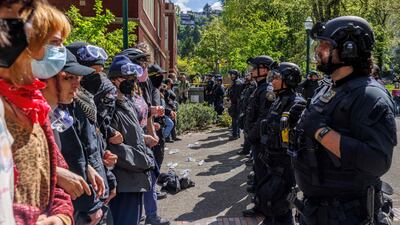
Students and activists protesting against the Gaza war face police after demonstrators were evicted from the library at Portland State University in Oregon. AFP -

A car is damaged after it was driven towards protesters at Portland State University. AFP -
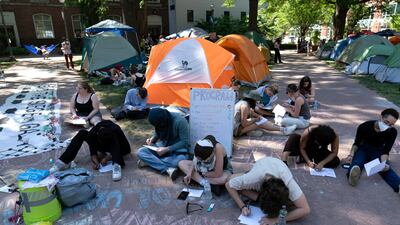
Students write letters in support of Palestinians in Gaza at an encampment at George Washington University, in Washington. AP -
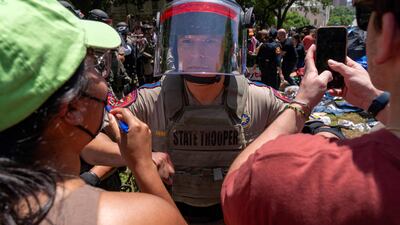
Pro-Palestinian protesters confront a state trooper at the University of Texas in Austin. AFP -
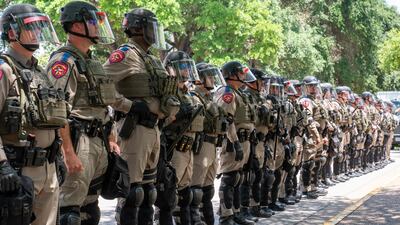
Texas State troopers stand guard at the University of Texas. AFP -
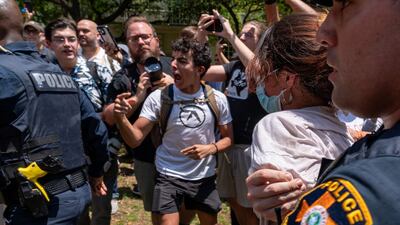
A protester confronts University of Texas police. AFP -

A demonstrator protests outside the encampment established in support of Palestinians in Gaza at Columbia University, in New York City. AFP -
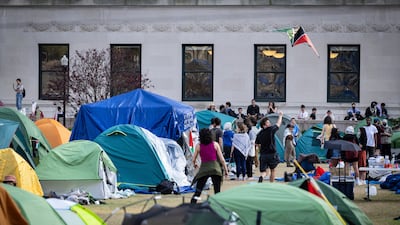
A student protester flies a kite inside the protest encampment at Columbia University. AP -
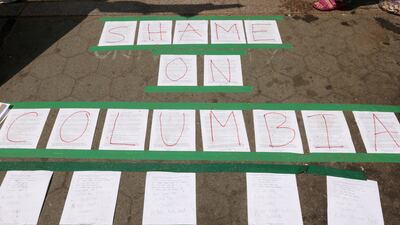
Students at Columbia University write a message as the conflict between Israel and Hamas continues. Reuters -
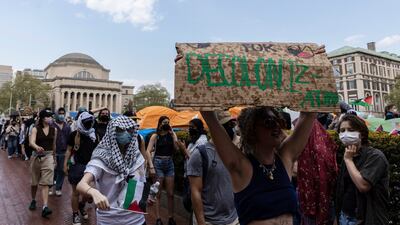
Student protesters march round their encampment at Columbia University. AP -
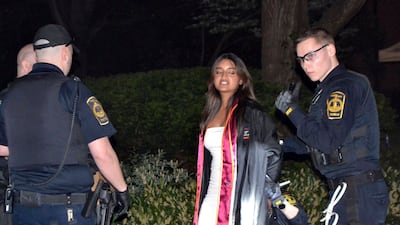
A student is arrested at a protest encampment on the Virginia Tech campus in Blacksburg. AP -
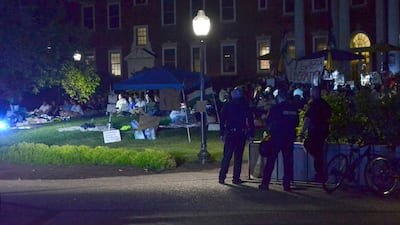
Police move to bring down an encampment after several days of protests by pro-Palestinian activists on the Virginia Tech campus. AP -

Vish Gill, a prominent figure at pro-Palestine protests, is arrested at Virginia Tech campus. AP -
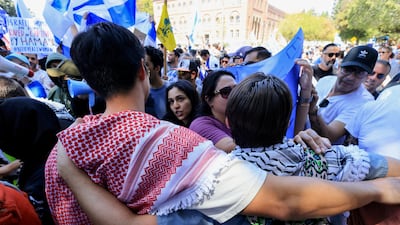
Pro-Israel counter-protesters gather at a pro-Palestine demonstration at the University of California, Los Angeles. Reuters -
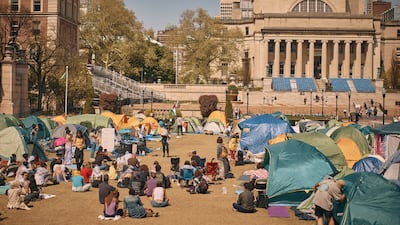
Pro-Palestine demonstrators gather on the campus of Columbia University. AP


Other UN special rapporteurs warned Columbia University, where the protest movement first gained momentum, that mass arrests and threatening suspension were a “clear violation” of “academic freedoms and students' fundamental rights”.
Mr Jarrar, who conducts advocacy for Dawn, said the Washington-based group has faced new challenges.
“When we reach out to anyone in the Middle East or North Africa now to say, you know, we would like to work on this project to support freedom of assembly or criticise a government, imprisonment of a student, people literally laugh,” Mr Jarrar said.
“Being a US-based organisation is becoming a liability because of the Biden administration.
“The United States at this point, under the Biden administration leadership, is becoming a country that stands for supporting human rights abusers around the world and crushing dissent internally and silencing students on campuses.”
Threats against press freedom
Students working at campus publications rose to the challenge in reporting events, which have attracted international attention but also dangers.
Daily Bruin reporters at the University of California, Los Angeles, said they were followed and attacked by pro-Israel protesters. Two students at Dartmouth College in New Hampshire were arrested during a police raid, despite identifying themselves as journalists.
A non-student cameraman in Texas was also knocked down and arrested while recording a demonstration.
“Journalists – including student journalists who have been thrust into a national spotlight to cover stories in their communities – must be allowed to cover campus protests without fearing for their safety,” Committee to Protect Journalists programme co-ordinator for the US Katherine Jacobsen told The National.
Students with the Columbia Spectator newspaper and radio station WKCR said they struggled to gain access to parts of campus as administrators imposed barriers to entry.
During a police raid on an academic building occupied by protesters, campus reporters said they were forced into areas far from police action and threatened with arrest if they left.
“Any efforts by authorities to stop them doing their jobs have far-reaching repercussions on the public’s ability to be informed about current events,” Ms Jacobsen said.

