
Live updates: Follow the latest on Israel-Gaza
The Pentagon has delayed a shipment of “high-payload munitions” to Israel, which must do more to protect civilians as it increases combat operations around Rafah, Defence Secretary Lloyd Austin said on Wednesday.
It is the first time the US has publicly confirmed that it has imposed restrictions on security assistance to Israel, which receives about $3.8 billion in military aid annually, with another $26 billion in the pipeline after recent action by Congress.
Mr Austin said the munitions were being blocked, at least temporarily, as Israel begins an assault on Rafah despite warnings of high casualties in the southern Gazan city where more than one million displaced civilians are sheltering.
“Israel shouldn't launch a major attack in Rafah without accounting for and protecting the civilians that are in that battle space,” Mr Austin told a Senate panel.
“As we have assessed that situation, we paused one shipment of high-payload munitions.”
The US has repeatedly pressed Israel to provide detailed plans on how it will protect civilians in Rafah, where two Hamas battalions are believed to be hiding, but so far Washington has not appeared to be satisfied.
The State Department said the US is considering further holds on weapons shipments.
"We have concerns about what [a Rafah invasion] would mean for the civilian population there, when you look at the fact that there are so many people crowded into such a small area, when you look at the way Israel has conducted its operations in the past and what the impact on the civilian population has been," State Department spokesman Matthew Miller told reporters.
"We have paused one shipment of near-term assistance, and we are reviewing others."
Mr Austin received angry opposition from Republican politicians who suggested holding the weapons could be seen as the US abandoning its ally as it fights Hamas, which led the October 7 attacks that killed about 1,200 people, according to Israeli tallies.
The Pentagon chief said he had not made a final decision on how to proceed with that shipment. He suggested the munitions, if transferred, would be used carelessly by Israel.
The delivery was supposed to contain 3,500 bombs, including thousands of 2,000-pound munitions, according to a senior administration official.
Gaza health authorities say more than 34,800 people, most of them women and children, have been killed in the strip since October 7.
“It's about having the right kinds of weapons for the task at hand,” Mr Austin said, indicating that small-diameter precision bombs are useful in an urban warfare environment.
“It's helpful, but maybe not so much is a 2,000-pound bomb that could create a lot of collateral damage.
"And so we've been very clear that … Israel needs to do more to protect the civilians in the battle space … and we would also like to see them do a more precise operation.”

Until now, the Pentagon and State Department have repeatedly stressed that US support for Israel as it attacks Hamas in Gaza is “ironclad”, and the Biden administration has refused to impose any end-use monitoring or conditions on how American weapons are used there.
“Something has changed,” said Aaron David Miller, a former Middle East analyst at the US State Department, although he cautioned that the move was probably tied to Rafah and did not necessarily signify a broader policy shift.
“The administration’s frustration and anger over Rafah has finally moved from passive-aggressive over the last six months when the administration withheld its fire and refused to impose a single cost or consequence that anybody would view as serious pressure," Mr Miller told The National.
“They now have signalled pretty strongly that there are limits.”
Axios on Sunday quoted two Israeli sources as saying that Washington last week put an ammunition shipment on hold.
Republican Speaker of the House Mike Johnson and Senate minority leader Mitch McConnell voiced their disapproval of the pause, saying "security assistance for Israel is an urgent priority that must not be delayed".
"The American public deserves to understand the nature, timing and scope of these reviews," they wrote in a joint statement.
Lindsey Graham, a hard-right Republican senator, said it was “obscene” that the US is delaying a weapons transfer.
“I think it was a disastrous decision,” he said. “If we stop [sending] weapons necessary to destroy the enemies of the state of Israel at a time of great peril, we will pay a price.
"This is obscene. It is absurd. Give Israel what they need to fight the war they can't afford to lose.”
Senator Chris Murphy, a Democrat, said that the “application of overwhelming military force can in fact grow terrorist threats, not shrink them”.
Mr Austin's remarks came as the Biden administration was expected to notify Congress whether it believes Israel had violated US and or international law in Gaza.
On Tuesday, the State Department hinted that it was unlikely to meet the May 8 deadline.
“It’s possible it slips just a little bit,” Mr Miller said.
The report, parts of which are expected to be made public after it is sent to Congress, could put a major dent in US support of Israel, especially if the administration deems Israel has breached US and international law.
Such a finding could lead to further weapons delays.
Civilians ordered to flee eastern Rafah as Israel begins invasion – in pictures
-

An Israeli soldier directs a tank near Israel's border with southern Gaza. Getty Images -
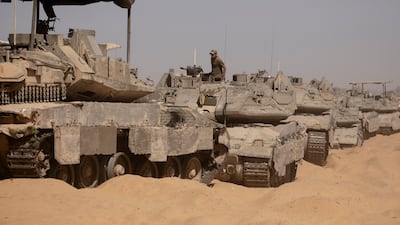
An Israeli soldier stands on a tank in southern Israel. Getty Images -

People flee the eastern parts of Rafah ahead of a threatened Israeli incursion. Reuters -

Palestinians leave ahead of a threatened assault on Rafah. Reuters -

Palestinians search for casualties in the rubble of a house destroyed in an Israeli strike in Rafah. AFP -

Palestinians carry an injured man who was pulled from the rubble of a house destroyed in an Israeli strike in Rafah. AFP -
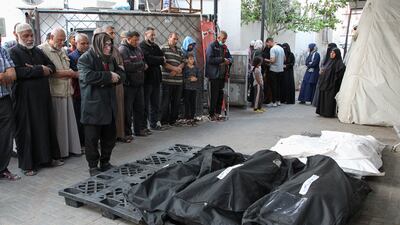
Mourners next to the bodies of Palestinians killed in an Israeli strike in southern Gaza. Reuters -

Mourners at Abu Yousef El-Najjar Hospital in Rafah. Reuters



