

Live updates: Follow the latest on Israel-Gaza
The student pro-Palestine movement sweeping the US will be remembered as a major generational moment in American political history.
Images of police using batons to arrest students and break up protest camps recall the anti-Vietnam War movement in the late 1960s and early '70s, when America was embroiled in another unpopular conflict.
Then, Americans saw what was unfolding on the other side of the world through newspapers, magazines and television broadcasts.
Today's events in Gaza can be viewed in real time by anyone with a phone.
Mark Naison, professor of history at Fordham University, said young people have been particularly affected by the “heartbreaking scenes of death and destruction in Gaza”.
These are being “conveyed with great power, day by day, hour by hour, minute by minute, on Instagram and TikTok, places where most young people get their information", Prof Naison told The National. “If you have daily exposure to those images, you might just be impelled to join them.”
When Columbia University called for New York police to clear student tents on campus in mid-April, resulting in more than 100 arrests, it influenced a wave of student solidarity and protest against Israel's war on Gaza.
Anti-war demonstrators at dozens of American colleges and universities set up their own camps, sit-ins and protest gatherings over the past two weeks.

Universities have responded to the protests – which have drawn violence from pro-Israel supporters and claims of anti-Semitism or Islamophobia – by calling for a police response, moving classes and exams online, cancelling graduation ceremonies or negotiating with student demonstrators.
More than 2,000 people have been arrested, according to an AP tally on May 2.
President Joe Biden said on Thursday that “dissent is essential for democracy” while denouncing violent protest or hate speech.
Steven Thrasher, a journalist and professor at Northwestern University, visited camps, including Columbia, and served as supporting faculty at his campus.
“One of the speakers they had at Columbia, the night I was there, had been arrested in that same spot in 1968,” he said, referring to a year when Vietnam War protests were at their height.
“She spoke very briefly and beautifully, and had a similar message that a Palestinian nurse who just returned from Gaza had also shared, that you will feel like you're really doing the right thing. You are going to remember the feeling of doing the right thing through your whole life. And that will continue to be a guiding voice for you.”

Rare show of support for Palestinians
The protests nationwide mark a rare moment of widespread US activism in support of the Palestinian cause.
“It's one-of-a-kind in the number and energy in terms of being pro-Palestine,” Helga Tawil-Souri, a Palestinian-American associate professor at New York University, told The National.
When visiting camps, chants of “free, free Palestine” can be heard from people wearing keffiyehs while both Jewish and Muslim participants take time to pray.
Protesters at Columbia renamed a building “Hind's Hall” in honour of a girl, six, who was killed by Israeli gunfire.
“It'd be hard to imagine this having happened, you know. Even in the war against Gaza in like 2008, 2009, you didn't see any kind of uprising,” Ms Tawil-Souri said.
Students across the country have issued a few common demands: for their universities to disclose their investments and divest from any companies or academic institutions connected to Israel's action in the Palestinian territories, and to demand a ceasefire in Gaza.
-
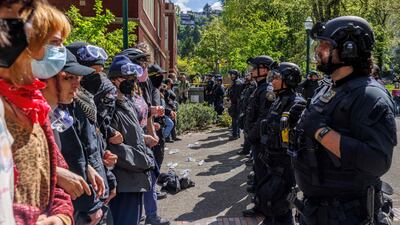
Students and activists protesting against the Gaza war face police after demonstrators were evicted from the library at Portland State University in Oregon. AFP -

A car is damaged after it was driven towards protesters at Portland State University. AFP -
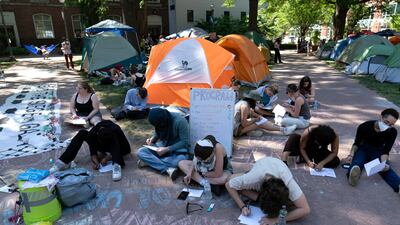
Students write letters in support of Palestinians in Gaza at an encampment at George Washington University, in Washington. AP -
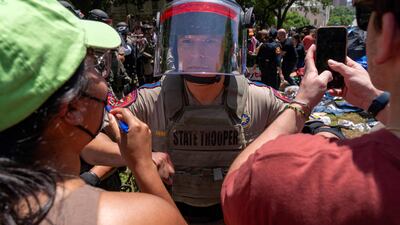
Pro-Palestinian protesters confront a state trooper at the University of Texas in Austin. AFP -
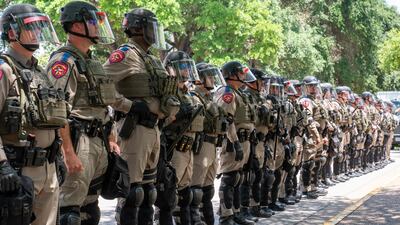
Texas State troopers stand guard at the University of Texas. AFP -
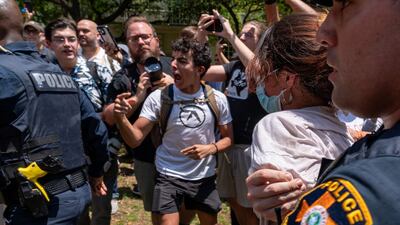
A protester confronts University of Texas police. AFP -

A demonstrator protests outside the encampment established in support of Palestinians in Gaza at Columbia University, in New York City. AFP -
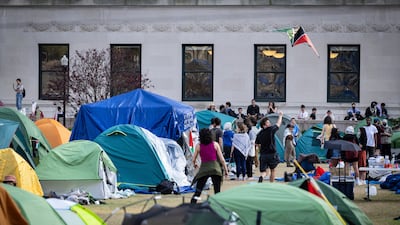
A student protester flies a kite inside the protest encampment at Columbia University. AP -
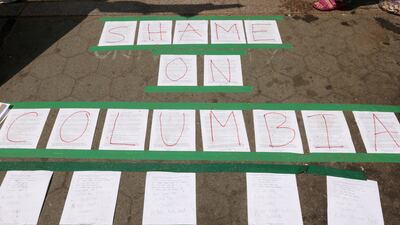
Students at Columbia University write a message as the conflict between Israel and Hamas continues. Reuters -
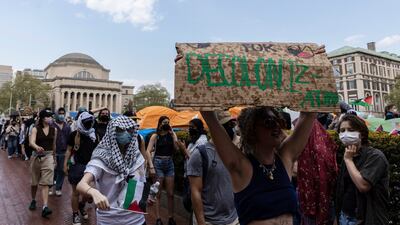
Student protesters march round their encampment at Columbia University. AP -
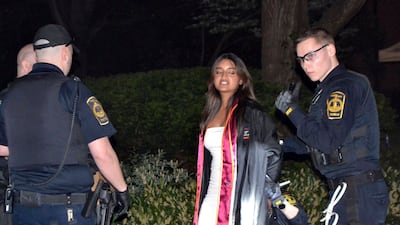
A student is arrested at a protest encampment on the Virginia Tech campus in Blacksburg. AP -
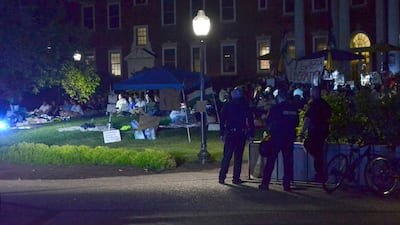
Police move to bring down an encampment after several days of protests by pro-Palestinian activists on the Virginia Tech campus. AP -

Vish Gill, a prominent figure at pro-Palestine protests, is arrested at Virginia Tech campus. AP -
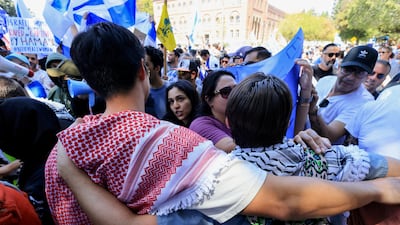
Pro-Israel counter-protesters gather at a pro-Palestine demonstration at the University of California, Los Angeles. Reuters -
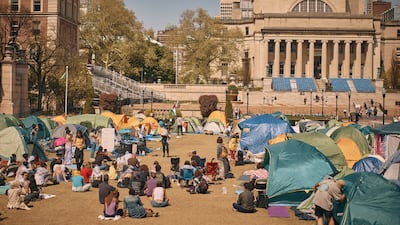
Pro-Palestine demonstrators gather on the campus of Columbia University. AP


Health officials in Gaza report more than 34,500 people have been killed during Israel's war on the Palestinian enclave.
That was after a Hamas-led attack on Israel in October, where officials say 1,200 were killed.
Young Americans over the years have been active against gun violence and climate change, making them “no strangers to protest", Prof Naison said.
“Four years ago, when many of them were in high school, they participated in the largest mass movement in modern US history, the Black Lives Matter movement that emerged in response to the murder of George Floyd in May 2020.”
For some, the growing support for Palestine in American universities is a result of the US backing Israel in Gaza.
“What's special about it is [Israel] couldn't do what it's doing without the support of the United States, so students in the United States think we have the responsibility,” Columbia's Prof Bruce Robbins told CNN.
History repeats itself on campuses
Columbia is no stranger to civil disobedience.
Hamilton Hall, on the Morningside campus in the city's Upper West Side, is named after founding father Alexander Hamilton, who attended King's College, the former name of Columbia.
Columbia's order for the NYPD to clear the pro-Palestine occupation of the hall on April 30 was on the 56th anniversary of police breaking up a week-long protest lock-in there in 1968.
Back then, students were initially protesting against a racially segregated campus gymnasium. But their anger later turned towards the university's ties to the Pentagon during the Vietnam War.
The police crackdown was violent and the university's website says “the fallout dogged Columbia for years”.
Hamilton Hall was also occupied by students against war in 1972, calling for divestment from South Africa for its apartheid policies in 1985, and demanding the creation of an ethnic studies department in 1996.
Republican politicians' calls for the National Guard to respond to protests brings back memories of 1970, when Ohio National Guard members fired into a crowd of Kent State University anti-war demonstrators, killing four and wounding nine.
And at Yale University, historical records and archives related to the Black Panthers, a racial-equality political organisation led by young students, has relevance for the protests there today, Prof Roderick Ferguson tells The National.
Four pro-Palestine protesters were violently apprehended and arrested there by police this week.
Prof Ferguson says that judging by the police response, being the custodian of the Black Panthers' historical documents does not make Yale the champion of what the group stood for.
He described the Panthers' main aims as being "an end to racial and colonial domination, the self-determination of minority communities, the critique of police repression, and a commitment to the sanctity of the downtrodden".
“The current protests are attempts to extend these commitments to Palestinians,” Prof Ferguson said.
When asked on Thursday whether the protests compelled him to reconsider his support for Israel, Mr Biden answered: “No”.
“I think the world will look back at this moment as a failure of moral leadership on the part of government officials and university administrators,” Prof Ferguson said.
“It will also remember the students as the ones who stepped into the gap to decry a slaughter on an industrial scale.”
Prof Naison added: "These young people will not give up, no matter how many police or National Guard are sent to break up their encampments.
"For many, this protest is part of a life mission that they discovered when they were still in high school."


