The UAE Cabinet has approved a national charter for children that sets out 10 cultural rights, including access to the arts, opportunities to develop their talents and the right to participate in and shape the country’s cultural life.
The National Charter for Children’s Culture aims to ensure every child in the UAE has access to a safe and supportive cultural environment, with government organisations sharing responsibility for meeting their needs.
It recognises children as active participants in the country’s cultural development, as well as custodians of its national identity, stating that every child has the right to develop and take pride in their cultural identity.

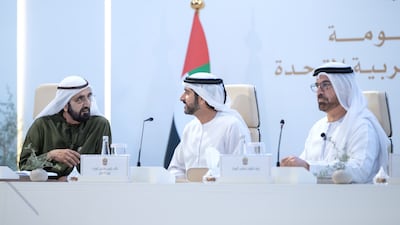
The charter was approved at a Cabinet meeting chaired by Sheikh Mohammed bin Rashid, Vice President, Prime Minister and Ruler of Dubai, at which measures covering education, artificial intelligence, the environment and the economy were announced.
The Cabinet also approved the National Youth Policy, which aims to improve the well-being of young people, strengthen their sense of national identity and better prepare them for the future.
A new framework for overseeing higher education institutions across the Emirates, including those operating in free zones, was also approved.
Institutions will be classified and assessed on the quality of their performance and educational outcomes, with the level of regulatory oversight determined by their compliance and risk profiles.
AI to transform government services
Sheikh Mohammed said Mira, the UAE government’s AI-powered concierge service, would be available to everyone using federal government services from March next year.
Federal government bodies have been instructed to integrate their services into the platform within timelines approved by the Cabinet.
“We are entering a new phase in how we deliver government services,” Sheikh Mohammed said. “People will be able to speak to the government in their own language and get the services they need in their own words. They will spend less time on government transactions and have more time for their work.”
The Cabinet approved a strategy to incorporate agentic AI – technology capable of carrying out tasks autonomously – into 50 per cent of government operations, services and procedures.
The strategy includes plans to train 80,000 federal government employees and halve the time required to carry out government operations and develop strategies.
A unified technology platform, FedAI, will enable federal entities to develop and operate AI systems within secure government infrastructure.
Clean energy and investment
The Cabinet also reviewed progress towards the country’s clean energy targets, with renewable and nuclear power accounting for about 32 per cent of electricity generation in 2025, against a national target of 35 per cent by 2031.
About Dh41 billion ($11.2 billion) has been earmarked for projects involving hydrogen, its derivatives and sustainable aviation fuel.
Ministers also reviewed the performance of the Sheikh Zayed Housing Programme, which has issued more than 75,000 housing support decisions worth more than Dh54 billion since its establishment in 1999.
The Cabinet was told that the UAE ranked ninth globally for foreign direct investment inflows last year, attracting Dh177 billion, equivalent to about 7.9 per cent of the country’s gross domestic product.
A new framework for joint economic committees between the UAE and other countries was approved to strengthen international trade and investment partnerships.
Ministers also approved a resolution designating the Emirates Genome Council as the authority responsible for establishing a national genomic database to support the development of personalised health care and advanced treatments.
The resolution sets out rules governing the storage, use and sharing of genetic data, as well as safeguards to protect privacy.

