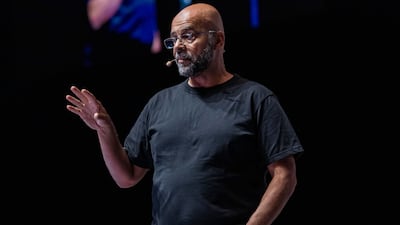
Artificial intelligence is an “incredible superpower” but there is a huge responsibility on everyone to ensure it is used ethically for the good of humanity, a Dubai conference heard on Monday.
In an impassioned and sobering speech to mayors and city officials from across the world, Mo Gawdat said the “whole world was about to change” because of AI. The former Google X executive cautioned that, while its transformative impact can be hugely beneficial, it is equally imperative to keep it out of the hands of “bad actors”.
“Artificial intelligence is not good or evil,” Mr Gawdat told the Asia Pacific Cities Summit and Mayors' Forum, at Expo City Dubai. “Apply it for good and you can build a utopia for everyone. You apply it for evil and you can destroy quite a few things.” Mr Gawdat said the most important responsibility today was preventing “bad actors from applying it for their own agendas”.
“We don't realise how this technology is shaping everything … And it will shape your cities in ways that you've never even considered,” such as the inclusion of robots into work, he said. “I guarantee you I will have a robot at home next year,” he said. “They're very, very capable.
“There will be a time in the very near future where instead of buying a vacuum cleaner, you're going to buy a robot. How are we integrating those? How are we integrating [that] reality into our cities … The whole world that we live in today is about to change.”
Why AI could be 'Pandora's Box'
His comments came on the opening day of a conference that organisers said will draw mayors and leaders from more than 300 cities. Attendees will discuss some of the pressing challenges facing the world’s cities, such as climate change and embracing technology, in the location that hosted Expo 2020 Dubai.
During his talk on “reimagining urban futures with AI”, Mr Gawdat predicted that every task performed by a human would “very, very soon” be able to be performed better by AI. He said this was down to an “intelligence explosion”.
“I will tell you that it literally is Pandora's Box,” he said, repeating a point about AI being like “raising Superman”, whereby superpowers such as the ability to stop speeding bullets are used for good.
“If the family that adopted [Superman] said, ‘oh, you can fly through walls, fly through that and ... rob everyone’, it would become a super villain, right? And that change, that difference … is entirely [everyone’s] responsibility.
“Never support an AI that you don't want your daughter to be at the receiving end of. And please think deeply about that in every decision that you make, because we are releasing Superman in the real world. If we release a Superman that will be a super villain, eventually it will turn against us.”
Has AI already changed the world?
Geoffrey Hinton, widely thought to be the “godfather of AI”, Apple co-founder Steve Wozniak and Prince Harry are among the signatories to a petition calling for the prohibition of the development of AI “superintelligence” – which usually refers to developing reasoning skills that would surpass humans.
But the use of AI is increasing. In the UAE, a recent report from the consultancy firm KPMG, which collaborated with the University of Melbourne, found AI use and enthusiasm is higher than the global average. It found 97 per cent of UAE respondents said they had recently used AI “for work, study or personal purposes”.
Mr Gawdat said Dubai showed a “preview” of what the rest of the world could be like, pointing to the way the city has deployed technology to ensure resident safety. “The reason this is the reality of the life that we live here is because of technology. In the years I've lived here, in the rare occasion when something goes wrong, it's a matter of minutes to hours before the perpetrators are identified.
“Every time I had my leadership, my chief executive officer or co-founders come to the UAE, they came out with one comment, which I don't know if I've ever shared, but they basically got on the plane and the first thing they said is 'this city, this nation is run like a start-up'. It has that incredible speed. It has that incredible agility.”
Dubai's leading role
Earlier, at the official welcome for attendees, Reem Al Hashimy, Minister of State for International Co-operation, said Dubai would be a “laboratory of ideas” over the next few days.
“This gathering is about how cities work, how they serve their people, adapt to pressure and continue to deliver when the ground shifts beneath them,” said Ms Al Hashimy. She said Dubai’s own journey was one of “continuous learning”.
“Our city has grown from a modest coastal jewel into a global crossroads precisely because we have been willing to listen to new technologies, new partners and new ways of thinking,” she said.
“Our growth has never been just about scale but purpose, and while we do not claim to have all the answers, we have never lost our appetite to ask the right questions. That curiosity sits at the heart of our story and it is the same curiosity that animates the summit today.”
The conference continues at Expo City Dubai until Wednesday.

KILLING OF QASSEM SULEIMANI
What vitamins do we know are beneficial for living in the UAE
Vitamin D: Highly relevant in the UAE due to limited sun exposure; supports bone health, immunity and mood.
Vitamin B12: Important for nerve health and energy production, especially for vegetarians, vegans and individuals with absorption issues.
Iron: Useful only when deficiency or anaemia is confirmed; helps reduce fatigue and support immunity.
Omega-3 (EPA/DHA): Supports heart health and reduces inflammation, especially for those who consume little fish.
Conflict, drought, famine
Estimates of the number of deaths caused by the famine range from 400,000 to 1 million, according to a document prepared for the UK House of Lords in 2024.
It has been claimed that the policies of the Ethiopian government, which took control after deposing Emperor Haile Selassie in a military-led revolution in 1974, contributed to the scale of the famine.
Dr Miriam Bradley, senior lecturer in humanitarian studies at the University of Manchester, has argued that, by the early 1980s, “several government policies combined to cause, rather than prevent, a famine which lasted from 1983 to 1985. Mengistu’s government imposed Stalinist-model agricultural policies involving forced collectivisation and villagisation [relocation of communities into planned villages].
The West became aware of the catastrophe through a series of BBC News reports by journalist Michael Buerk in October 1984 describing a “biblical famine” and containing graphic images of thousands of people, including children, facing starvation.
Band Aid
Bob Geldof, singer with the Irish rock group The Boomtown Rats, formed Band Aid in response to the horrific images shown in the news broadcasts.
With Midge Ure of the band Ultravox, he wrote the hit charity single Do They Know it’s Christmas in December 1984, featuring a string of high-profile musicians.
Following the single’s success, the idea to stage a rock concert evolved.
Live Aid was a series of simultaneous concerts that took place at Wembley Stadium in London, John F Kennedy Stadium in Philadelphia, the US, and at various other venues across the world.
The combined event was broadcast to an estimated worldwide audience of 1.5 billion.
Mercer, the investment consulting arm of US services company Marsh & McLennan, expects its wealth division to at least double its assets under management (AUM) in the Middle East as wealth in the region continues to grow despite economic headwinds, a company official said.
Mercer Wealth, which globally has $160 billion in AUM, plans to boost its AUM in the region to $2-$3bn in the next 2-3 years from the present $1bn, said Yasir AbuShaban, a Dubai-based principal with Mercer Wealth.
“Within the next two to three years, we are looking at reaching $2 to $3 billion as a conservative estimate and we do see an opportunity to do so,” said Mr AbuShaban.
Mercer does not directly make investments, but allocates clients’ money they have discretion to, to professional asset managers. They also provide advice to clients.
“We have buying power. We can negotiate on their (client’s) behalf with asset managers to provide them lower fees than they otherwise would have to get on their own,” he added.
Mercer Wealth’s clients include sovereign wealth funds, family offices, and insurance companies among others.
From its office in Dubai, Mercer also looks after Africa, India and Turkey, where they also see opportunity for growth.
Wealth creation in Middle East and Africa (MEA) grew 8.5 per cent to $8.1 trillion last year from $7.5tn in 2015, higher than last year’s global average of 6 per cent and the second-highest growth in a region after Asia-Pacific which grew 9.9 per cent, according to consultancy Boston Consulting Group (BCG). In the region, where wealth grew just 1.9 per cent in 2015 compared with 2014, a pickup in oil prices has helped in wealth generation.
BCG is forecasting MEA wealth will rise to $12tn by 2021, growing at an annual average of 8 per cent.
Drivers of wealth generation in the region will be split evenly between new wealth creation and growth of performance of existing assets, according to BCG.
Another general trend in the region is clients’ looking for a comprehensive approach to investing, according to Mr AbuShaban.
“Institutional investors or some of the families are seeing a slowdown in the available capital they have to invest and in that sense they are looking at optimizing the way they manage their portfolios and making sure they are not investing haphazardly and different parts of their investment are working together,” said Mr AbuShaban.
Some clients also have a higher appetite for risk, given the low interest-rate environment that does not provide enough yield for some institutional investors. These clients are keen to invest in illiquid assets, such as private equity and infrastructure.
“What we have seen is a desire for higher returns in what has been a low-return environment specifically in various fixed income or bonds,” he said.
“In this environment, we have seen a de facto increase in the risk that clients are taking in things like illiquid investments, private equity investments, infrastructure and private debt, those kind of investments were higher illiquidity results in incrementally higher returns.”
The Abu Dhabi Investment Authority, one of the largest sovereign wealth funds, said in its 2016 report that has gradually increased its exposure in direct private equity and private credit transactions, mainly in Asian markets and especially in China and India. The authority’s private equity department focused on structured equities owing to “their defensive characteristics.”
Our family matters legal consultant
Name: Hassan Mohsen Elhais
Position: legal consultant with Al Rowaad Advocates and Legal Consultants.
TEACHERS' PAY - WHAT YOU NEED TO KNOW
Pay varies significantly depending on the school, its rating and the curriculum. Here's a rough guide as of January 2021:
- top end schools tend to pay Dh16,000-17,000 a month - plus a monthly housing allowance of up to Dh6,000. These tend to be British curriculum schools rated 'outstanding' or 'very good', followed by American schools
- average salary across curriculums and skill levels is about Dh10,000, recruiters say
- it is becoming more common for schools to provide accommodation, sometimes in an apartment block with other teachers, rather than hand teachers a cash housing allowance
- some strong performing schools have cut back on salaries since the pandemic began, sometimes offering Dh16,000 including the housing allowance, which reflects the slump in rental costs, and sheer demand for jobs
- maths and science teachers are most in demand and some schools will pay up to Dh3,000 more than other teachers in recognition of their technical skills
- at the other end of the market, teachers in some Indian schools, where fees are lower and competition among applicants is intense, can be paid as low as Dh3,000 per month
- in Indian schools, it has also become common for teachers to share residential accommodation, living in a block with colleagues
Learn more about Qasr Al Hosn
In 2013, The National's History Project went beyond the walls to see what life was like living in Abu Dhabi's fabled fort:
