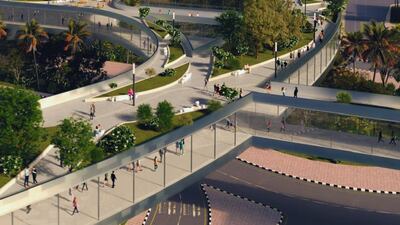
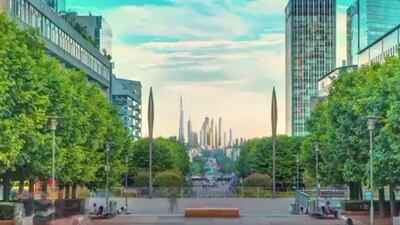
Residents take a stroll on a pedestrian bridge in the Bluewaters island development. Photo: Reuters

Dubai set to follow in footsteps of Paris and New York to create pedestrian city


John Dennehy
  • English
  • Arabic

A major plan to transform Dubai into a “pedestrian-friendly” city could connect inaccessible neighbourhoods, as well as encouraging mobility and healthier lifestyles, experts say.

The Dubai Walk project could also boost public transport by linking pedestrian routes to existing infrastructure – although questions about sustainability, coping with summer heat and connectivity in a car-centric city remain.

However, the move is being hailed as a step forward in encouraging mobility and championing active lifestyles among the emirate's surging population. And seen as echoing other successful schemes across the world from New York to Seoul that reclaim derelict spaces for pedestrian use.

“There is no going back in terms of a car-centric city, but we can reduce the footprint and impact of cars … by connecting neighbourhoods and getting people to walk,” said Apostolos Kyriazis, associate professor of architecture and urbanism at Abu Dhabi University.

  • Sheikh Mohammed bin Rashid, Vice President and Ruler of Dubai, has announced The Dubai Walk Master Plan. All photos: @HHShkMohd X
    Sheikh Mohammed bin Rashid, Vice President and Ruler of Dubai, has announced The Dubai Walk Master Plan. All photos: @HHShkMohd X
  • Sheikh Mohammed, other sheikhs and senior officials attend a ceremony to announce the plans
    Sheikh Mohammed, other sheikhs and senior officials attend a ceremony to announce the plans
  • It will include an integrated walking network featuring 112km of waterfront paths, 124km of green walking paths, and 150km of rural and mountain paths for pedestrians
    It will include an integrated walking network featuring 112km of waterfront paths, 124km of green walking paths, and 150km of rural and mountain paths for pedestrians
  • About 3,300km of pedestrian paths will be constructed
    About 3,300km of pedestrian paths will be constructed
  • Creating greener communities, with amenities within walking distance, is central to Dubai's development strategy
    Creating greener communities, with amenities within walking distance, is central to Dubai's development strategy
  • The master plan calls for developing a '20-minute city'
    The master plan calls for developing a '20-minute city'

A plan to get Dubai walking

Sheikh Mohammed bin Rashid, Vice President and Ruler of Dubai, on Saturday announced the plan to transform the emirate into a “year-round pedestrian-friendly city”, with more than 3,000km of new walkways and 110 new bridges and tunnels.

A pilot phase will run from 2025 to 2027, with the plan due to finish in 2040. More details will be announced, but Dubai Media Office said the scheme aims to increase pedestrian and environmentally friendly transportation use “from 13 per cent to 25 per cent”.

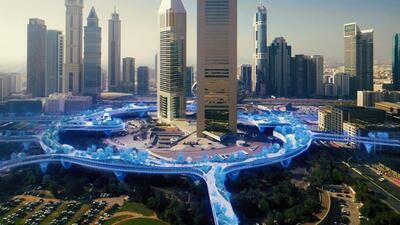
Two key routes were highlighted. One runs along the Dubai Creek area, which is already accessible for walkers, while the second is called the “future loop” around the Museum of the Future, featuring new elevated paths and an “air-conditioned zone”, also connecting Dubai World Trade Centre, Emirates Towers, Dubai International Financial Centre and nearby metro stations.

Dubai Metro passes over flyovers on the Sheikh Zayed Road in Dubai. Connecting pedestrian paths to public transport is seen as crucial to boosting mobility. Chris Whiteoak / The National

From car-centric past to walkable future

Gulf cities such as Dubai that began expanding in the 1950s were built largely with cars in mind. New developments offered little consideration for pedestrians. Many areas lacked paths, shaded areas and pedestrian bridges. However, this is changing amid the promotion of cycling and public transport.

Dubai's 2040 Urban Master Plan called for developing a “20-minute city”, giving residents access to 80 per cent of their daily needs and destinations within 20 minutes by foot or bicycle.

Experts who spoke to The National welcomed any effort to increase walking and highlighted how much can be done even through small improvements such as adding shade.

“City authorities are trying to change tactics,” said Prof Kyriazis. “More and more are trying to turn the priority to ones that need it – such as walking and cycling. Dubai and Abu Dhabi are two of these cities.”

Prof Kyriazis said the Dubai plan could boost safety while closing the division of neighbourhoods that cars sometimes create. “The street network does connect places but can disconnect too,” he said. “It creates boundaries not easy to cross and creates social alienation.”

It is further hoped the plan could help older people and those with disabilities affecting mobility navigate the city. "[They are] particularly sensitive to aspects such as steps and short crossing times at signalised crossings," said Paulo Anciaes, senior researcher in transport at University College London. "The improvement of walking conditions can contribute to the mobility of those people, and thus to their social inclusion."

How public transport could benefit

Dubai is trying to rebalance the car-centric environment by expanding Dubai Metro and increasing bus routes. Authorities have also improved bus stations and added shaded areas for passengers.

Monica Menendez, professor of civil and urban engineering at New York University Abu Dhabi, said if walking in Dubai becomes normalised then there could be more public transport use.

She said the Dubai Walk scheme could be an “enabler of public transport if the connectivity is there” and people can walk between stations.

“Awareness is increasing and any effort is good. If we manage to increase the share of pedestrians, we end up improving the whole mobility system,” she said. “I would like it to be also used for commuting – even part of the journey – and not only by people doing exercise.”

Making Dubai more walkable is no easy task, said Prof Kyriazis, but doing so in conjunction with more public transport could cut traffic congestion.

“More roads, more traffic – this is a universal law,” he said. Instead, authorities need to offer public transport options and encourage cycling, which could “liberate cities further”, he said. “Dubai has the critical numbers to support such schemes.”

The High Line in New York. Getty Images

Walking around the world

The High Line in New York and Seoul's Skygarden are two examples of elevated corridors brought back for pedestrian use. New York’s park was created on a former railway, while a derelict highway overpass in the South Korean capital has been revitalised as an urban garden.

“They not only revitalised neighbourhoods but led to amazing architecture and created a real-estate frenzy,” said Prof Kyriazis. “People are healthier, more active and are exploring more. It is a win-win situation.”

Mr Anciaes said the scale of the Dubai plan is "unprecedented anywhere" but similar schemes such as the High Line and also Paris's Promenade Plantee and Hong Kong's network of connected walkways have proved their worth.

"Cities are increasingly ‘competing’ for global investment and tourists, and the improvement of pedestrian conditions facilitates mobility, enhances quality of life, and consolidates a positive image of the city," he said. "So Dubai can achieve a competitive advantage in comparison with other cities of the same size."

The city of New York, however, emerged before the era of the car and has an extensive public transport system, and projects such as the High Line tend to be geared more towards leisure than pedestrian access.

However, authorities from Barcelona to Copenhagen are trying to wrestle back space from cars and make the urban core more accessible, pedestrian and bike-friendly.

Prof Menendez said planners in the UAE are aware of the need for more pedestrian-friendly areas, not just for sustainability but also health.

“Initiatives like this might help more active lifestyles and be good for health. I like that,” she said.

The Skygarden in Seoul. Getty Images

Sustainability and the summer

The Dubai Walk Master Plan aims to encourage pedestrians all “year-round”, even in the scorching summers. Artist's impressions show people walking under green canopies, past water fountains and along elevated pedestrian bridges.

“The biggest challenge is weather,” said Prof Menendez. “Greenery is always good and makes walkers feel more comfortable. But there are questions of irrigation and how to make it sustainable. Shading is one basic solution.”

Prof Kyriazis highlighted that authorities in Dubai and Abu Dhabi can use native trees, such as sidr and ghaf, that need less water and can withstand heat. “We can choose wisely,” he said.

Increased tree cover has benefits such as reducing heat, pollution and flood risk. Mr Anciaes pointed to a report by The Nature Conservancy organisation that showed increasing tree canopy in hot and arid climates does increase demand but it can be "feasibly met" and is "justified" by their benefits.

Prof Kyriazis also cautioned against outdoor air-conditioning as it was not “sustainable or logical”. He said: “The hot weather should be converted from an excuse to air-condition public spaces to an opportunity to revisit passive cooling strategies.

“There is enough shade from a natural source or from a structure such as a canopy. It is more than enough for people to walk with cooling air breezes as they pass through.”


THE BIO

Mr Al Qassimi is 37 and lives in Dubai
He is a keen drummer and loves gardening
His favourite way to unwind is spending time with his two children and cooking

STAGE 4 RESULTS

1 Sam Bennett (IRL) Deceuninck-QuickStep - 4:51:51

2 David Dekker (NED) Team Jumbo-Visma

3 Caleb Ewan (AUS) Lotto Soudal 

4 Elia Viviani (ITA) Cofidis

5 Matteo Moschetti (ITA) Trek-Segafredo

General Classification

1 Tadej Pogacar (SLO) UAE Team Emirates - 12:50:21

2 Adam Yates (GBR) Teamn Ineos Grenadiers - 0:00:43

3 Joao Almeida (POR) Deceuninck-QuickStep - 0:01:03

4 Chris Harper (AUS) Jumbo-Visma - 0:01:43

5 Neilson Powless (USA) EF Education-Nippo - 0:01:45

%3Cp%3E%3Cstrong%3ETHE%20SPECS%3C%2Fstrong%3E%0D%3Cbr%3EEngine%3A%203.5-litre%20V6%0D%3Cbr%3ETransmission%3A%209-speed%20automatc%0D%3Cbr%3EPower%3A%20279hp%0D%3Cbr%3ETorque%3A%20350Nm%0D%3Cbr%3EPrice%3A%20From%20Dh250%2C000%0D%3Cbr%3EOn%20sale%3A%20Now%3C%2Fp%3E%0A
COMPANY%20PROFILE
%3Cp%3E%3Cstrong%3EName%3A%20%3C%2Fstrong%3EKinetic%207%3Cbr%3E%3Cstrong%3EStarted%3A%3C%2Fstrong%3E%202018%3Cbr%3E%3Cstrong%3EFounder%3A%3C%2Fstrong%3E%20Rick%20Parish%3Cbr%3E%3Cstrong%3EBased%3A%3C%2Fstrong%3E%20Abu%20Dhabi%2C%20UAE%3Cbr%3E%3Cstrong%3EIndustry%3A%3C%2Fstrong%3E%20Clean%20cooking%3Cbr%3E%3Cstrong%3EFunding%3A%3C%2Fstrong%3E%20%2410%20million%3Cbr%3E%3Cstrong%3EInvestors%3A%3C%2Fstrong%3E%20Self-funded%3C%2Fp%3E%0A
What are the influencer academy modules?
  1. Mastery of audio-visual content creation. 
  2. Cinematography, shots and movement.
  3. All aspects of post-production.
  4. Emerging technologies and VFX with AI and CGI.
  5. Understanding of marketing objectives and audience engagement.
  6. Tourism industry knowledge.
  7. Professional ethics.

Mercer, the investment consulting arm of US services company Marsh & McLennan, expects its wealth division to at least double its assets under management (AUM) in the Middle East as wealth in the region continues to grow despite economic headwinds, a company official said.

Mercer Wealth, which globally has $160 billion in AUM, plans to boost its AUM in the region to $2-$3bn in the next 2-3 years from the present $1bn, said Yasir AbuShaban, a Dubai-based principal with Mercer Wealth.

Within the next two to three years, we are looking at reaching $2 to $3 billion as a conservative estimate and we do see an opportunity to do so,” said Mr AbuShaban.

Mercer does not directly make investments, but allocates clients’ money they have discretion to, to professional asset managers. They also provide advice to clients.

“We have buying power. We can negotiate on their (client’s) behalf with asset managers to provide them lower fees than they otherwise would have to get on their own,” he added.

Mercer Wealth’s clients include sovereign wealth funds, family offices, and insurance companies among others.

From its office in Dubai, Mercer also looks after Africa, India and Turkey, where they also see opportunity for growth.

Wealth creation in Middle East and Africa (MEA) grew 8.5 per cent to $8.1 trillion last year from $7.5tn in 2015, higher than last year’s global average of 6 per cent and the second-highest growth in a region after Asia-Pacific which grew 9.9 per cent, according to consultancy Boston Consulting Group (BCG). In the region, where wealth grew just 1.9 per cent in 2015 compared with 2014, a pickup in oil prices has helped in wealth generation.

BCG is forecasting MEA wealth will rise to $12tn by 2021, growing at an annual average of 8 per cent.

Drivers of wealth generation in the region will be split evenly between new wealth creation and growth of performance of existing assets, according to BCG.

Another general trend in the region is clients’ looking for a comprehensive approach to investing, according to Mr AbuShaban.

“Institutional investors or some of the families are seeing a slowdown in the available capital they have to invest and in that sense they are looking at optimizing the way they manage their portfolios and making sure they are not investing haphazardly and different parts of their investment are working together,” said Mr AbuShaban.

Some clients also have a higher appetite for risk, given the low interest-rate environment that does not provide enough yield for some institutional investors. These clients are keen to invest in illiquid assets, such as private equity and infrastructure.

“What we have seen is a desire for higher returns in what has been a low-return environment specifically in various fixed income or bonds,” he said.

“In this environment, we have seen a de facto increase in the risk that clients are taking in things like illiquid investments, private equity investments, infrastructure and private debt, those kind of investments were higher illiquidity results in incrementally higher returns.”

The Abu Dhabi Investment Authority, one of the largest sovereign wealth funds, said in its 2016 report that has gradually increased its exposure in direct private equity and private credit transactions, mainly in Asian markets and especially in China and India. The authority’s private equity department focused on structured equities owing to “their defensive characteristics.”

The President's Cake

Director: Hasan Hadi

Starring: Baneen Ahmad Nayyef, Waheed Thabet Khreibat, Sajad Mohamad Qasem 

Rating: 4/5

Tips on buying property during a pandemic

Islay Robinson, group chief executive of mortgage broker Enness Global, offers his advice on buying property in today's market.

While many have been quick to call a market collapse, this simply isn’t what we’re seeing on the ground. Many pockets of the global property market, including London and the UAE, continue to be compelling locations to invest in real estate.

While an air of uncertainty remains, the outlook is far better than anyone could have predicted. However, it is still important to consider the wider threat posed by Covid-19 when buying bricks and mortar. 

Anything with outside space, gardens and private entrances is a must and these property features will see your investment keep its value should the pandemic drag on. In contrast, flats and particularly high-rise developments are falling in popularity and investors should avoid them at all costs.

Attractive investment property can be hard to find amid strong demand and heightened buyer activity. When you do find one, be prepared to move hard and fast to secure it. If you have your finances in order, this shouldn’t be an issue.

Lenders continue to lend and rates remain at an all-time low, so utilise this. There is no point in tying up cash when you can keep this liquidity to maximise other opportunities. 

Keep your head and, as always when investing, take the long-term view. External factors such as coronavirus or Brexit will present challenges in the short-term, but the long-term outlook remains strong. 

Finally, keep an eye on your currency. Whenever currency fluctuations favour foreign buyers, you can bet that demand will increase, as they act to secure what is essentially a discounted property.

MATCH INFO

Liverpool v Manchester City, Sunday, 8.30pm UAE

Avatar: Fire and Ash

Director: James Cameron

Starring: Sam Worthington, Sigourney Weaver, Zoe Saldana

Rating: 4.5/5

Key facilities
  • Olympic-size swimming pool with a split bulkhead for multi-use configurations, including water polo and 50m/25m training lanes
  • Premier League-standard football pitch
  • 400m Olympic running track
  • NBA-spec basketball court with auditorium
  • 600-seat auditorium
  • Spaces for historical and cultural exploration
  • An elevated football field that doubles as a helipad
  • Specialist robotics and science laboratories
  • AR and VR-enabled learning centres
  • Disruption Lab and Research Centre for developing entrepreneurial skills
Updated: June 04, 2025, 4:40 AM