

Live updates: Follow the latest on Israel-Gaza
The Lebanese community in the UAE holds slim hope for lasting peace, even though a deal has been struck with Israel to halt the war with Hezbollah.
Many worry for elderly relatives displaced after ancestral homes were destroyed in Israeli strikes that have levelled large parts of Lebanon.
Fahed Farah, 43, is despondent after repeated attacks devastated a new home he was building, his parent’s house and an uncle’s home in Alma el Chaab, a Christian village in which he grew up 1km from the Israeli border.
“Lebanon will not be back, it will take more than 15 years to rebuild all that is lost,” Mr Farah told The National. "Our villages are destroyed, these villages took years and years to build. I wish for peace for everyone but there is no hope for us who live on the border, even after a deal.
"We were always hoping things would change but I don’t see that ever happening. If it [violence] does not start again, it will happen later when my kids grow up. Even though we have no connection with the war, we face the damage.”
The Dubai resident began building his dream home four years ago and the work was almost complete last year when shelling hit on October 15, a week after Hamas attacked southern Israel and abducted more than 200 hostages.
“We were planning to spend this summer in our new home but that was never to be," he said. "But more than my own house, I feel sad for my parents’ house because they lost the only place they know as home. It is a place of my childhood memories. Now our homes are destroyed from the map, it’s vanished, there is only dust.”

Mr Farah works in the IT sales sector in Dubai and has lived in the UAE for 14 years with his wife and four daughters. His parents and uncle’s family have moved to Beirut and he hopes they will make it to Dubai so the family will spend Christmas together.
But the future is bleak with all Mr Farah’s savings eroded. His deposits in Lebanon’s banks have not only shrunk, he has no access to the funds due to the financial crisis that left the country’s economy in ruins.
“My savings from my first 10 years in Dubai are gone because the banks will not give us our money,” he said. “So first I lost my money in the bank and then I lost my property.” Mr Farah has no plans to return to Lebanon as he believes it is only a matter of time before violence erupts again.
“Imagine, at the age of 43, I’m starting from scratch in terms of investing and saving. Everything I have built in my life is gone,” he said. “I’m not thinking to build again in Lebanon because I cannot take another tragedy, I know this will happen again after a few years.
“I always thought I would save in the UAE and spend my retirement in Lebanon but now I have decided to save, invest and spend in the UAE. My family will live in Dubai, it’s safer here and we have a future here.”
He cherishes memories of Christmas at home and misses the olive groves in his village. “Imagine the difference from owning land with olive trees where we had fresh produce from the harvest, now we buy olive oil from the supermarket,” he said. “Our village was one of the most beautiful, with Christmas celebrations and decorations that people would come from far away to see.”
High emotions
Dubai resident Rabih Takkoush told The National: “I was on a call with my family in Beirut and we were all crying,” referring to when news of a potential ceasefire broke. It has been more than a year since the social media manager, 28, visited home to see his family.
“For someone like me, who visits Beirut at least two to three times a year to recharge and spend time with family, this has been so difficult," he said. He plans to fly home at the first available opportunity. “I have an open ticket until March 2025. I’ll contact Middle East Airlines and reschedule my ticket. That’s how much I want to go back. While Dubai is home, Beirut will always be my first home. That’s where my family and friends live. I miss seeing my mum and dad, my cousins and their little ones.”
Mr Takkoush’s family have been unharmed so far. “But some air strikes hit near our family home. It was massive and my family actually felt like the missile was passing over our building," he said. “It’s heartbreaking to see the little ones affected … my little cousins talk about the ‘war’ and how ‘the missile could strike’, and even warn us about ‘closing our ears’. This has been a really tough time for everyone, living in the country or abroad, so this ceasefire is a relief for all of us.”
Cautious optimism
Others welcomed the ceasefire but were not getting carried away with the announcement. Umm Ali, 44, a Lebanese mother of three who has lived in Sharjah for 22 years with her husband, described the ceasefire as a lifeline for her family and community back home.
“This decision brings happiness to all of us because it will stop the death toll," she said. "My extended family of uncles, aunts and cousins are all in Lebanon, and we’ve already lost one of my cousins in his early thirties, a newlywed. He was martyred when the building next to his collapsed in an explosion, causing a wall to fall on him."
For Ms Ali, the ceasefire represents a much-needed pause in the cycle of destruction. “It will stop the senseless deaths and allow displaced people to return to their homes,” she said. "It will also provide those who have been forced to live on the streets with safe shelters."
Her family lives in Al Basta, a heavily damaged area close to the centre of Beirut. “The destruction there is immense, as we see on the news and hear from our relatives,” she said. "It will take a long time for the area to recover, not to what it was, maybe to something not even close."
Israel launches strikes across Beirut hours before ceasefire
Six key moments of the Israel-Hezbollah war in Lebanon - in pictures
-
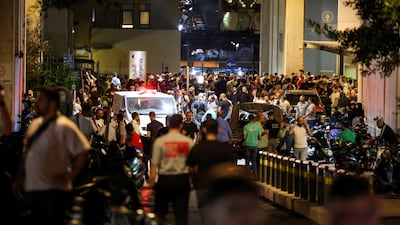
Panic at a Beirut hospital after thousands, including Hezbollah fighters and medics, were injured when the pagers they used to communicate exploded across Lebanon. Several people were killed. Reuters -
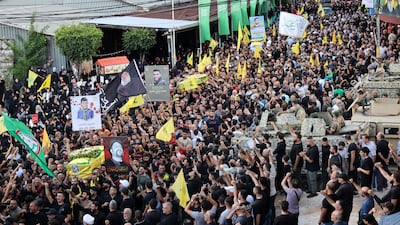
Mourners in Beirut's southern suburbs carry the coffins of people killed after hundreds of paging devices exploded, in a mass funeral on September 18, 2024. AFP -
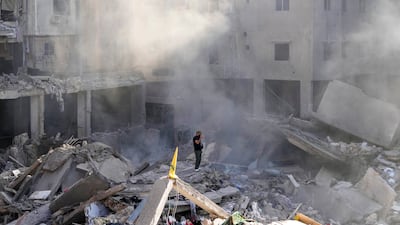
A man stands on the rubble of buildings near the site of the assassination of Hezbollah leader Hassan Nasrallah in Beirut's southern suburbs on September 29, 2024. AP -
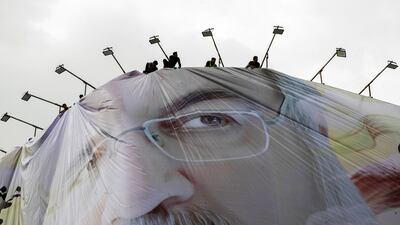
Workers drape a building in a vast banner depicting Nasrallah in Tehran, two days after his assassination by Israeli forces in Beirut. Getty Images -
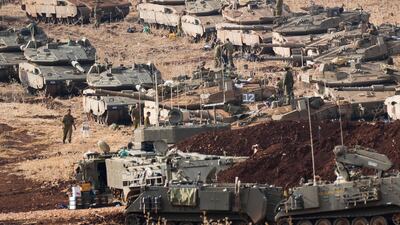
Israeli soldiers work on tanks at a staging post near the border with Lebanon on October 1, 2024. AP -
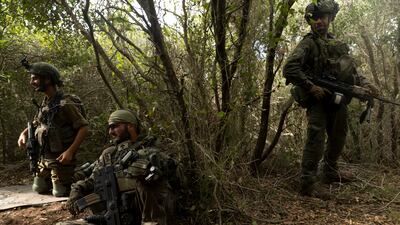
Israeli soldiers rest in an operation zone near Naqoura, southern Lebanon on October 13, 2024, after a ground invasion was launched. Getty Images -
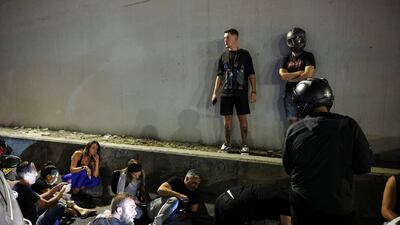
People take cover by a roadside in Tel Aviv as a siren sounds after Iran fired a salvo of ballistic missiles at Israel. Reuters -
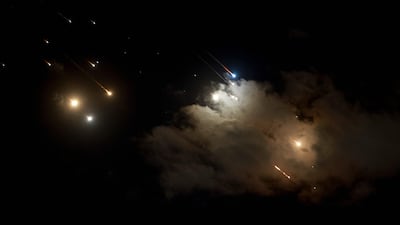
Iranian-launched projectiles being intercepted by Israel above Jerusalem on October 1, 2024. AFP -

The aftermath of a rocket salvo in Petah Tikva, near Tel Aviv, on November 24, 2024. Hezbollah said it launched the missiles from Lebanon at an Israeli army intelligence base. AFP -
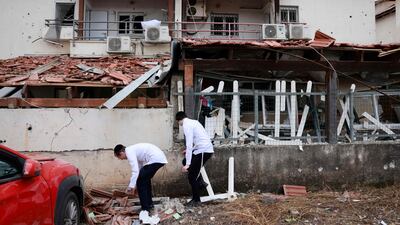
Residents in Petah Tikva check the damage after the rockets were fired from Lebanon. AFP



