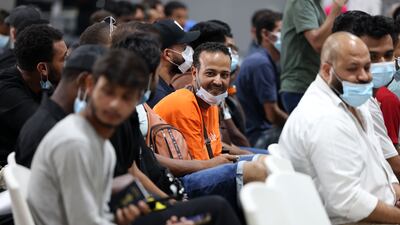
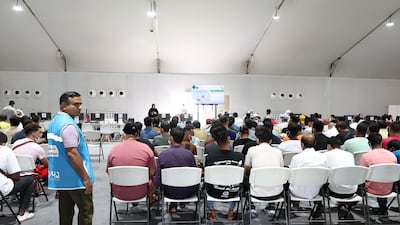
The UAE visa amnesty has been extended until December 31 owing to huge demand from overstayers looking to change their status, officials said on Thursday.
“The extension is the last opportunity for overstayers to regularise their stay in the UAE without having a ban,” Maj Gen Suhail Saeed Al Khaili, director of the Federal Authority for Identity, Citizenship, Customs and Port Security, said in a statement. “The initiative witnessed a large number of overstayers wishing to change their status.”
Maj Gen Al Khaili confirmed this is the last extension for the initiative and that fines will be automatically listed on January 1, 2025. “The authority will launch extensive campaigns for checks for people without valid visas following the deadline,” he added.
“The authority was keen to give violators a good chance to overcome their obstacles and change their status by either leaving the country without paying fines or by having a work contract and changing their status to stay in the country.”
The message remains the same
Initially launched for two months, the amnesty started on September 1. It offers people on expired visas an opportunity to claim amnesty and either update their documents by finding employment, or leave the country without fear of penalties, with any overstay fees waived.
Immigration centres across the country had been braced for a busy day on Thursday, the day previously listed as the amnesty's deadline, with a high turnout of overstayers expected to arrive before the 8pm closure. At Dubai's Al Awir Centre, the number of immigration officers was doubled to deal with demand. With overstayers now offered an extra two months to regularise their stay, the message remains the same, and offers people a second chance.
“If you cannot find a job, please leave the country, you can come back, you are most welcome any time,” Lt Col Salem bin Ali, director of the customer happiness department at Dubai's General Directorate of Residency and Foreigners Affairs, previously told The National.
A redemption story from this year's amnesty comes in the shape of an Indian software engineer duped by fraudsters promising a dream job with Emirates airline. He has now emerged from two years of turmoil to make a fresh start in the UAE.
Abhijeet Ahire, 31, had been living here illegally since June 2022, when a fake company in Mumbai offered him what he believed to be a legitimate role with the Dubai airline, only to swindle his family out of Dh24,000 ($6,500), leaving him with a mountain of debt he saw no way of clearing.
Mr Ahire headed to Dubai’s Al Awir Centre intending to request an exit pass to return to his home country and put his bitter experience behind him. His fortunes turned, however, after he received an employment offer from the LuLu Exchange Group, who were among the companies interviewing people with expired visas.
Watch: Abhijeet Ahire on how the visa amnesty changed his life
Where to apply for the amnesty
There are locations throughout the Emirates where an application for amnesty can be processed. In Abu Dhabi, people can apply at ICP centres in Al Dhafra, Sweihan, Al Maqam and Al Shahamah and private typing centres that are recognised by the ICP.
Typing centres typically perform administrative services, including application submissions. In Dubai, amnesty services will be provided at its Amer service centres, and the centre for immigration violators in Al Awir. Amnesty applications can be made at ICP centres throughout the rest of the Emirates.
Why is there a need for a visa amnesty?
Such amnesties provide a reprieve for those without valid documentation who could be reluctant to come forward due to concerns about possible fines or jail sentences. This allows the government to ensure people are living in the Emirates legally, an important consideration against the backdrop of a population boom.
It is also a chance for many to grasp the chance of a new start – whether in the UAE or back in their home country. Most residents living or working in the UAE would usually have a two or three-year visa.

Ten tax points to be aware of in 2026
1. Domestic VAT refund amendments: request your refund within five years
If a business does not apply for the refund on time, they lose their credit.
2. E-invoicing in the UAE
Businesses should continue preparing for the implementation of e-invoicing in the UAE, with 2026 a preparation and transition period ahead of phased mandatory adoption.
3. More tax audits
Tax authorities are increasingly using data already available across multiple filings to identify audit risks.
4. More beneficial VAT and excise tax penalty regime
Tax disputes are expected to become more frequent and more structured, with clearer administrative objection and appeal processes. The UAE has adopted a new penalty regime for VAT and excise disputes, which now mirrors the penalty regime for corporate tax.
5. Greater emphasis on statutory audit
There is a greater need for the accuracy of financial statements. The International Financial Reporting Standards standards need to be strictly adhered to and, as a result, the quality of the audits will need to increase.
6. Further transfer pricing enforcement
Transfer pricing enforcement, which refers to the practice of establishing prices for internal transactions between related entities, is expected to broaden in scope. The UAE will shortly open the possibility to negotiate advance pricing agreements, or essentially rulings for transfer pricing purposes.
7. Limited time periods for audits
Recent amendments also introduce a default five-year limitation period for tax audits and assessments, subject to specific statutory exceptions. While the standard audit and assessment period is five years, this may be extended to up to 15 years in cases involving fraud or tax evasion.
8. Pillar 2 implementation
Many multinational groups will begin to feel the practical effect of the Domestic Minimum Top-Up Tax (DMTT), the UAE's implementation of the OECD’s global minimum tax under Pillar 2. While the rules apply for financial years starting on or after January 1, 2025, it is 2026 that marks the transition to an operational phase.
9. Reduced compliance obligations for imported goods and services
Businesses that apply the reverse-charge mechanism for VAT purposes in the UAE may benefit from reduced compliance obligations.
10. Substance and CbC reporting focus
Tax authorities are expected to continue strengthening the enforcement of economic substance and Country-by-Country (CbC) reporting frameworks. In the UAE, these regimes are increasingly being used as risk-assessment tools, providing tax authorities with a comprehensive view of multinational groups’ global footprints and enabling them to assess whether profits are aligned with real economic activity.
Contributed by Thomas Vanhee and Hend Rashwan, Aurifer
Zayed Sustainability Prize
MATCH INFO
Uefa Champions League semi-final, first leg
Bayern Munich v Real Madrid
When: April 25, 10.45pm kick-off (UAE)
Where: Allianz Arena, Munich
Live: BeIN Sports HD
Second leg: May 1, Santiago Bernabeu, Madrid
The Perfect Couple
Starring: Nicole Kidman, Liev Schreiber, Jack Reynor
Creator: Jenna Lamia
Rating: 3/5
Jetour T1 specs
Engine: 2-litre turbocharged
Power: 254hp
Torque: 390Nm
Price: From Dh126,000
Available: Now
The five pillars of Islam
COMPANY PROFILE
Name: HyperSpace
Started: 2020
Founders: Alexander Heller, Rama Allen and Desi Gonzalez
Based: Dubai, UAE
Sector: Entertainment
Number of staff: 210
Investment raised: $75 million from investors including Galaxy Interactive, Riyadh Season, Sega Ventures and Apis Venture Partners
Killing of Qassem Suleimani
Who's who in Yemen conflict
Houthis: Iran-backed rebels who occupy Sanaa and run unrecognised government
Yemeni government: Exiled government in Aden led by eight-member Presidential Leadership Council
Southern Transitional Council: Faction in Yemeni government that seeks autonomy for the south
Habrish 'rebels': Tribal-backed forces feuding with STC over control of oil in government territory
ARGYLLE
%3Cp%3EDirector%3A%20Matthew%20Vaughn%3C%2Fp%3E%0A%3Cp%3EStarring%3A%20Bryce%20Dallas%20Howard%2C%20Sam%20Rockwell%2C%20John%20Cena%3C%2Fp%3E%0A%3Cp%3ERating%3A%203%2F5%3C%2Fp%3E%0A
The years Ramadan fell in May
Try out the test yourself
Q1 Suppose you had $100 in a savings account and the interest rate was 2 per cent per year. After five years, how much do you think you would have in the account if you left the money to grow?
a) More than $102
b) Exactly $102
c) Less than $102
d) Do not know
e) Refuse to answer
Q2 Imagine that the interest rate on your savings account was 1 per cent per year and inflation was 2 per cent per year. After one year, how much would you be able to buy with the money in this account?
a) More than today
b) Exactly the same as today
c) Less than today
d) Do not know
e) Refuse to answer
Q4 Do you think that the following statement is true or false? “Buying a single company stock usually provides a safer return than a stock mutual fund.”
a) True
b) False
d) Do not know
e) Refuse to answer
The “Big Three” financial literacy questions were created by Professors Annamaria Lusardi of the George Washington School of Business and Olivia Mitchell, of the Wharton School of the University of Pennsylvania.
Answers: Q1 More than $102 (compound interest). Q2 Less than today (inflation). Q3 False (diversification).
Company%C2%A0profile
%3Cp%3E%3Cstrong%3ECompany%20name%3A%20%3C%2Fstrong%3Eamana%3Cbr%3E%3Cstrong%3EStarted%3A%20%3C%2Fstrong%3E2010%3Cbr%3E%3Cstrong%3EFounders%3A%3C%2Fstrong%3E%20Karim%20Farra%20and%20Ziad%20Aboujeb%3Cbr%3E%3Cstrong%3EBased%3A%20%3C%2Fstrong%3EUAE%3Cbr%3E%3Cstrong%3ERegulator%3A%20%3C%2Fstrong%3EDFSA%3Cbr%3E%3Cstrong%3ESector%3A%20%3C%2Fstrong%3EFinancial%20services%3Cbr%3E%3Cstrong%3ECurrent%20number%20of%20staff%3A%20%3C%2Fstrong%3E85%3Cbr%3E%3Cstrong%3EInvestment%20stage%3A%20%3C%2Fstrong%3ESelf-funded%3Cbr%3E%3C%2Fp%3E%0A
AI traffic lights to ease congestion at seven points to Sheikh Zayed bin Sultan Street
The seven points are:
Shakhbout bin Sultan Street
Dhafeer Street
Hadbat Al Ghubainah Street (outbound)
Salama bint Butti Street
Al Dhafra Street
Rabdan Street
Umm Yifina Street exit (inbound)