
The UAE has highlighted that the role of the UN Palestinian refugee agency UNRWA is “indispensable and irreplaceable”, joining 117 other countries in voicing support for the agency.
Presenting the UAE's statement at a pledging conference for the agency in New York, Mohammed Abushahab, UAE ambassador to the UN, said the country rejected any attempts to undermine its role in Gaza as it “provides a glimmer of hope to Palestinian refugees in these difficult circumstances”.
“My country stands in solidarity with the UNRWA’s efforts to continue its vital role despite the serious challenges” it faces.
Nearly 200 UNRWA employees have been killed, with Israel attacking many of its facilities and accusing some of its staff of involvement in the October 7 Hamas attack on Israel.
Several countries resumed funding after suspending it, with the UN conducting an internal investigation into its workings.
Since the outbreak of the conflict last October, the UAE has “provided an additional contribution to the UNRWA, amounting to $20 million to support our Palestinian brothers in Gaza”, Mr Abushahab added.
During the session, the UN Secretary-General Antonio Guterres appealed to all UN member states to “protect the UNRWA, protect the UNRWA staff and protect the UNRWA’s mandate – including through funding”.
“Let me be clear: there is no alternative to the UNRWA,” he added.
The agency was created in 1949 by a UN General Assembly to serve Palestinian refugees in Lebanon, Jordan, Syria, the Gaza Strip, the West Bank and Jerusalem.
With the war on Gaza entering its 10th month, Mr Abushahab said the UAE “continues to demand an immediate and permanent ceasefire”.
He highlighted the country's humanitarian efforts under the Gallant Knight 3 operation.
So far, the UAE field hospital in Gaza has treated more than 21,000 patients, while the floating hospital at Al Arish in Egypt has treated 700 more.
Since the launch of the aid mission in November, the UAE has provided 33,100 tonnes of urgent supplies to Gaza.
The figures, released by the Ministry of Foreign Affairs, show the aid was delivered by 320 flights, seven ships and 1,243 lorries up until June 13.
Under operation Gallant Knight 3, the UAE also established two hospitals to help those in need, including a field hospital in the southern Gaza Strip and the floating hospital.
It has also helped set up five automatic bakeries and six desalination plants that produce 1.2 million gallons of clean drinking water a day to 600,000 people in the Gaza Strip.
A total of 3,382 tonnes of relief supplies were also sent to isolated parts of Gaza by aid drops.
-
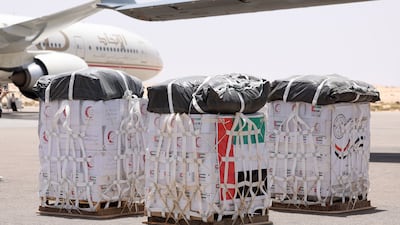
Aid is loaded on to a military plane at Al Arish International Airport, Egypt, to be dropped over Gaza. All photos: Chris Whiteoak / The National -

Aid is loaded on to a military plane at Al Arish International Airport, Egypt, to be dropped over Gaza -

Aid is loaded on to a military plane at Al Arish International Airport, Egypt, to be dropped over Gaza -

Aid is loaded on to a military plane at Al Arish International Airport, Egypt, to be dropped over Gaza -
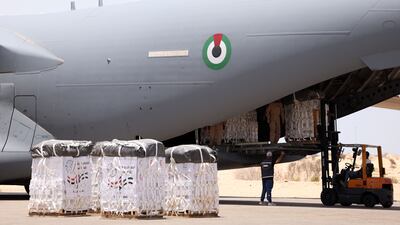
Aid is loaded on to a military plane at Al Arish International Airport, Egypt, to be dropped over Gaza



