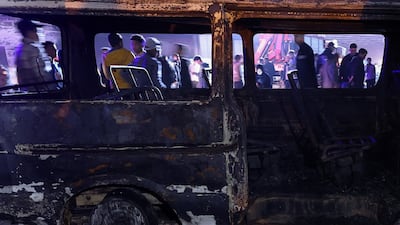

After a flurry of statements in the immediate aftermath of last week's tanker explosion in Cairo, the government had gone silent, fuelling rumours that a sweeping reshuffle to defuse public rage may be in the works.
It broke its silence on Sunday with a statement issued after an emergency session on the November 25 tragedy, in which a fuel tanker on a busy Cairo ring road overturned, caught fire and exploded within minutes, killing 32 people and injuring more than two dozen.
Sunday's government statement was met with criticism on social media and appeared to have stopped short of comforting Egyptians enraged by the accident, and failed to offer any concrete plans to reduce the number of similar road and rail accidents.

The statement reiterated that President Abdel Fattah El Sisi had immediately directed the government and state agencies to provide care for the injured and support their families and those of the dead.
"The prime minister has also emphasised during the meeting the extreme importance of adopting a strategy to reduce road accidents nationwide," said the statement without giving any details.
The horrific images of Wednesday's inferno touched Egyptians, who have since taken to social media to blame the government, particularly powerful Transport Minister Kamel Al Wazir.
They also blamed laxity in law enforcement - the tanker was travelling on the left side of the road - and a parliament packed with government supporters unable or unwilling to hold officials accountable.
In the hours that followed the tragedy, relevant government ministers issued a flurry of statements similar to the one by the government on Sunday, detailing measures taken to deal with the accident.

But the relevant ministers, including Mr Al Wazir, had remained publicly silent on the matter since, a sign often taken as a prelude to a government reshuffle in Egypt's political culture.
Mr Al Wazir had consistently dominated newspaper headlines and night-time talk shows in the aftermath of similar road and rail tragedies, defending his record in government, blaming human error and lavishly praising the work done during his seven-year tenure.

Past calls on President Abdel Fattah El Sisi to sack Mr Al Wazir had gone unheeded, frustrating many Egyptians who hold the former army general morally responsible for the deadly mishaps that have killed or injured hundreds in recent years despite a multibillion-dollar programme to upgrade and build new roads and overhaul the railway system.
The only word from Mr Al Wazir on the accident has so far come in an online post by a little-known TV host, Mohammed Ali Kheir, who said he had received a private call from the minister. He quoted Mr Al Wazir as saying a lane in the Cairo ring road will be dedicated to lorries after repairs are completed on the 107-km-long highway notorious for its rush hour congestion and accidents.
Mr Al Wazir's transport portfolio has given him immense power. It has placed him in charge of billions of dollars, mostly secured by foreign borrowing, to carry out an ambitious programme to upgrade roads, build seaports, airports and modern modes of transport like a Cairo monorail and a fast electric train.
More recently, his ministry, together with private sector conglomerates, has gained more leverage by taking on the strategically important work of upgrading seaports in nations in the Horn of Africa. It's a region where two of Egypt's primary national security concerns - Red Sea shipping and a long-running water dispute with Ethiopia - need to be addressed.

Significantly, Egyptians have continued to direct their anger at authorities and not the driver of the car, who authorities said collided with the tanker, causing it to crush a communal taxi when it overturned and later exploded.
Security videos publicised by authorities validate the government's version of how the accident happened, but many Egyptians did not direct their wrath at the driver of the car and remained focused on the bigger issues.
Among the questions they raise are why a fuel tanker was allowed on a busy road during rush hour, why so many of the capital's street lights have recently been turned off, and why police are not diligently enforcing traffic rules.
The furore over what happened appears to have touched a raw nerve in Egypt, although thousands routinely perish every year in road and rail accidents. But it has also unified Egyptians at a trying time, with millions offering a special prayer for the victims on Friday and thousands donating blood for the victims.
Private donations for the families of the dead and injured have to date reached 300 million pounds (about $5.5 million).
But the public anger over the accident came less than three weeks after two trains collided south of Cairo, killing seven and injuring at least 125, the latest in a string of railway mishaps that have claimed scores of lives since Mr Al Wazir became the transport minister in 2019.
It's also the horrific manner in which the victims have died, incinerated while in their cars or caught in balls of fire that shot across the site of the accident following the explosion of the tanker.
"Our pain is too great although road accidents have been with us for a long time," said Amr Adeeb, host of what is easily the most-watched talk show in Egypt. "People were burned alive and others watched that happen before their eyes. Death is death, but this is the most horrific way to die."

