
Iraq’s government on Friday estimated losses of $100 billion due to oil being smuggled through the Kurdistan region, as it moves to assert further control over the north.
Government spokesman Haider Al Aboudi said the Federal Board of Supreme Audit had found that damages resulting from the export of Kurdistan oil outside the State Oil Marketing Organisation (Somo) from 2008 and 2025 had exceeded $100 billion.
It comes shortly after Iraq ordered the closure of two border crossings with Syria and Iran that had previously been administered by the Kurdistan Regional Government (KRG).

Al Waleed crossing with Syria and the Bashta crossing with Iran are now shut, the commander of Iraq's border forces told the Iraqi News Agency, following a ruling by Iraq's highest court on Wednesday allowing Baghdad to send federal troops to all international frontiers, including in the Kurdistan region.
Iraq's Prime Minister Ali Al Zaidi on Tuesday ordered federal authorities to take over border points run by the KRG, as part of a broader push by Baghdad to strengthen central control over strategic assets, including oilfields managed by Kurdish security forces.
“The closures and control of international borders target smugglers,” Mr Al Aboudi said. Legal action would be taken against any parties found to have been involved in the loss of public funds, he added.
US President Donald Trump said on Friday: “We support Iraqi Prime Minister Ali Al Zaidi’s efforts to assert state authority throughout Iraq, stop the smuggling of Iraqi oil, end corruption and bring all weapons under the exclusive control of the state.”
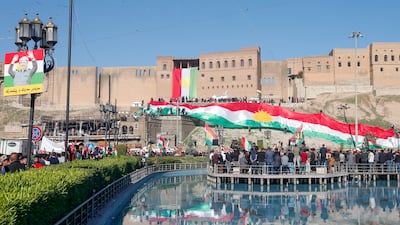
Kurdish authorities have criticised the measures, saying they infringe on the constitutional powers of the Kurdistan region. Protests broke out in the Kurdish capital of Erbil on Thursday, where thousands of people waved flags of the region.
They voiced their opposition to Mr Al Zaidi's decision for the federal government to take control of oil operations and border crossings in the north. Mr Al Zaidi had said the measures were part of a bid to stop oil smuggling.
On Thursday, the government sought to ease fears of a confrontation with the Kurdistan region, denying reports that army units were advancing north. Government spokesman Haider Al Aboudi rejected reports suggesting federal troops were being sent to the region.
“Prime Minister Ali Al Zaidi has emphasised the need to protect the people of Kurdistan, not threaten them,” he told state-run Al Iraqiya TV. “There is no movement of army units towards the Kurdistan region.”
Authorities said an agreement was reached in a meeting at Baghdad Palace on Wednesday to hold a national dialogue aimed at addressing the escalating constitutional tension between the federal government and Erbil.
The meeting included Mr Al Zaidi, President Nizar Amedi, Parliament Speaker Haibat Al Halbousi and the head of the Supreme Judicial Council, Faiq Zaidan.

