Two Iraqi border crossings with Syria and Iran that were previously administered by the Kurdistan Regional Government (KRG) have been closed, as Baghdad moves to assert more control over the northern region.
Al Waleed crossing with Syria and the Bashta crossing with Iran have been closed, the commander of Iraq's border forces told the Iraqi News Agency. The closures follow a ruling by Iraq's highest court on Wednesday allowing Baghdad to send federal troops to all international borders, including in the Kurdistan region.
Iraqi Prime Minister Ali Al Zaidi on Tuesday ordered federal authorities to take over crossings run by the KRG, as part of a broader push by Baghdad to strengthen central control over strategic assets, including oilfields controlled by Kurdish security forces.

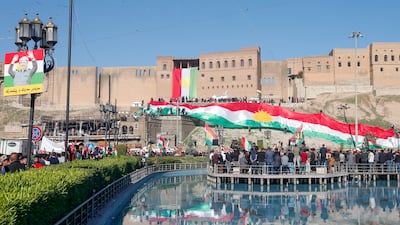
Kurdish authorities have criticised the measures, saying they infringe on the constitutional powers of the Kurdistan region. Protests broke out in the Kurdish capital of Erbil on Thursday, where thousands of people waved flags of the region.
They voiced their opposition to Mr Al Zaidi's decision for the federal government to take control of oil operations and border crossings in the north. Mr Al Zaidi had said the measures were part of a bid to stop oil smuggling.
On Thursday, the government sought to ease fears of a confrontation with the Kurdistan region, denying reports that army units were advancing north. Government spokesman Haider Al Aboudi rejected reports suggesting federal troops were being sent to the region.
“Prime Minister Ali Al Zaidi has emphasised the need to protect the people of Kurdistan, not threaten them,” he told state-run Al Iraqiya TV. “There is no movement of army units towards the Kurdistan region.”
Authorities said an agreement was reached in a meeting at Baghdad Palace on Wednesday to hold a national dialogue aimed at addressing the escalating constitutional tension between the federal government and Erbil.
The meeting included Mr Al Zaidi, President Nizar Amedi, Parliament Speaker Haibat Al Halbousi and the head of the Supreme Judicial Council, Faiq Zaidan.

