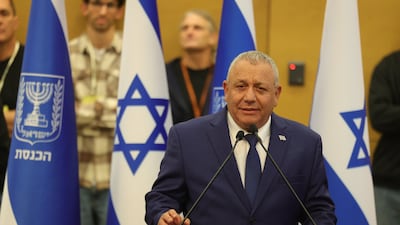
Israeli opposition leader Gadi Eisenkot said on Monday that he sees no immediate threat from Iran that would justify military action, as the clock ticks down on his chance to form a government.
Mr Eisenkot, a former army general, said the “gravest threat” from Iran was its estimated 440kg stockpile of enriched uranium. “We need to focus on that,” he said.
Mr Eisenkot's remarks put him at odds with Prime Minister Benjamin Netanyahu, who responded by saying Iranian threats “are real” and that those playing them down are doing so for political reasons.

The disagreement between the two men comes despite growing signs that their parties could agree to join forces in a unity government, after last month's inconclusive election in Israel. Representatives of the two parties, Mr Netanyahu's Likud and Mr Eisenkot's Yashar, held more than four hours of talks on Sunday.
While little was revealed publicly, leaks to Israeli media suggested they avoided the question of whether Mr Netanyahu or Mr Eisenkot should take the premiership first. The idea of a rotation over the next parliamentary term has been mooted, and has some precedent in Israel.
Reports said the talks instead addressed military service for ultra-Orthodox Jews, reforms to Israel's legal system and an investigation into the October 7 attacks of 2023 – three of the most contentious political issues in Israel in recent years.

Israeli President Isaac Herzog gave Mr Eisenkot the first shot at forming a government on November 8. The former military chief has a maximum of 42 days to do so, of which 15 have passed.
A unity government could resolve some of Mr Eisenkot's difficulties and create others. Working with Likud could open the way to a majority without relying on Arab parties, an alliance that would be controversial in Israel and which some members of the opposition have ruled out.
It would, however, be likely to alienate some of Mr Eisenkot's supporters after he campaigned on removing Mr Netanyahu from power. Yair Golan, the leader of another opposition party, said on Sunday that “anyone who wants to form a unity government with Netanyahu is stabbing their voters in the back”.
“We are at the start of the third week of the Change Bloc’s mandate, and there is still no real progress on forming a government,” he warned.
While Mr Netanyahu remains in office for now, with no formal limits on his powers, Mr Eisenkot has urged him to avoid “dangerous moves that can wait until a new government”. It has been speculated that any return to war or other sudden crisis could help Mr Netanyahu extend his tenure.