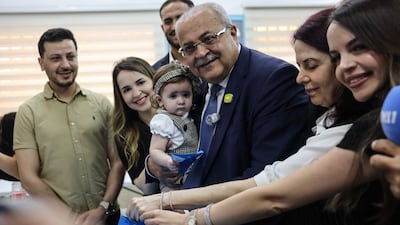

With most votes counted in Israel's general election, one of the most striking stories is how well Israeli Arab parties have performed at the polls.
As it stands, the Arab Joint List, which includes Hadash, Balad and Ta'al, alongside the Ra'am party led by Mansour Abbas, have won a record 18 of the Knesset's 120 seats.
A government needs 61 seats for a majority. With a tight race between Prime Minister Benjamin Netanyahu's Likud party and his rival Gadi Eisenkot's Yashar party, government formation cannot happen without a coalition.

So which are the Palestinian Israeli parties and how did they influence the results?
Arab Joint List
The Arab Joint List is made up of three parties: Hadash, Ta'al and Balad.
Hadash is a left-wing party, comprising Arab and Jewish Israelis, headed by Yousef Jabareen. Mr Jabareen is a lawyer who regularly goes to the Supreme Court with motions to defend Palestinian rights. He was first elected to the Knesset in 2015 and is also the head of the Arab Joint List. Hadash's other significant members include MP Ofer Cassif, a vocal critic of Mr Netanyahu and his war on Gaza, which he calls a genocide.
Ta'al is an anti-Zionist, nationalist Arab Israeli party led by Ahmad Tibi. It is considered a secular movement that supports a two-state solution and an Israeli troop withdrawal. Mr Tibi, who has been in the Knesset since 1999, is from the mainly Arab city of Taibeh and was an adviser to late Palestinian leader Yasser Arafat, as well as a mediator between Israeli and the Palestine Liberation Organisation. His involvement in Israeli politics has been significant, including a spell as deputy speaker of the Knesset between 2006 and 2013.
Balad, a left-wing secular party led by Sami Abu Shehadeh, is also in the alliance. Mr Abu Shehadeh was disqualified from running in the elections by Israel's Supreme Court, which upheld a decision by the Central Elections Committee earlier this month. The ban on Mr Abu Shehadeh's candidacy was linked to alleged extreme views and incitement of hatred against Israel. Balad, formed in 1996, is seen by Israeli commentators as far-left and the most extreme anti-Zionist party of the three. It believes Israel should not be an independent state, instead supporting a one-state solution.
Ra'am, which used to be part of the Arab Joint List, is a religious Muslim party running separately and was on course for four seats. Its leader Mr Abbas, a dentist by profession, made history in 2021 as the first Palestinian-Israeli to become a minister in a government coalition. Unpopular among Palestinians in the occupied West Bank, Mr Abbas is seen by many as a "traitor" and a "normaliser" with Israel, focusing on local issues rather than the wider Palestinian cause.
Why did the Arab parties do so well?
Palestinian-Israelis are already celebrating their gains at the polls, with a large Arab voter turnout seen as having largely contributed. But why did Arab-Israeli voters decide to vote in elections that they had previously been known to boycott?
Xavier Abu Eid, a political scientist and former PLO official, told The National this time was different.
"For Palestinian citizens, it's an existential matter. Keeping the far-right in the government is being seen as keeping the prospects for a new Nakba," he said.

Videos circulated in Arab communities, showing the elderly urging young people to vote. Palestinians in Gaza and the occupied West Bank asked those in Israel to try to make a difference. Violence against Palestinians and Israeli-Arabs has surged since the Hamas attacks and subsequent Israeli war on Gaza beginning in October 2023.
"The amount of incitement against Palestinians went up, persecution against students and professors, doctors and nurses in Israel also went up, so the way they've been living in the past three years, shows that the only thing the government wants them to do is leave the country," Mr Abu Eid said. Many Palestinian Israelis see themselves as the likely next targets after attacks on Palestinians in Gaza and the West Bank.
Although the two main election rivals, Mr Netanyahu and Mr Eisenkot, are unlikely to enter a formal coalition with Arab parties - a development that would result in another election - analysts say that the Arab turnout has still been significant.
"The Arabs are not going to be kingmakers, but they still have a huge achievement," said Danny Citrinowitz, a senior fellow at the Institute for National Security Studies. He believes that, with the feat of snapping up about 18 seats in the Knesset, Arab voters have reduced Mr Netanyahu's chances of forming a majority government.
This could force Mr Netanyahu into a unity government, which would include members of the opposition, potentially pushing extreme figures such as Itamar Ben-Gvir and Bezalel Smotrich out of a future cabinet.
"Not the outcome they [Arab voters] hoped for but their turnout prevented Netanyahu from having 61 seats. They prevented him from having a path unless it's a unity government," Mr Citrinowitz said.
If the results of 18 seats of the Knesset's 120 seats for Arab politicians are final, representing 15 per cent of the total number of seats, the ratio of Arabs in the Knesset will be more reflective of the community's representation in Israeli society, which stands at 20 per cent. This would also break the current record of 15 seats for Arab parties in the Knesset, set during the 2020 elections.

