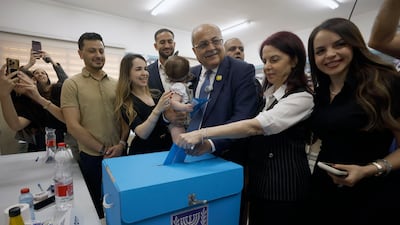

Arab voters have gone to polling stations in substantial numbers across Israel in a surge that could prove decisive in forming the country’s next government.
By midmorning on Tuesday, the overall turnout in Israel’s election was the highest since 1981, and that was reflected in Nazareth, which has an almost entirely Arab population of Muslims and Christians.
Voters at the Nazareth Baptist School, which was being used as a polling station, told The National they were desperate for change after more than three years of “catastrophe” for Arabs living in Israel since the October 7, 2023, attacks.

The high turnout was being seen as bad news for Prime Minister Benjamin Netanyahu, who said there were "huge lines at polling stations" in Arab areas. "The future of our Jewish state hangs in the balance," he said in a plea to supporters to head to the polls.
The Arab minority makes up one in five of Israel’s 10 million people, but has had minimal say in the country's political future. But with a heavy turnout, which some political sources said could be “astronomical”, going from 50 per cent to more than 70 per cent, that could change.
There is also a realisation among younger and older Arabs that – instead of boycotting elections as many have done in the past, feeling uneasy that their vote would effectively recognise the Israeli state – by joining the political process they can influence its outcome.
Arab parties are tipped to win up to 16 seats in the 120-member Knesset, an increase from the current 10, making the conservative Ra’am party led by Mansour Abbas and the Joint List of three united Arab parties potential kingmakers in the next Israeli government.
It is expected that the anti-Netanyahu bloc, led by Gadi Eisenkot, will not reach the 61 seats needed for an outright majority. That would mean they need Arab support, either by forming a coalition or by tolerating a minority government.
Furthermore, a higher number of Arab votes cast would raise the number of votes needed to cross the 3.25 per cent electoral threshold for a party to enter the Knesset. That could adversely affect smaller hard-right parties and further weaken the Netanyahu bloc.
Politics for the good
Hasar Zoabi, who voted for the Joint List, argued that “as a minority in Israel we should use our democratic right to vote to try to influence the politics for the good”.
One government employee, who did not want to be named, felt people were also being driven to vote by fear because “us Arabs in Israel no longer feel safe, even if you speak Arabic you are stopped, so that is why we are seeing such a big turnout on the streets today”.
Simona Fasciani said it was the first time she would go to the polls as “it is very important for Arab people to vote and this will be seen in countries around the world. Arabs must reclaim their position”.

But there was some disquiet among elderly voters that the ballot papers were only in Hebrew and they had to ask for translation. Some also spoke about Jewish settlers driving to people’s homes and trying to intimidate them into not voting.
There was, at times, a heavy police presence, but the crowds queued peacefully to cast their ballots and place them in a sealed envelope.
Political threshold crossed
The Arab population has also experienced soaring crime, with one of the highest murder rates in the world, at a time when the national police force has been led by the far-right politician Itamar Ben-Gvir. They have also witnessed the mass demolition of homes in the southern Negev region.
While the Arab vote could have a serious impact on the government, it could also be ignored by the Zionist parties of the centre-right, fearing that a coalition with Arab parties would severely damage their standing among Jewish voters.
But it is clear that Arab Israelis have crossed a political threshold that could see them increase their political clout, a moment that has drawn comparisons to Catholics securing political representation in Northern Ireland during the Troubles.
That this is the most consequential election in Israel’s difficult history has been understood by both young and old. “It has been a horrible situation for Arabs which is why we need to change it,” said Akram Mawaid, an 89-year-old who has rarely gone to the ballot box. “Today my conscience told me to vote.”

