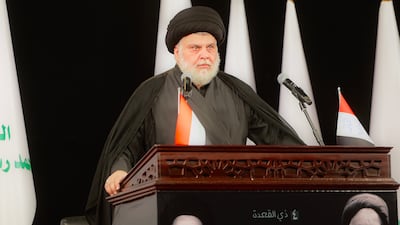

Shiite cleric Moqtada Al Sadr is seeking to reinforce a long-standing Iraqi nationalist platform that aims to keep Baghdad out of regional conflicts and curb Iranian influence, experts and officials have told The National.
Mr Al Sadr’s push comes as he called for a new chapter between the US and Iraq following the withdrawal of American troops on September 30.
The prominent cleric and former battlefield enemy of American troops during the US occupation is at a turning point in his own rebranding. Mr Al Sadr has millions of faithful supporters across Iraq, many of whom were part of his armed militia for years. That has now changed.

On the day of the departure of US troops, he dissolved his Promised Day Brigade as well as his armed militia, Saraya al Salam (the Peace Brigades), which will now be under government control. Its members are expected to be incorporated into Iraq’s formal security apparatus under the authority of Prime Minister Ali Al Zaidi's government.
Mr Al Zaidi has been pushing to disarm all armed groups as Iraq undergoes a political shift following the exit of the US-led coalition forces.

Meanwhile, Mr Al Sadr is portraying himself as a statesman seeking to keep Iraq out of regional conflicts while strengthening the state's monopoly on force.
The withdrawal of US forces has weakened a key justification used by armed groups to keep their weapons. The question of why armed factions still operate without state control remains. The groups were expected to disarm by the September 30 deadline, but this has since been pushed to June next year.
Mr Al Sadr’s recent statement and actions raise some suspicion as to how the process of disarmaming his militias will play out.
Experts and a close aide to Mr Al Sadr told The National that his latest moves should be seen as part of a broader effort to continue his nationalist campaign, which combines religious leadership with political activism.

“Mr Al Sadr has long advocated dissolving armed factions, including calling for the disbandment of groups operating outside state control,” Renad Mansour, director of the Iraq Initiative at London's Chatham House, told The National.
“But integrating fighters into government institutions does not necessarily resolve questions over their loyalties,” he added.
“What we'll have to see is what this actually means in reality. The bigger question is over loyalties: will they then become under a different chain of command, or will they still fall under the informal chain?” Mr Mansour said.
Mr Al Sadr's vision for Iraq merges political and religious movements. “He believes that clerics should be active in politics, not isolated to religious affairs only. He is trying to chart his own role in the Iraqi state, one that bridges these different branches,” he said.
The cleric's political movement, the Sadrists, have distanced themselves from the mainstream political scene in Iraq during the last few years. In the past decade, Mr Al Sadr has reinvented himself as a nationalist and an anti-corruption campaigner, emerging as a political kingmaker.

He has always voiced his concerns over US and Iranian influence on Iraq's internal affairs.
The shift in Mr Al Sadr's mindset comes as Iran continues to project influence across the region through allied armed groups, even as some nationalist movements seek to distance themselves from Tehran, said Bente Scheller, head of the Middle East and North Africa division at the Heinrich-Boll-Stiftung Foundation in Berlin.
“Proxies are the method of choice in the region, yet because Iran deploys them in its own interest, this often brings them into conflict with their own national interests,” Ms Scheller told The National.
By championing the state's monopoly on force, Mr Al Sadr may be seeking both to shield Iraq from becoming entangled in regional conflicts and to strengthen his credentials as a national political leader.
“If Sadr now adopts a statesmanlike stance and emphasises the state's monopoly on the use of force, this may serve to take Iraq out of the line of fire,” she said.
Setting an example
Dhia Al Assadi, a former Iraqi minister and adviser to Mr Al Sadr, told The National that the cleric had long sought to help build a strong and stable Iraq.
“Mr Al Sadr has consistently taken the initiative in setting an example. He encourages others to be brave and sensible enough to sacrifice political or material gains for the sake of stabilising and rebuilding Iraq on sound principles,” Mr Al Assadi said.
The cleric's vision for the country begins with a “strong and well-founded Iraq, and looks outward to the world on the basis of mutual respect, co-operation, and shared interests”, he added.
Based on Mr Al Sadr's recent statements on US-Iraqi ties, the region could benefit if American policymakers adopted a new approach and learnt from past mistakes, he said.

Optimism would be limited if Washington continued to pursue narrowly defined interests at the expense of regional stability, Al Assadi added.
Marsin Al Shammary, Iraq expert and assistant professor of political science at Boston College, said Mr Al Sadr's most recent policy had been based on playing the “long game in Iraq”.
“He foresees a political future for himself and doesn’t want to undermine that by positioning himself as anti-state. We’ve seen in the past that he has a remarkable ability to mobilise and demobilise his followers,” Ms Al Shammary told The National.
Another possibility is that he chooses to become closer to the successor to spiritual leader Ayatollah Ali Al Sistani, she said, adding that “he has been making overtures towards Najaf recently”.
The southern city of Najaf is home to Iraq's senior Shiite clerics and was the site of a 2004 rebellion against US forces by militias loyal to Mr Al Sadr.
“Mr Al Sadr and Najaf do agree on one thing and that’s the importance of limiting Iranian influence in succession,” she said. Ms Al Shammary added that the cleric shared a long-term strategy with authorities in Najaf for an Iraq independent of Iran but with friendly ties with the region.