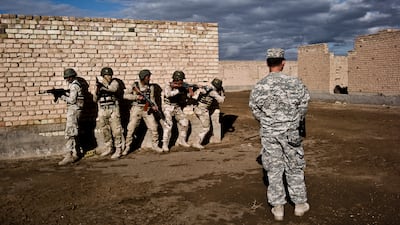
Iraq will face an array of milestones that are set to change the political landscape of the country this week, with the planned US troop withdrawal and the launch of a months-long process of bringing militia weapons under state control.
For years, various governments have attempted to curb the power of Iran-backed militias in the country while vowing to keep foreign troops out of the state. The process is starting to happen under the leadership of Prime Minister Ali Al Zaidi.
Ending the mission of the US-led international coalition to fight ISIS is under way, and officials say the hundreds of US troops remaining in the Iraqi Kurdistan region will have left by the September 30 deadline. Iraq is hoping to move to individual bilateral security co-operation with the US, Nato and other nations.

The withdrawal was initially linked to an ultimatum for militias to lay down their weapons as Baghdad faces pressure from Washington to keep them under state control. But most have indicated they have no plans to do so.
The lingering question is what will happen after Wednesday's planned withdrawal. Iraqi officials are sticking to the US drawdown deadline, while officials in the Kurdistan Regional Government would rather forces stayed in place for a longer period.
“Everyone is anxious as to what will happen after the September 30 deadline,” an Iraqi official told The National. “Iraq is currently in a fragile situation due to the war between the US and Iran. No one is clear about the future posture of the government, militias, or foreign actors in Iraq.

“Relations with neighbouring Arab countries are strained, co-operation is minimal and distrust is high, exacerbated by accusations and complaints among regional states,” he added. Iraq has been caught between the US and Iran in the conflict, with American assets and bases coming under attack, while Iran-aligned groups were also targeted.
Iranian-aligned factions in Iraq launched drones and missiles towards Gulf states, prompting the UAE, Saudi Arabia, Qatar, Kuwait, Bahrain and Jordan to hold Baghdad responsible for attacks from its territory. Iraq has been seeking to mend ties with the Gulf region since.
For years, Iran-backed armed groups have called for the withdrawal of foreign troops and have targeted US facilities and coalition forces in Iraq. Since the start of the Iran war in February, the militias have attacked US-affiliated targets within Iraq and across its borders, while also collaborating with Yemen’s Houthis to hit targets in Saudi Arabia.

US forces invaded Iraq in 2003 to overthrow the regime of Saddam Hussein and went on to occupy the country and fight a years-long counterinsurgency before withdrawing at the end of 2011. The style of government installed by Washington has benefited from Iranian influence.
They returned three years later to help Iraqi forces in their fight against ISIS from 2014 to 2017, at the request of Baghdad.
Iraq and the US agreed in 2024 on a framework under which the US-led military coalition will conclude its mission in Iraq by September 30, ending a deployment that was established to help defeat ISIS after it swept across large parts of Iraq and Syria in 2014.
The Iraqi official said: “The withdrawal date of American forces from Iraq was determined by Mr Al Zaidi during his visit to Washington [in July], not by the Americans themselves – he was the one who pushed for September 30, although there was an agreement to withdraw all American troops by this year.”
However, there are differences between how Baghdad and Erbil – capital of the semi-autonomous Kurdistan region -view the departure of the US-led coalition, even as both sides seek to prevent an ISIS resurgence and maintain stability in northern Iraq.
“The problem now is the promise that Mr Al Zaidi pledged to disarm militias,” the official said. “They have no intention to drop their arms by September 30 and that’s why the government pushed the deadline to next year.” Mr Al Zaidi has reviewed the September 30 deadline and said last week the government aimed to complete the disarmament process by June 2027.
Militias have largely pushed back against the deadline to disarm. Two prominent pro-Tehran armed groups, Asaib Ahl Al Haq and Kataib Imam Ali, alongside cleric Moqtada Al Sadr’s Saraya Al Salam faction, claim they have placed their weapons under state authority. But hardline factions – mainly Kataib Hezbollah and Harakat Hezbollah Al Nujaba – say they will not disarm until foreign troops leave.
'Days of sovereignty'
The government has announced that Wednesday and Thursday will be public holidays to mark the occasion, extending until Saturday under the theme of “Days of Sovereignty.”
According to a statement from the Prime Minister's office, the holidays are aimed at celebrating the end of the combat mission of the coalition and what the government describes as the “restoration of full national sovereignty”.
The celebrations come as Iraqis remain deeply divided over the pullout of US forces. Billboards have been erected in Baghdad, praising the move, with one carrying the slogan: “reclaiming the decision and building the home”, portraying a hand turning the page of military operations to one of construction and prosperity.

Mr Al Zaidi and his supporters from Iran-backed political parties and armed factions have strongly backed the withdrawal, framing it as a historic achievement and a step towards independent security decision-making.
In contrast, many Kurdish and Sunni leaders have expressed scepticism. They argue that the withdrawal is premature given the continued threat from ISIS sleeper cells and the recent surge in drone and missile attacks, and warn that the absence of US air support, intelligence and air defences could leave security gaps.
Sunni politician Atheel Al Nujaifi warned on Monday that ISIS “is not dead, and its cells are not as dormant as we reassure ourselves. Its ability for armed confrontation means it still possesses weapons, safe havens and supply lines”.
Mr Al Nujaifi said maintaining international co-operation in counter-terrorism “does not mean taking sides in the conflicts of others”, adding that “protecting Iraqis from terrorism is a purely Iraqi interest, not a card in a war between two states”.
The greater danger lies in how the state responds to the threat, he said.
“What I fear is not the return of the organisation, as it can be confronted,” Mr Al Nujaifi said. “What I fear is that its return becomes a pretext for the return of the approach that preceded its emergence,” he added, referring to claims that policies of Shiite-led governments since 2003 deemed Sunnis collaborators with extremist groups.
“We have known in past years a policy that treated an entire community as suspects, and even those who shed their blood and money in confronting terrorism were not spared from the accusation,” he said.
Kurdish concerns
Iraq's Kurdistan region has signalled it feels uneasy about the planned withdrawal of US-led coalition forces, warning that militant groups could exploit a resulting security vacuum and revive insurgent activities. Kurdish officials told The National that Iraq's security environment remained too fragile to justify full withdrawal.
“We continue to believe that the presence of these forces remains necessary to safeguard Iraq’s security and stability. However, the decision to proceed with the withdrawal was ultimately made by the Iraqi federal government,” Noreldin Waisy, press secretary to the Prime Minister of Iraqi Kurdistan, Masrour Barzani, told The National.
“The political, security and military situation in Iraq has not yet reached a level of stability that would justify such a withdrawal,” he said. “We are concerned that the departure of Coalition forces could create a significant security vacuum that terrorist organisations and other extremist groups may seek to exploit.”
Mr Waisy said the Kurdistan Regional Government expects coalition members to maintain ties with Iraq through separate bilateral security agreements after the coalition mission ends.
On Monday, the Peshmerga Ministry said the pullout comes at a “sensitive time given security instability in Iraq and the wider Middle East, which requires vigilance and sound political decisions”.
Since the Iran war broke out, Kurdistan has come under more than 1,000 drone and ballistic-missile attacks, some of which hit civilian areas, killing and injuring people and causing material damage, it said.
It described the departure of US forces from Kurdistan, without providing any defensive system as a “cause for concern”.

The repeated drone and missile attacks on the Kurdistan region by Iran and its proxies, have exposed the vulnerability of civilian areas, airports and energy infrastructure, said Jangish Awakalay, a Kurdish official working with the Foreign Ministry in Erbil.
“Strengthening air and missile defence capabilities is therefore a key priority,” he said, adding that Erbil was working with Baghdad and international partners to improve protection against such threats.
“I would not describe what happens after September 30 simply as a withdrawal, but rather as a transition to a new phase,” he said.
“The key issue will be how Erbil, Baghdad, Washington and other international partners shape future security co-operation”, to address ISIS, border security and drone and missile threats.
During its peak, ISIS occupied a third of Iraq and killed thousands of people. Sleeper cells continue to exist despite the territorial defeat, particularly in areas contested by Baghdad and Erbil.

