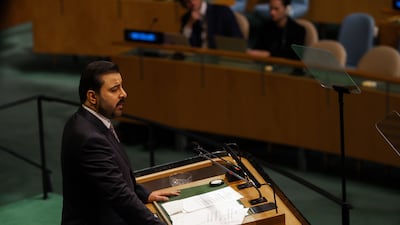
Prime Minister Ali Al Zaidi appealed to the world to invest in Iraq on Friday as he pitched his economic and anti-corruption plans to the UN General Assembly in New York.
Speaking from the UN podium for the first time since taking office in May, Mr Al Zaidi set out his "vision" for a strong state, a modernised economy and a country moving on from years of conflict.
"Here from the United Nations we say to the world: invest with Iraq. Iraq has resources, markets, a good location and the necessary will to build a new economy," he said.
He said Iraq wants to develop energy links with Turkey, Jordan and Syria to help address the Strait of Hormuz bottleneck. Mr Al Zaidi said Iraq is concerned by the blockade of shipping in the Middle East and the effect on energy prices worldwide.
“To contain the subsequent risks and the consequences for our peoples, we are working to diversify our oil export ports and develop energy lines and corridors linking Iraq, Turkey, Jordan and Syria,” he said. The aim was to "reach global markets with the aim of contributing to energy security and diversifying supply routes”.
Discussions have already been held on alternative routes over land, such as an unbuilt pipeline linking Basra in Iraq to the Jordanian port of Aqaba. While in New York, Mr Al Zaidi met Syrian President Ahmad Al Shara for the first time.
Mr Al Zaidi said his vision was for a strong state and "a diversified and modern economy". Iraqi authorities have made dozens of arrests in a series of startling raids during the anti-corruption campaign launched by Mr Al Zaidi. Critics say the campaign has lost momentum, although two sitting female MPs were jailed by an anti-corruption court this week.
Regional position
In his speech, Mr Al Zaidi offered his country as a “bridge for dialogue” and a centre for energy production after enduring many years as an "arena of war and conflict". He said Iraq “extends a hand to everyone” on the basis of dialogue and diplomacy.
Iraq uniquely found itself under fire from both the US and Iran as the regional war spread in March, due to the presence of both American troops and pro-Iranian militias on its soil.
“Iraq, perhaps more than others, has experienced wars and the damage they cause. We have lived through the conditions they create. Our people have paid a hefty price and lost the lives of their children, their resources and their development opportunities,” he said.
He said Iraq was moving to a “new phase” in which military involvement by other powers would give way to economic and development co-operation, with a US-led coalition set to withdraw the last of its forces.
“Iraq aspires to exercise its influence and have an impact as an effective economic power in the region and as a bridge for dialogue and co-operation among the peoples of the region”, Mr Al Zaidi said.

