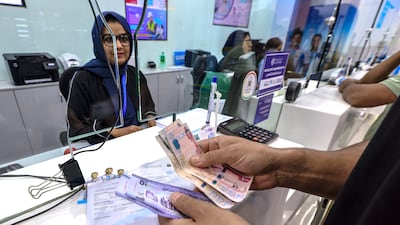

Public-sector bank employees in India have proposed a three-day nationwide strike next week that could affect millions of customers in and outside the country, including the UAE.
The strike is set to run from September 28–30, as workers demand the fulfillment of a long-standing call for a shorter working week. Its month-end timing, which coincides with many people receiving their salary, could disrupt in-person banking services.
To minimise disruption, the Reserve Bank of India has permitted all bank branches, offices, ATM-linked branches, and Currency Chests to operate on Sunday, September 27. Without this measure, the strike would have resulted in five consecutive days of closure, as the fourth Saturday is a bank holiday.

The unions are seeking to make all Saturdays holidays, effectively moving banks to a five-day working week. The workers’ body has pushed for the change for years and has said that an agreement reached in 2024 has not yet been implemented.
How will the bank strike impact UAE residents?
India, the world's largest recipient of remittances, receives significant inflows from the UAE.
The UAE is currently the second-largest source of remittances to India, accounting for 19.2 per cent of total inflows. The Indian diaspora in the UAE, numbering approximately 4.3 million, is the country's largest resident community. These remittances are essential to India's foreign exchange reserves and provide vital financial support to thousands of families.
"For individuals in the UAE transferring money to India, the services are unlikely to be affected, as these systems run on computerised back-end systems that require no manual processing by branch staff," said Vijay Valecha, chief investment officer at Century Financial, a financial service provider. "However, issues or delays might arise if a payment is flagged for compliance, has incorrect details, or requires manual processing.
"Systems such internet and mobile banking and ATMs are expected to continue operating; therefore, receiving and using the funds shouldn’t be an issue. However, if the recipient relies on public-sector bank branches for cash access, then it could be a concern."
Services most likely to be affected include physical Know Your Customer processes, documentation, cheque processing, and cash transactions. Many non-resident Indians (NRI) worldwide may be impacted, as their banking needs often involve more documentation than those of domestic customers.
"Reports specifically identify cheque clearance as a service likely to be affected during the strike," said Mr Valecha. "An NRI expecting a cheque payment into an account should not assume that depositing the cheque immediately before the strike will ensure normal settlement between September 28-30."
Al Ansari Exchange in the UAE assured customers that a strike would not disrupt transfers to India, but did not clarify the impact on in-person transfers and recipients.
“The proposed bank strike in India is not expected to affect our remittance services or cause delays to customer transfers. Customers can use our digital channels or visit any of our 290 branches across the UAE,” Ali Al Najjar, CEO of Al Ansari Exchange, told The National.
He added that about 30 per cent of Al Ansari Exchange’s transactions take place digitally, while the remaining 70 per cent are made at walk-in branches in the UAE.
Preparing ahead
Saravanan Malairaj, an Indian resident in the UAE since 2009, plans to transfer money to his family in Tamil Nadu when he receives his salary. However, with the upcoming bank strike, he intends to use a money transfer app and has advised his family to do the same.
"Even if I transfer the money from a money exchange house here, they might not receive it or be able to withdraw it. So, I plan to do it online," said Mr Malairaj.
Jiju Pulikkathodi, a photographer, said he had already transferred funds to his family in Kerala. He didn't want any delay if the strike went ahead.
According to Zolt Money, a cross-border financial technology platform, digital channels now account for 73.5 per cent of all remittance transactions, a sharp shift away from cash and branch-based transfers. In the UAE, this figure stood at 76.1 per cent in 2024, according to an RBI Report.

