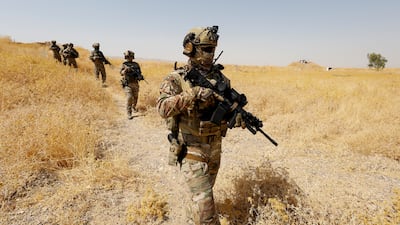

Iraq's Counterterrorism Service (CTS) has killed two suspected ISIS suicide bombers in the northern province of Kirkuk, days before the planned withdrawal of US troops from the country.
The CTS said its forces clashed with three terrorists from the “remnants” of ISIS in the town of Altun Kupri, north of Kirkuk city. Two of them, who were wearing belts laden with explosives, were killed, while their driver was wounded and arrested, the statement added. No details were given about their nationalities.
Maj Gen Saad Maan, spokesman for the Iraqi Security Media Cell, later said a civilian was killed and two CTS members were injured in the clashes on Sunday. The CTS said the operation was carried out in accordance with judicial orders and as part of its continuous security and intelligence efforts to weed out terrorist gangs.

“The Counterterrorism Service confirms the continuation of its qualitative operations to pursue the remnants of terrorism to defend Iraq's security and the safety of its people,” a statement read.

Altun Kupri lies on the road between Kirkuk and Erbil, the capital of Iraq's semi-autonomous Kurdistan region. Since the territorial defeat of ISIS in Iraq in late 2017, remnants continue to operate in small cells in remote areas, mainly in desert areas or valleys, and it is unusual for clashes with militant fighters to break out in urban areas.
The operation came days before a planned withdrawal of US troops on Wednesday, following the end of the combat mission of the US-led anti-ISIS international coalition in Iraq.
Under an agreement reached in 2024 between Baghdad and Washington, once the coalition's military mission in Iraq concludes it will be followed by a transition to a bilateral security partnership focused on advising, training and intelligence sharing.
US forces have already left several bases in Iraq and will continue to operate with reduced numbers in Kurdistan until September 30 for operations against ISIS in Syria.

The move has sparked a heated political argument inside Iraq.
The government of Prime Minister Ali Al Zaidi and its supporters, including the Co-ordination Framework, say Iraqi forces are now capable of maintaining security independently and that ending the foreign combat presence restores full sovereignty. The CF is the largest parliamentarian bloc and consist of Iran-backed political parties and militias.
Opponents, including some Sunni and Kurdish politicians and security analysts, have expressed concerns about the capabilities of Iraqi forces to contain ISIS without coalition air power, intelligence and logistical support.
The group still poses a lethal but low-level threat and that withdrawal could create security gaps, opponents of the coalition withdrawal say, particularly in the rugged and poorly policed areas that are still contested between Baghdad and Erbil, by federal and Kurdish forces.
In 2003, the US led an international coalition to invade Iraq and topple Saddam Hussein’s regime, claiming it was developing and stockpiling weapons of mass destruction. No such weapons were found and the invasion plunged Iraq into years of chaos.
By the end of 2011, the US had withdrawn from Iraq, leaving a small number of troops to protect its embassy, and train and assist Iraqi forces. At its peak in 2007, the US military presence consisted of 170,000 soldiers.
Foreign combat troops returned in 2014, by which time ISIS had seized about a third of the country as the US-trained Iraqi security forces melted away. Then, the Iraqi government asked the US to support it in its fight against ISIS.
In excerpts from an interview with Iraqi TV broadcast on Saturday, Masoud Barzani, the leader of Kurdistan Democratic Party said he feared the “same scenario” of 2014 would develop.
When ISIS arrived in 2014, he said, “the then-Iraqi government solicited the US, European countries and Nato to ‘come and help us’”.

