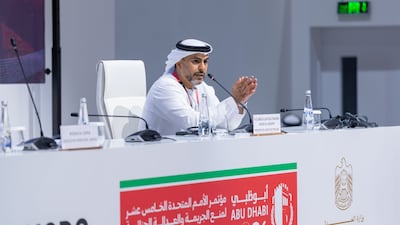
The Minister of Justice has vowed that global borders should "never be a shield" after revealing how alleged crime boss Daniel Kinahan was arrested in the Emirates only 48 hours after a request from Irish authorities.
Abdullah Al Nuaimi cited the high-profile extradition case as an example of how law enforcement agencies and courts from around the world must work together to root out serious crime and close the net on offenders.
Mr Kinahan, 49, faces charges in his native Ireland relating to organised crime, including leading a criminal organisation, murder and drug trafficking.

The extradition on August 9 followed a ruling by the Dubai Court of Cassation and was carried out under the extradition treaty between the UAE and Ireland, which came into force in May 2025.
Mr Kinahan is being detained at a 200-year-old high-security prison before he faces trial, one of the most anticipated in Ireland's history, which is expected to begin next year.
“Crime today has no borders," Mr Al Nuaimi said during the UN Congress on Crime Prevention and Criminal Justice, in Abu Dhabi on Sunday. "Criminals, assets, money and evidence can move across several jurisdictions, which means that no country can fight transnational crime in isolation.
"The UAE’s message is clear: borders should never become a shield for criminals or criminal assets. Our objective is to ensure that effective judicial co-operation enables the proceeds of crime to be traced, frozen, seized and recovered through sound judicial procedures that uphold the rule of law.
"We see international judicial co-operation as a partnership between countries, built on trust, direct communication, swift action and practical solutions.”

Under sanction
Mr Kinahan and his organisation were publicly identified and placed under sanctions by the US in 2022 but no arrest warrant was issued until April 15.
His arrest on April 17, made by Dubai Police in co-operation with the Ministry of Interior, came as part of the UAE's efforts to tackle organised crime and pursue suspects who are wanted internationally.
After Mr Kinahan's detention, Ireland's Prime Minister Micheal Martin thanked the UAE for its co-operation, telling Irish media the arrest confirms “the strong relationship with the United Arab Emirates in terms of extradition arrangements”.
Last year, Sean McGovern became the first of Mr Kinahan's alleged associates to be extradited from the UAE. In June this year, he was sentenced to 24 years in prison at the Special Criminal Court in Dublin after pleading guilty to two charges of directing the activities of a criminal organisation.
Global effort
The minister said the UAE is party to 16 universal and regional multilateral agreements and has more than 140 bilateral agreements in force with 53 countries.
These cover extradition, mutual legal assistance, asset freezing and confiscation, evidence gathering and the transfer of people who have been sentenced.
In 2025, the UAE received a total of 576 extradition requests. Courts issued decisions in 178 cases, while the remaining requests were either under review or awaiting additional information.
Mr Al Nuaimi also highlighted co-operation with authorities in France involving four people, which led to the identification and tracing of assets and the seizure of 82 properties in the UAE in November 2025.

