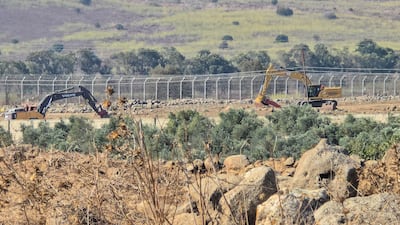

Syria has accused Israel of building major military fortifications in Syrian territory along the occupied Golan Heights, a move that could entrench a new territorial takeover and undermine a US drive for peace.
The Syrian Foreign Ministry said that Israel was working to complete its “Sufa 53 Line”, in “flagrant violation” of a 1974 disengagement of forces agreement brokered by US secretary of state Henry Kissinger. The agreement followed Syria's failed war in 1973 to regain the Golan, a strategic plateau occupied by Israel since 1967.
Building the line continues the “aggressive approach of the Israeli occupation, along with its attacks and field incursions”, the ministry said on Sunday. Qatar, a major backer of the post-Assad order in Syria, and Jordan, issued similar condemnation and called for an end to Israeli occupation of Syrian territory.
There was no immediate reaction from Israel. If the Sufa Line is completed, the 1974 ceasefire line negotiated by Mr Kissinger would move east, entrenching old and new occupation of Syrian territory. An Israeli armoured brigade known as Sufa (storm) played a main role in foiling Syrian operations in the 1973 war.

The areas near the occupied Golan Heights have been the scene of an increasing number of Israeli incursions this year. Israeli troops crossed into southern Syria and areas west of Damascus, and occupied parts of those regions, soon after rebel forces led by current President Ahmad Al Shara ousted the regime of Bashar Al Assad in December 2024.
A security source based in Amman said Israel started work on the Sufa 53 Line in 2022 to counter infiltration by Hezbollah and other militant groups supported by Iran. The groups had expanded into the Syrian-controlled side of the Golan Heights during Assad's rule.
“We are talking about a major military line running from west Damascus to the border of Jordan,” the source said. It comprises a north-south road and major barriers, observation posts and firing positions that “would give the Israelis flexibility” and make it easier to defend the Golan positions. “They will be more comfortable,” the source said.
The line would run two to three kilometres parallel to the main 1974 armistice line, starting near the Syrian town of Hader in Quneitra governorate, about 40km south-west of Damascus. It would end in the Yarmouk river basin in Deraa governorate, near the border with Jordan, according to the source. It does not appear to encompass highly populated Syrian areas but would run through farms and other Syrian properties.
After the 2023 Gaza war broke out, those areas became a launch pad for Iranian-supplied rockets fired at Israeli troops in the Golan Heights. However, Israeli attacks in Lebanon and Syria vastly weakened Hezbollah and, by the end of 2024, the group had withdrawn most of its forces from Syria, setting the stage for the Assad regime's fall.
Last week, Syrian authorities said that security forces arrested three members of a cell linked to Hezbollah and dismantled rocket launchers in their possession in the southern Yarmouk river basin.
This followed remarks by Israel's Defence Minister Israel Katz that the Israeli army was mounting “daily activity” across the Golan to “thwart threats, to eliminate remnants of the old regime, to prevent dangerous consolidation of the new regime” and “protect our communities and our border”.

The security source said the Sufa Line signals the “breakdown of trust” that the US tried to build between the two sides. “They look at Damascus and see a militant regime supported by Turkey, although Al Shara himself would love to strike a deal,” the source said.
Turkey, the source said, had been pressuring Mr Al Shara to talk to Hezbollah. Reuters reported this month that Hezbollah and Syrian government officials had met in Turkey to calm tensions.
The US, which backs Syria's current rulers, has supervised several meetings between Israeli and Syrian officials in an effort to negotiate a peace deal between the two countries. They discussed halting Israeli attacks on Syria and the return of Israeli forces to the 1974 armistice line adjacent to the Golan Heights.
Early on Monday, Israeli forces killed a man at an undisclosed location in southern Syria. The military described him as an infiltrator. Syrian state news agency Sana reported extensive Israeli land-clearing operations in the Quneitra governorate.

