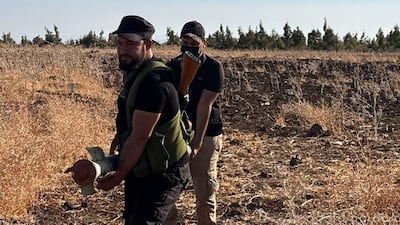

Syrian security forces have arrested three members of a cell linked to the Lebanese armed group Hezbollah and dismantled rocket launchers in their possession in the southern Yarmouk river basin, the authorities have said.
The area near the occupied Golan Heights and the border with Jordan has been the scene of an increasing number of Israeli incursions this year. Israeli troops crossed into southern Syria and areas west of Damascus, and occupied parts of these regions, soon after militant forces led by current President Ahmad Al Shara ousted the Assad regime in December 2024.
The three men had been involved in a Hezbollah “sabotage plot” in the Yarmouk river basin, the official news agency Sana reported late on Tuesday. It said the launchers had been “completely dismantled”.

“The operation was a result of precise surveillance of an attempt by the cell to prepare rocket launchers and execute attacks,” the agency said, without specifying the target. It gave the initials of the three men, without mentioning their nationalities.
Hezbollah said in a statement that it “categorically denies” any link to those detained. The Shiite group called on Syrian authorities to be alert to attempts to “stir up tension and sow discord” between Lebanon and Syria.
A security source in Jordan said the three men belonged to remnants of Syrian militant groups set up by Hezbollah in areas facing the Golan in the last six years of Syria's civil war. Both Syrian and Israeli forces have been separately combing these areas for weapons caches since the downfall of the former regime.
"Most of the rockets have been confiscated but there remain some underground. They can be also accessed through the black market," the source said.
In Damascus, the General Intelligence Directorate released photographs showing Syrian security forces removing the weapons seized in what it called a pre-emptive operation that thwarted the Iran-backed militia.
Hezbollah and other pro-Iranian groups had established proxies on the Syrian-controlled side of the Yarmouk river basin during the rule of former president Bashar Al Assad. After the 2023 Gaza war broke out, the basin became a launch pad for Iranian-supplied rockets fired at Israeli troops in the Golan. However, Israeli attacks in Lebanon and Syria vastly weakened Hezbollah and, by the end of 2024, the group had withdrawn most of its forces from Syria, setting the stage for the Assad regime's fall.
Last month, Israeli Defence Minister Israel Katz said the Israeli army was mounting “daily activity here to thwart threats, to eliminate remnants of the old regime, to prevent dangerous consolidation of the new regime” and “protect our communities and our border”.
On Tuesday, Israeli forces mounted two incursions in Quneitra governorate west of Damascus, detaining a labourer on a farm and interrogating shepherds before "physically assaulting several of them", Sana said.
The US, which backs Syria's current rulers, has supervised several meetings between Israeli and Syrian officials in an effort to negotiate a peace deal between the two countries. They discussed halting Israeli attacks on Syria and the return of Israeli forces to a 1974 armistice line adjacent to the Golan, the strategic plateau occupied by Israel for almost six decades.
The last of these meetings was last month in Amman. Jordan has sought to play an interlocutor role on issues that have destabilised Syria since the end of the war.
On Wednesday, Syria's Defence Minister Murhaf Abu Qasra telephoned the new head of Jordan's Joint Chiefs of Staff, Maj Gen Majdi Al Harasis, who was appointed on September 3. The two men discussed boosting defence co-operation between the two countries, the ministry said.
Jordan fortified its border with Syria with US support during the Assad era. However, narcotics and weapons smuggling from Syria remain a concern.
Additional reporting by Fatima Al Mahmoud in Abu Dhabi.

