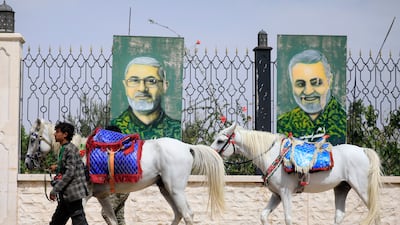
Less than a week after Yemen’s Houthi rebels seized the Red Sea coast, Iran’s hand in the offensive is coming to light.
Sources in Tehran, Aden and Cairo who spoke to The National in recent days detailed a plan by Iran to use the conflict in Yemen as a new pressure point in its war with the US.
From a field operative wanted by Washington to a joint operations room, a secret regional meeting and a Mahan flight carrying fighters, the emerging web of Iranian activity shows how one geopolitical conflict is increasingly linking two of the world’s most important maritime chokepoints, the Strait of Hormuz and the Bab Al Mandeb strait.

At the heart of the operation on Yemen’s western coast is Abdul Reza Shahlai, also known as Hajj Yusef.
Mr Shahlai is a high-ranking commander in Iran’s Islamic Revolutionary Guard Corps' Quds Force. The US says he is based in Sanaa, and is offering a reward of up to $15 million for information on his financial activities, networks and associates.
Nicknamed the Shadow Man, Mr Shahlai was named by the US as a Specially Designated Global Terrorist in 2011. The US has accused him of funding and directing a plot to assassinate the Saudi ambassador to the US in Washington and planning follow-up attacks in the US and elsewhere.
“He was present on the ground and directly involved,” a Yemeni security source told The National, referring to the recent Houthi takeover. Other IRGC operatives were also present and had helped oversee operations, the source added.
“The Iranians are present on the ground. We've had information that a group of experts came in on the last Mahan flight, which started this whole situation. The Iranians are known to have been present even before,” a second Yemeni source with close knowledge of the matter told The National.
Closely interconnected
The latest Houthi escalation began in July after what the rebels described as Saudi aggression against Sanaa airport following the landing of a direct flight from Tehran to the Yemeni capital.
“Many operatives are thought to have arrived on that plane,” a third Yemeni source confirmed.
The Yemeni government, as well as Iranian and regional sources told Reuters last week that the Houthi advance along Yemen’s Red Sea coast was carried out with direct guidance from the IRGC as Iran sought to open another front in its war with the US.
The operation allowed the Houthis to seize Yemen’s western coast and take control of the strategic island of Perim, which splits the waters of Bab Al Mandeb and gives the rebels an unprecedented position over the chokepoint. But Iran, the Houthis’ main backer, stands to benefit the most.
The advance potentially extends the pressure Tehran has exerted on shipping in the Strait of Hormuz to the other end of the maritime route at the Bab Al Mandeb strait, threatening traffic along a corridor that connects the Gulf and Indian Ocean with the Red Sea and Suez Canal.
For Iran, the move comes as talks with the US stall and its economy faces mounting pressure. Iran has warned in recent weeks that it could expand its attacks beyond the Strait of Hormuz, and sources in Tehran say the developments in Yemen should be viewed in that context.
“The Yemen and Iran files are closely interconnected, and their co-ordination has increased significantly since the war on Iran because the threat has become existential,” a source in Tehran claimed. “It can be said that there is now a joint operations room.”
Full-scale regional war
The source said that although the Houthis had their “own strategic project”, several circumstances had converged in their favour. “The US is preoccupied with Iran, while Israel is occupied with Lebanon and the West Bank. The Yemenis therefore saw an opportunity, and their co-ordination with Tehran produced positive results,” the source said.
“What is happening in Yemen has given Tehran considerable leverage and a highly important negotiating card. Iran has effectively come to control two of the world’s most important straits,” the source added. “Iran is sharing in Yemen’s victory, rather than merely celebrating or encouraging it.”
Conversations with regional officials also revealed Iran’s role in influencing the Houthis not only in their military operations but also in determining which targets they attack.
Regional sources told The National about a recent meeting between Houthi representatives and a regional country, mediated by Iran, aimed at reaching an understanding under which the rebels would refrain from attacking ships travelling through the Bab Al Mandeb strait and north towards the Suez Canal.
“An agreement was reached in principle that vessels sailing through the Red Sea on their way north to the Suez Canal would not be targeted by the Houthis,” one of the sources said.
The escalation in Yemen has also coincided with attacks launched from Iraq against Saudi Arabia, including a strike that forced the kingdom to shut its strategic East-West oil pipeline, taking a major export route out of operation.
Iran has sought to create sufficient regional and economic pressure to push the US towards ending the war. An Iraqi militant source told The National that the attack was intended as a “gesture of support” for the Houthis, but the choice of the East-West pipeline as a target carried much broader significance.
US President Donald Trump said Iran was probably responsible for the aerial attack.
“We are no longer talking about a US-Iran war, but rather a full-scale regional war, with fighting now taking place on all fronts,” the source in Tehran said.

