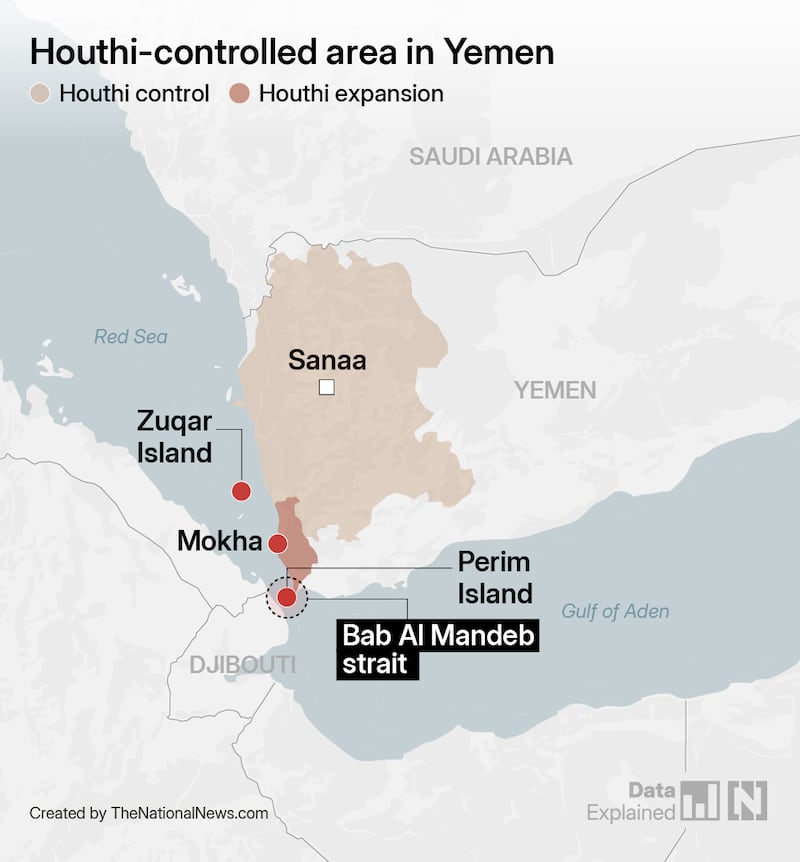
Ship traffic in the Bab Al Mandeb strait has dropped by half as the Houthi rebels seize control of Yemen's entire Red Sea coast and the strategically important Perim Island, which lies at the centre of the waterway.
The total ship crossings in the strait fell to 15 on Friday, having been 30 a day earlier, preliminary data from Kpler shows. Of Friday's total, six exited the Red Sea and nine entered. Ships were laden with crude, grains and steel, while three were ballast.
The latest data comes as the Iran-backed Houthis seize control of key areas overlooking the Red Sea and the strait. On Thursday, the group seized the port city of Mokha, giving them an ability to monitor ship movements along Red Sea.

Perim, also known as Mayyun, was seized by the Houthis, along with other important places, including Dhubab along the coast.
Perim, in the heart of the strait, is strategically important. Whoever controls the island has an advantage in keeping track of vessels entering or leaving the Red Sea and those sailing towards the Suez Canal, moving between Asia, the Gulf and Europe.
“Mocha improves the Houthi position on the approaches, but Dhubab and Perim matter more for shipping,” Arsenio Longo, founder of tanker movement analytics specialists Huax, told The National.
“They already had missile and drone range over Bab. Moving further south would put them much closer to vessels entering and leaving the strait and give them more options to maintain pressure on shipping.”
The pressure will be more on Saudi shipping as the Houthis announced a “maritime embargo” on vessels linked to the kingdom passing through Bab Al Mandeb.
The Houthis announced the embargo last month and has been attacking vessels passing through the strait, forcing the kingdom to divert crude cargoes towards the Suez Canal and take a longer route around Africa to export oil to Asian markets.
The Strait of Hormuz, the other key route for global crude shipments, remains virtually closed amid the conflict between the US and Iran.
Oil prices rose to nearly $110 per barrel earlier this week, as the Houthis began taking control of key areas along the Red Sea. Brent, the benchmark for two thirds of the world's oil closed the week at $104.6 a barrel, while West Texas Intermediate, the gauge that tracks US crude, was trading at $100 per barrel.
Ship traffic in the Strait of Hormuz, meanwhile, rose to 14 on Friday from seven on Thursday, with 10 exiting and four entering the waterway, Kpler data shows. Vessel transits along the strait in the Arabian Gulf has been decreasing since the start of the week, as Iran and the US engage in tit-for-tat tanker attacks disrupting further.
The Strait of Hormuz was used to transport more than 20 million barrels of oil per day before the war broke out in February, with more than 100 ships crossing every day. Current estimates are about 10 million bpd.